Quasi-Geostrophic Theory is a simplified approach in atmospheric and oceanic dynamics that examines large-scale flows where rotation and stratification are important. It assumes small deviations from geostrophic balance, where pressure gradient and Coriolis forces nearly balance each other. The theory filters out fast-moving waves, focusing on slow, large-scale motions like Rossby waves. It provides a framework for understanding weather systems, cyclogenesis, and the evolution of atmospheric disturbances.
Quasi‑Geostrophic Theory Basics
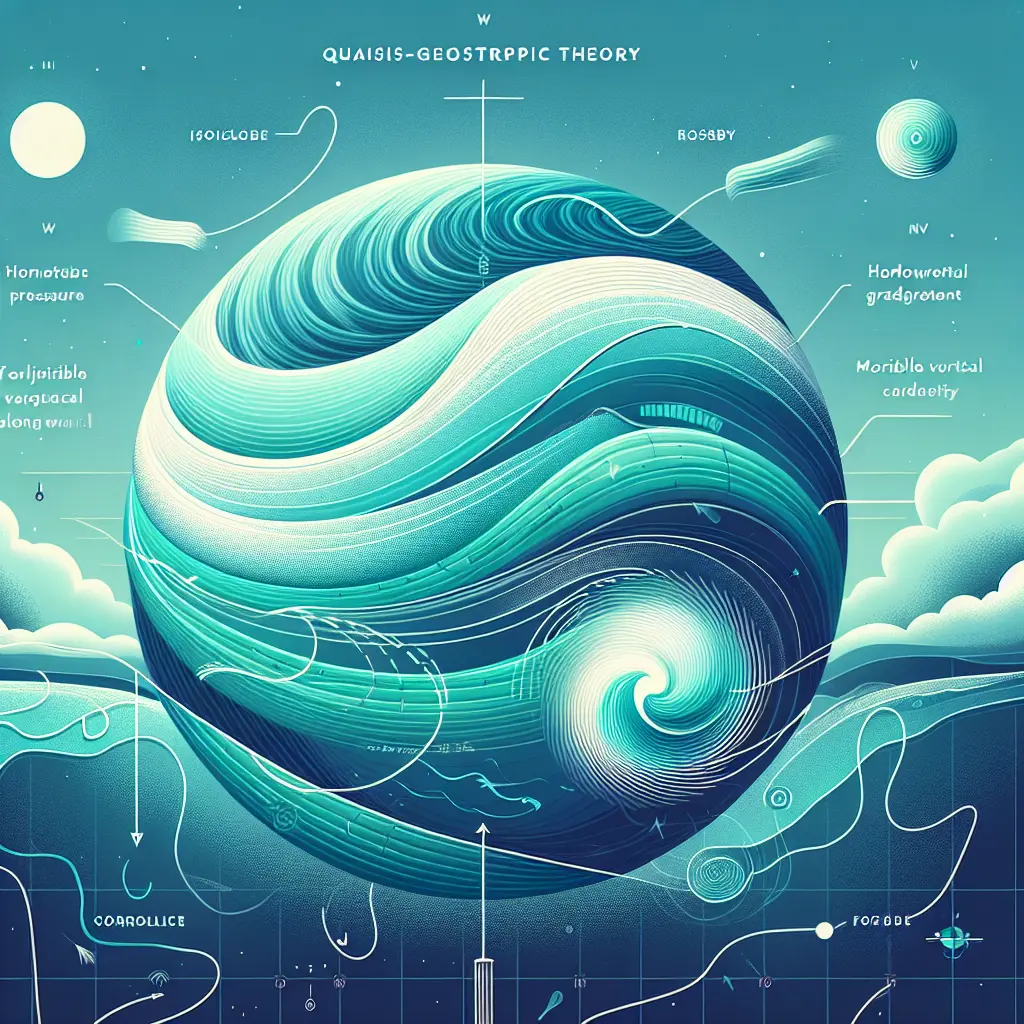
Quasi-Geostrophic Theory is a simplified approach in atmospheric and oceanic dynamics that examines large-scale flows where rotation and stratification are important. It assumes small deviations from geostrophic balance, where pressure gradient and Coriolis forces nearly balance each other. The theory filters out fast-moving waves, focusing on slow, large-scale motions like Rossby waves. It provides a framework for understanding weather systems, cyclogenesis, and the evolution of atmospheric disturbances.
💡 Key Takeaways
- Grasp the quasi-geostrophic approximation: large-scale flows are nearly in geostrophic balance with small ageostrophic corrections.
- See how rotation (Coriolis force) and stratification shape pressure systems and jet-like flows in the atmosphere and oceans.
- Learn how QG links potential vorticity, height fields, and horizontal wind to explain mid-latitude dynamics like Rossby waves.
- Understand the conditions for QG validity (small Rossby number, strong rotation) and the limitations of the approach.
- Apply QG ideas to interpret weather patterns, upper-level flow, and basic geophysical fluid dynamics concepts.
❓ Frequently Asked Questions
What is quasi-geostrophic theory?
A simplified framework for studying large-scale atmospheric and oceanic flows that assumes near geostrophic balance (pressure gradient force balanced by Coriolis force) with small deviations to capture the evolution of disturbances from rotation and stratification.
What are the main assumptions behind quasi-geostrophic theory?
Large-scale, slowly varying flows; small Rossby number (near geostrophic balance); hydrostatic vertical balance; and evolution described via potential vorticity on a reference level.
How does quasi-geostrophic theory relate to geostrophic balance?
Geostrophic balance is the baseline state in QG theory. QG allows small, gradual deviations from this balance to model how disturbances like fronts and waves develop.
Where is QG theory most useful, and what are its limitations?
Useful for mid-latitude, synoptic-scale weather systems and ocean fronts where rotation and stratification dominate. Limitations include reduced accuracy near the equator, during strong nonlinear events or rapid vertical motions, and at very small scales where the full primitive equations are needed.