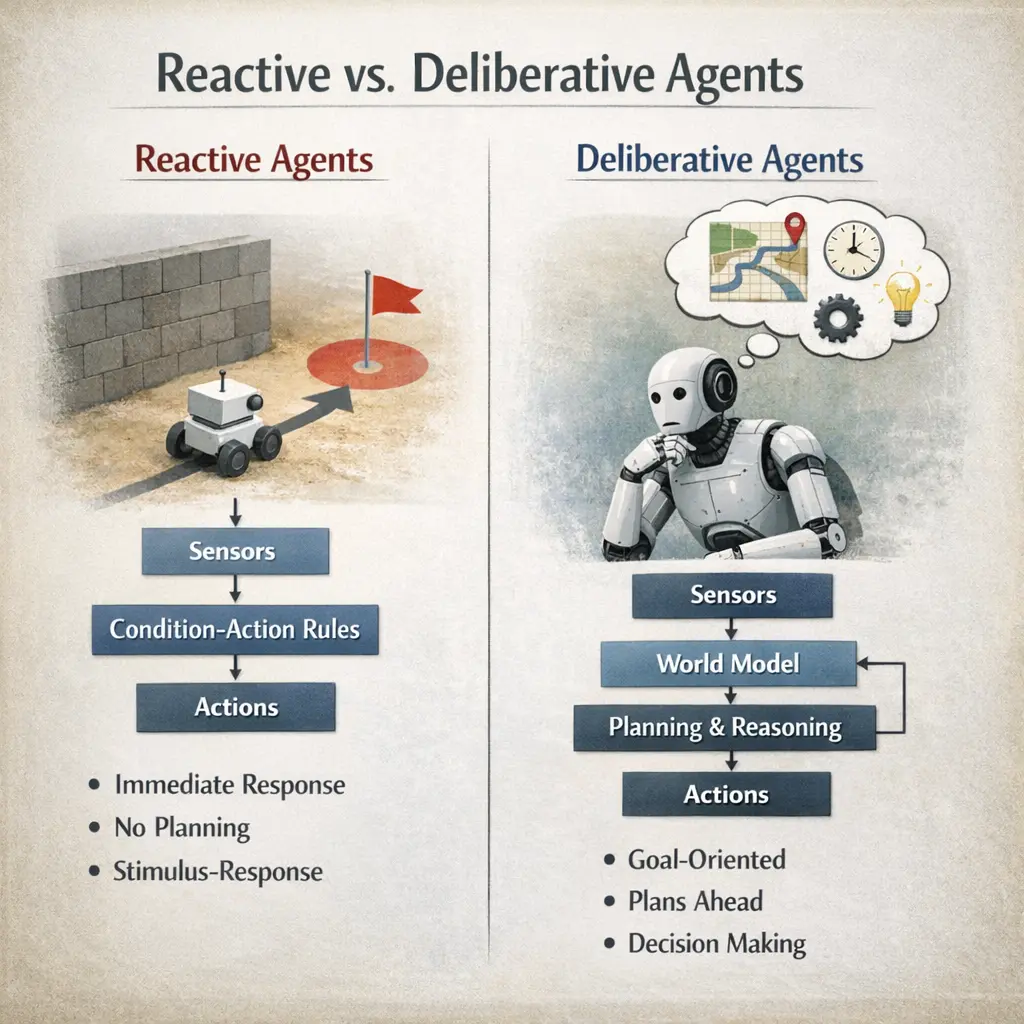
Reactive agents respond directly to environmental stimuli using predefined rules, without internal representations or planning. They are fast and simple but lack adaptability and foresight. Deliberative agents, in contrast, maintain internal models of the world, enabling reasoning, planning, and anticipation of future states. This architecture supports more complex, goal-oriented behaviors but requires greater computational resources. The choice between these approaches depends on the task’s complexity and environmental dynamics.
Reactive vs Deliberative Agents
Reactive agents respond directly to environmental stimuli using predefined rules, without internal representations or planning. They are fast and simple but lack adaptability and foresight. Deliberative agents, in contrast, maintain internal models of the world, enabling reasoning, planning, and anticipation of future states. This architecture supports more complex, goal-oriented behaviors but requires greater computational resources. The choice between these approaches depends on the task’s complexity and environmental dynamics.
💡 Key Takeaways
- Understand what a reactive agent is and how it responds to current inputs without planning.
- Understand what a deliberative agent is and how it uses internal models and planning to decide actions.
- Explain the trade-offs: reactive agents are fast and robust for simple tasks, while deliberative agents handle complex goals but require more computation.
- Explore hybrid architectures that combine reactive and deliberative components for balanced speed and planning.
- Identify real-world examples and best-fit scenarios for using reactive versus deliberative agents.
❓ Frequently Asked Questions
What is a reactive agent?
An agent that acts based on current percepts using simple rules, without building a long-term plan or model of the world.
What is a deliberative agent?
An agent that reasons about goals, plans, and a world model to decide actions, often using search and planning.
How do reactive and deliberative agents differ in planning?
Reactive agents respond immediately to percepts with rules; deliberative agents generate and evaluate plans before acting.
When would you choose a reactive agent?
In fast-paced, simple, or resource-constrained tasks where quick responses are essential and detailed planning is unnecessary.
When would you choose a deliberative agent?
In complex tasks that require foresight, goal-directed behavior, and the ability to evaluate future outcomes.