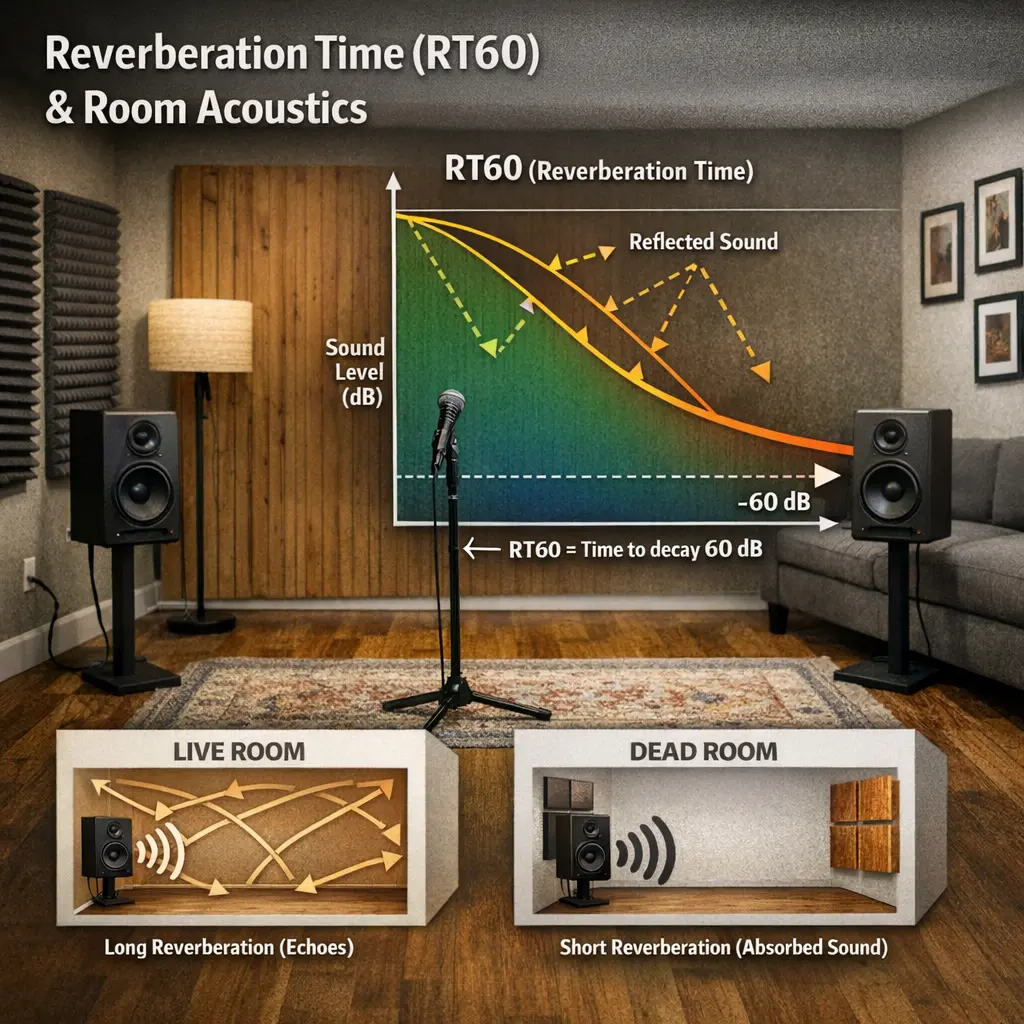
Reverberation Time (RT60) is the time it takes for sound to decay by 60 decibels after the source stops. It is a key measure in room acoustics, influencing clarity and intelligibility. RT60 depends on room size, shape, and the materials used, as different surfaces absorb or reflect sound differently. Understanding RT60 helps in designing spaces, selecting materials, and optimizing environments for speech, music, or recording purposes.
Reverberation Time (RT60) and Room Acoustics
Reverberation Time (RT60) is the time it takes for sound to decay by 60 decibels after the source stops. It is a key measure in room acoustics, influencing clarity and intelligibility. RT60 depends on room size, shape, and the materials used, as different surfaces absorb or reflect sound differently. Understanding RT60 helps in designing spaces, selecting materials, and optimizing environments for speech, music, or recording purposes.
💡 Key Takeaways
- Understand what RT60 is and why the 60 dB decay matters for room acoustics.
- Explain how room size, surface absorption, and materials affect RT60.
- Learn how to estimate RT60 (e.g., Sabine equation) and know its limitations.
- Identify practical ways to adjust RT60 using absorbers, diffusers, and bass traps to improve speech intelligibility or musical sound.
❓ Frequently Asked Questions
What is RT60 (reverberation time)?
RT60 is the time it takes for sound to decay by 60 dB after the source stops, indicating how reverberant a room sounds.
How is RT60 calculated or measured?
It can be estimated with Sabine's formula: RT60 ≈ 0.161 × V / A, where V is room volume in m^3 and A is total absorption (A = sum(alpha_i × S_i)). You can also measure it with impulse-response tests using a speaker and microphone.
What factors influence RT60 in a room?
Room volume, surface materials and their absorption, total surface area, furnishings, geometry, and occupancy all affect RT60; absorption also varies with frequency.
Why does RT60 matter for speech and music?
RT60 affects clarity and warmth: shorter RT60 improves speech intelligibility; longer RT60 can enrich music. The desired value depends on the room's use.
How can RT60 be adjusted in a room?
Increase or reduce absorption with panels, curtains, carpets, and diffusers; change furnishings or room layout. Use measurements to target specific RT60 values.