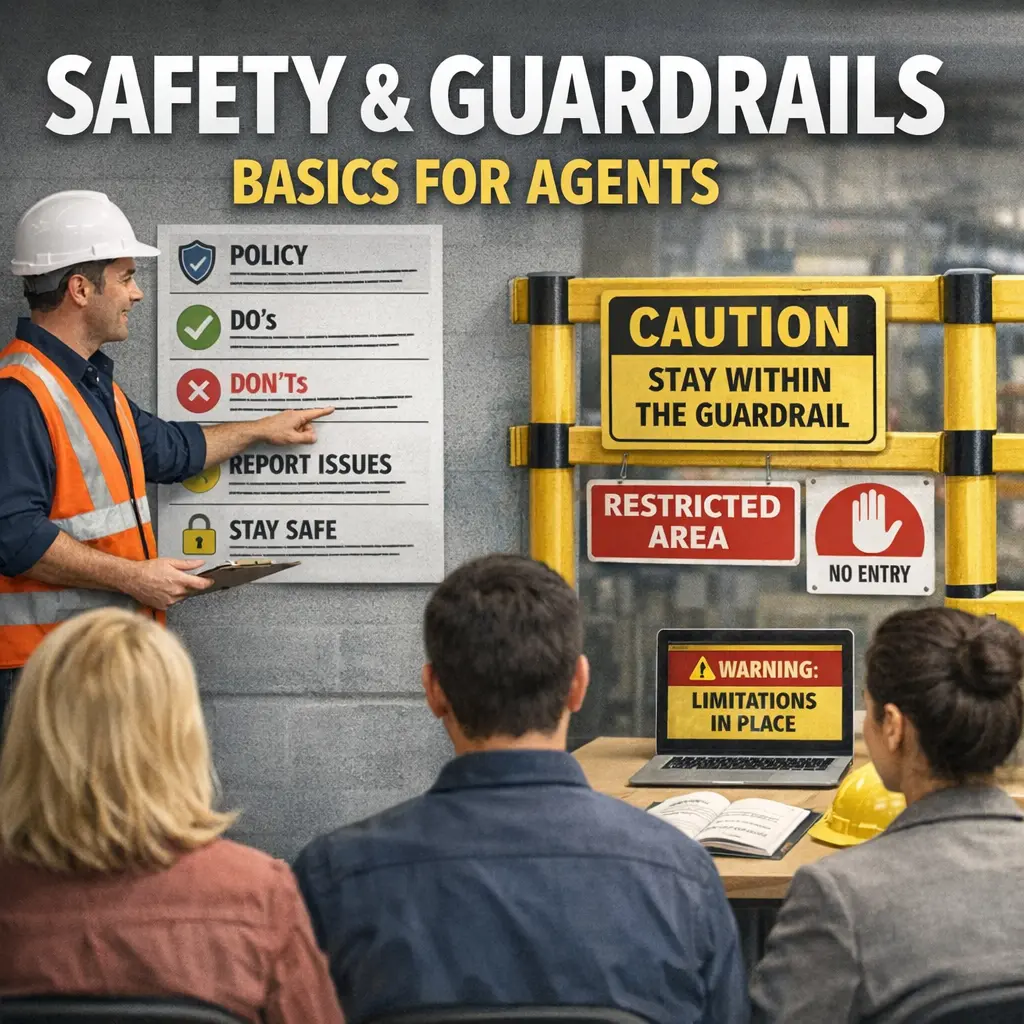
"Safety & Guardrails Basics for Agents (Agent Architecture)" refers to foundational principles and mechanisms designed to ensure that intelligent agents, such as AI systems, operate within defined boundaries. These safety measures and guardrails help prevent unintended behaviors, ethical violations, or harmful actions. In agent architecture, this involves implementing rules, constraints, and monitoring processes that guide agents' decision-making, ensuring alignment with human values, legal requirements, and organizational policies throughout their operation.
Safety & Guardrails Basics for Agents
"Safety & Guardrails Basics for Agents (Agent Architecture)" refers to foundational principles and mechanisms designed to ensure that intelligent agents, such as AI systems, operate within defined boundaries. These safety measures and guardrails help prevent unintended behaviors, ethical violations, or harmful actions. In agent architecture, this involves implementing rules, constraints, and monitoring processes that guide agents' decision-making, ensuring alignment with human values, legal requirements, and organizational policies throughout their operation.
💡 Key Takeaways
- Understand why safety guardrails matter for AI agents and how they protect users and systems.
- Differentiate between hard guardrails (strict, enforced limits) and soft guardrails (policy based guidance) and know when to apply each.
- Identify common safety risks in agent interactions such as hallucinations and data leakage, and learn practical mitigation approaches.
- Learn practical steps to implement guardrails including input validation, output filtering, policy checks, and ongoing monitoring.
❓ Frequently Asked Questions
What are safety guardrails for AI agents?
Guardrails are rules, policies, and checks that prevent unsafe actions, limit harmful outputs, and keep the agent's behavior within acceptable boundaries.
Why are guardrails important for agents?
They reduce risk, protect users, ensure compliance, and help maintain trust by keeping the agent's behavior predictable and safe.
How should an agent respond to unsafe or ambiguous requests?
The agent should refuse politely, explain the limitation, offer safe alternatives, and escalate to a human reviewer if needed.
What is escalation and human-in-the-loop?
Escalation routes risky or unclear cases to a human reviewer for final decision, ensuring safety when automation alone isn't enough.