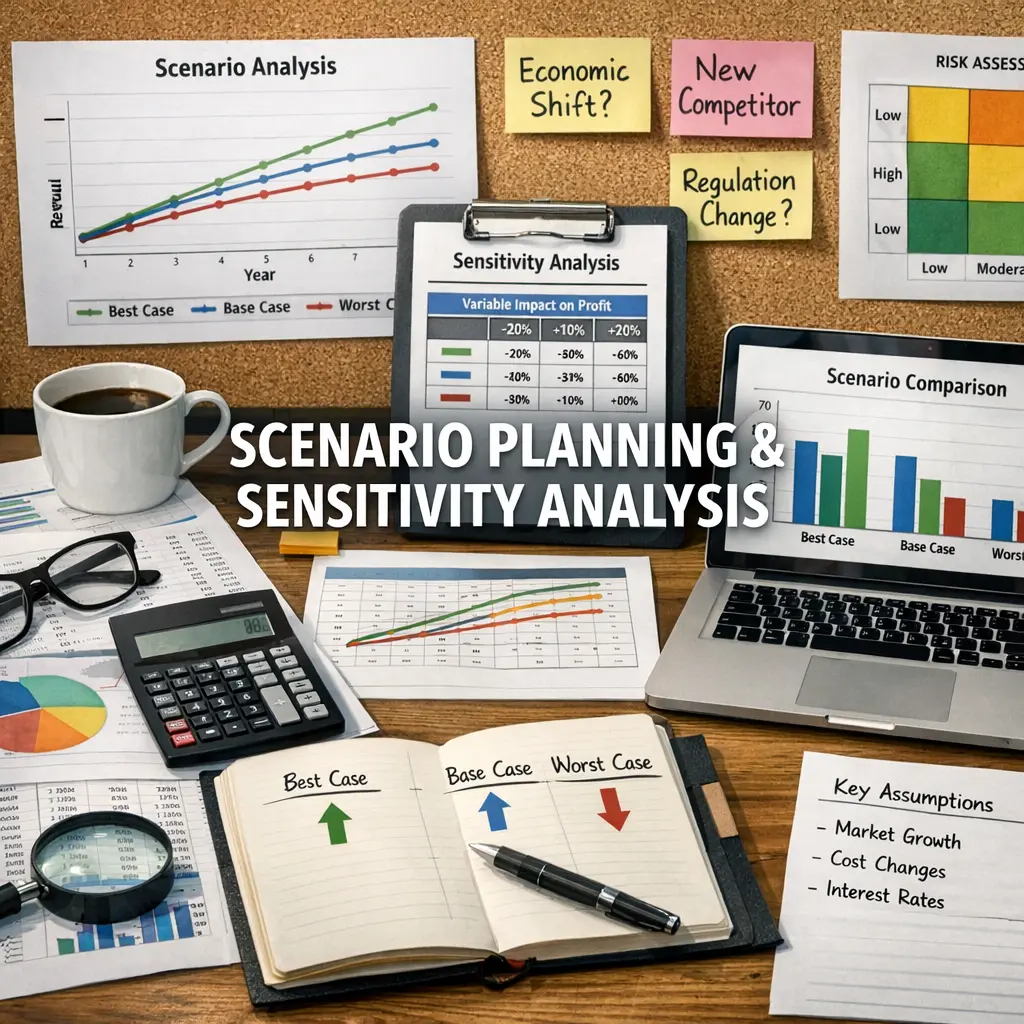
Scenario planning and sensitivity analysis are strategic tools used in financial management and business practices to anticipate and prepare for potential future events. Scenario planning involves developing and analyzing multiple plausible future situations to assess their impact on business outcomes. Sensitivity analysis evaluates how changes in key variables, such as costs or sales, affect financial results. Together, these methods help organizations make informed decisions, manage risks, and enhance resilience against uncertainty.
Scenario Planning & Sensitivity Analysis
Scenario planning and sensitivity analysis are strategic tools used in financial management and business practices to anticipate and prepare for potential future events. Scenario planning involves developing and analyzing multiple plausible future situations to assess their impact on business outcomes. Sensitivity analysis evaluates how changes in key variables, such as costs or sales, affect financial results. Together, these methods help organizations make informed decisions, manage risks, and enhance resilience against uncertainty.
💡 Key Takeaways
- Understand what scenario planning is and when to use it
- Identify critical drivers and assumptions that shape outcomes
- Learn how to create and compare multiple scenarios (baseline, optimistic, pessimistic)
- Learn basic sensitivity analysis techniques to see how input changes affect results
- Apply scenario planning to assess risk and inform contingency strategies
❓ Frequently Asked Questions
What is scenario planning?
A planning method that explores multiple plausible future environments to test strategies and decisions for resilience, rather than predicting a single outcome.
What is sensitivity analysis?
A technique to measure how changes in model inputs affect outputs, helping identify which variables have the biggest impact.
How do scenario planning and sensitivity analysis work together?
Scenario planning creates diverse futures to test decisions, while sensitivity analysis checks robustness by varying key inputs within those futures.
How do you perform a simple sensitivity analysis?
Select key inputs, vary them within reasonable ranges, run the model for each variation, and compare output changes to rank the most influential inputs.