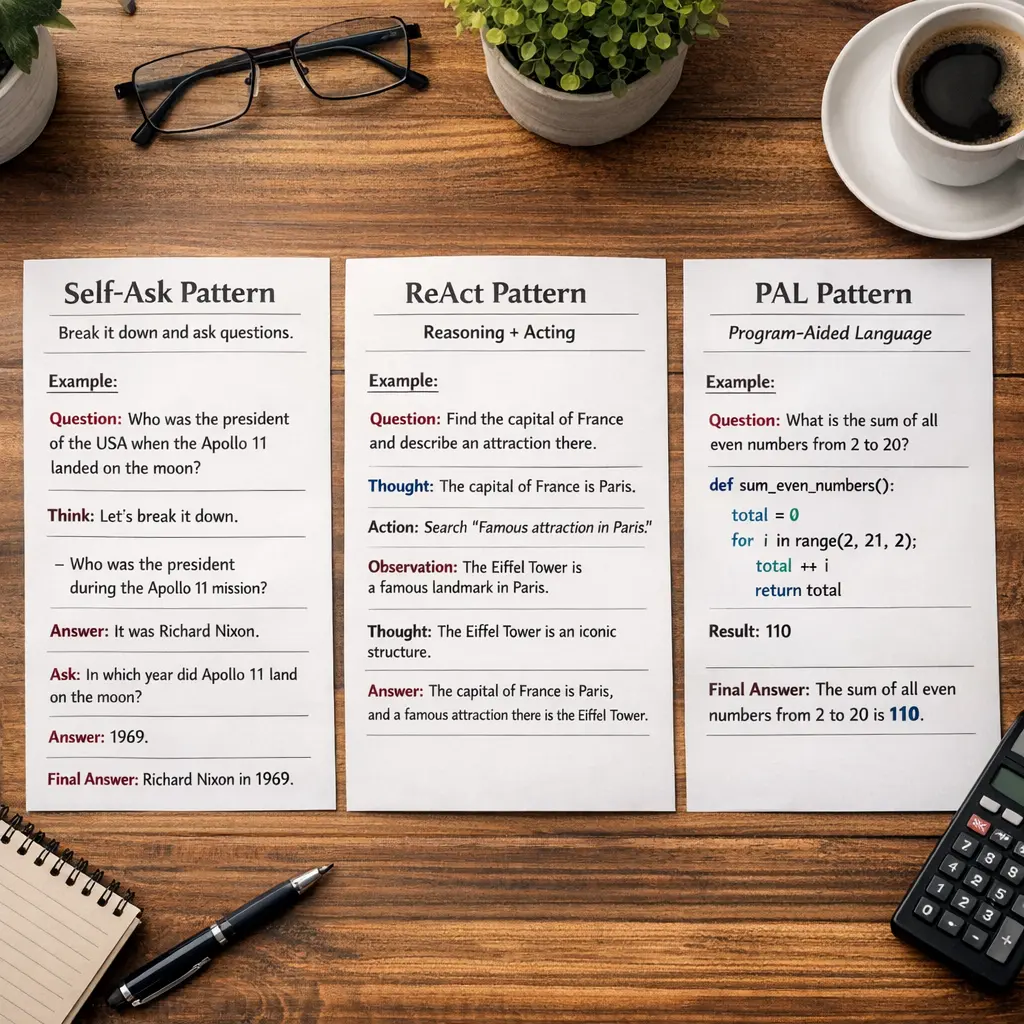
Self-Ask, ReAct, and PAL Patterns are agent architecture strategies in AI that guide how agents process information and make decisions. Self-Ask involves agents generating and answering their own intermediate questions to solve tasks. ReAct combines reasoning and acting, allowing agents to think step-by-step while interacting with their environment. PAL (Program-Aided Language) leverages code execution to enhance reasoning, enabling agents to use external tools or programs for complex problem-solving.
Self-Ask, ReAct & PAL Patterns
Self-Ask, ReAct, and PAL Patterns are agent architecture strategies in AI that guide how agents process information and make decisions. Self-Ask involves agents generating and answering their own intermediate questions to solve tasks. ReAct combines reasoning and acting, allowing agents to think step-by-step while interacting with their environment. PAL (Program-Aided Language) leverages code execution to enhance reasoning, enabling agents to use external tools or programs for complex problem-solving.
💡 Key Takeaways
- Understand how Self-Ask prompts break problems into questions to generate intermediate steps.
- Learn how ReAct interleaves reasoning and actions to solve tasks using tools.
- Explore the PAL pattern (Plan-Act-Learn) for iterative planning, action, and learning from outcomes.
- Identify when to apply Self-Ask, ReAct, or PAL based on task complexity and tool needs.
❓ Frequently Asked Questions
What is the Self-Ask pattern in AI prompting?
A prompting approach where the model asks itself clarifying questions and answers them step by step, helping gather information and reduce errors before giving a final response.
How does the ReAct pattern work?
It combines reasoning with actions. The model alternates between thinking steps and performing actions (like tool use or web search), using the results to refine the final answer.
What is the PAL pattern in prompting?
PAL stands for Program-Aided (or Program-Assisted) Language. The model outputs a short, executable program that encodes the steps to solve the task, and running the program yields the solution.
When should you use these patterns?
Use Self-Ask for uncertain or open-ended tasks, ReAct when external tools or data are needed, and PAL for tasks that benefit from explicit computation or algorithmic steps; they can also be combined with safety checks.