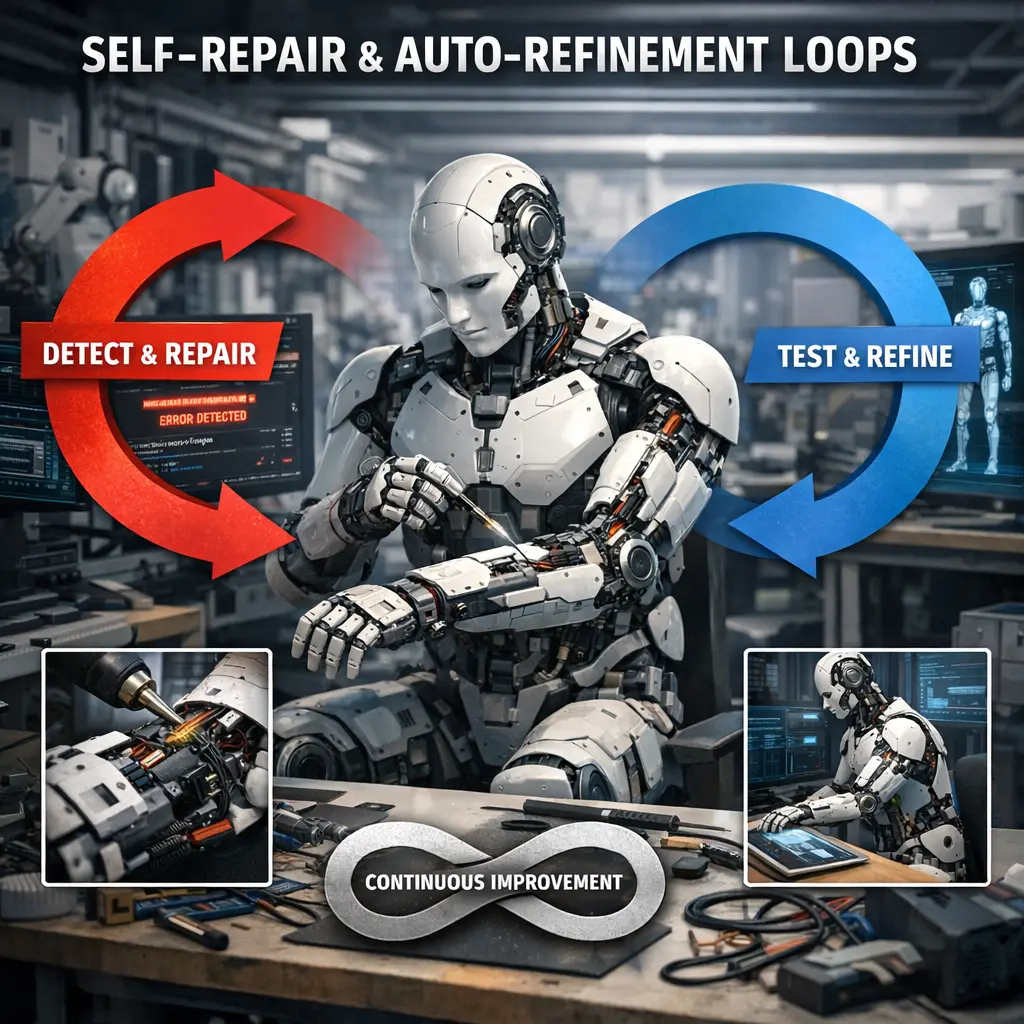
Self-Repair & Auto-Refinement Loops in agent architecture refer to mechanisms that enable an AI system to detect errors, inconsistencies, or inefficiencies in its own processes or outputs and autonomously correct or improve them. Through iterative feedback loops, the agent continually monitors its performance, diagnoses issues, and refines its strategies or knowledge base. This enhances reliability, adaptability, and long-term learning, allowing the agent to function more robustly in dynamic or unpredictable environments.
Self-Repair & Auto-Refinement Loops
Self-Repair & Auto-Refinement Loops in agent architecture refer to mechanisms that enable an AI system to detect errors, inconsistencies, or inefficiencies in its own processes or outputs and autonomously correct or improve them. Through iterative feedback loops, the agent continually monitors its performance, diagnoses issues, and refines its strategies or knowledge base. This enhances reliability, adaptability, and long-term learning, allowing the agent to function more robustly in dynamic or unpredictable environments.
💡 Key Takeaways
- Understand what self-repair and auto-refinement loops are and where they apply
- Identify the core mechanisms that enable self-repair (feedback, redundancy, and adaptive control)
- Explore real-world examples in engineering, software, and biology
- Explain the benefits, trade-offs, and challenges of deploying self-repair and auto-refinement loops
❓ Frequently Asked Questions
What is a self-repair loop?
A mechanism where a system automatically detects faults, diagnoses the cause, and applies a fix to restore normal operation without human intervention.
What is an auto-refinement loop?
An iterative process that uses feedback from outcomes to adjust parameters, rules, or models to improve performance over time.
How do these loops differ?
Self-repair focuses on restoring function after faults; auto-refinement focuses on improving performance through ongoing updates, often using results from the latest run.
Where are these loops commonly used?
In software resilience (self-healing services), AI/ML systems (online learning, model updating), robotics (fault-tolerant control), and system optimization (adaptive tuning).