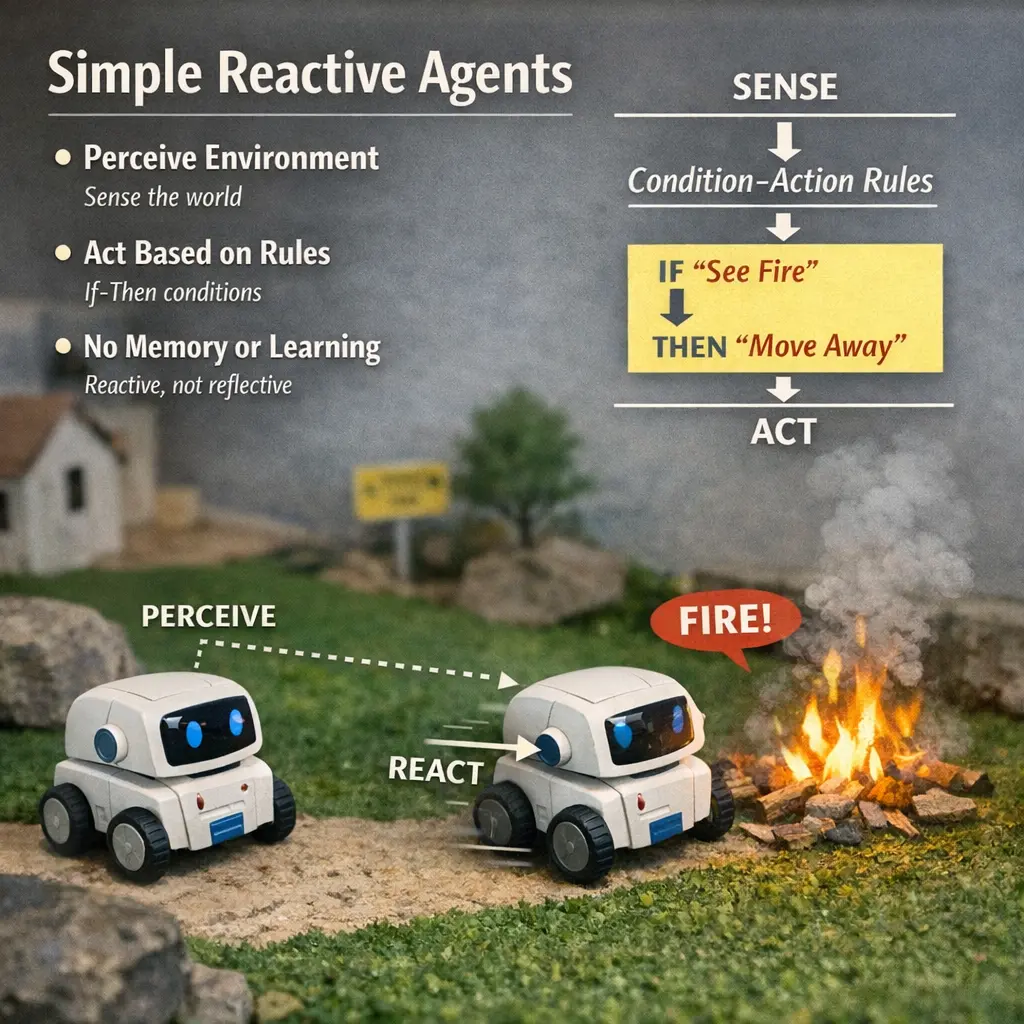
Simple Reactive Agents are a type of agent architecture in artificial intelligence that respond directly to environmental stimuli using a set of predefined rules or condition-action pairs. They lack memory or internal models of the world, meaning their actions depend solely on the current percept. This simplicity allows for fast, efficient responses, but limits the agent’s ability to plan, learn, or handle complex situations that require knowledge of past events or anticipation of future outcomes.
Simple Reactive Agents+50
Simple Reactive Agents are a type of agent architecture in artificial intelligence that respond directly to environmental stimuli using a set of predefined rules or condition-action pairs. They lack memory or internal models of the world, meaning their actions depend solely on the current percept. This simplicity allows for fast, efficient responses, but limits the agent’s ability to plan, learn, or handle complex situations that require knowledge of past events or anticipation of future outcomes.
💡 Key Takeaways
- Understand what a simple reactive agent is and how it maps current percepts directly to actions.
- Learn how condition-action rules drive behavior without internal state or planning.
- Recognize the limitations of reactive agents, including lack of memory and foresight.
- Compare simple reactive agents with more advanced agents to identify typical use cases and scenarios.
❓ Frequently Asked Questions
What is a simple reactive agent?
An AI agent that chooses actions based only on the current percept using a fixed set of condition-action rules, with no internal model of the world or planning.
How do simple reactive agents decide what to do?
They apply rules that map percepts to actions. When a percept matches a condition, they perform the linked action; if no rule matches, they may take a default action or do nothing.
Where are simple reactive agents commonly used, and can you give examples?
In simple, fully observable tasks: for example, a basic reflex vacuum cleaner using rules (if dirty then clean), a thermostat, or simple game characters reacting to nearby stimuli.
What are the main limitations of simple reactive agents?
They have no memory or planning, struggle with partial observability and noise, can't learn, and are brittle for complex or changing tasks.