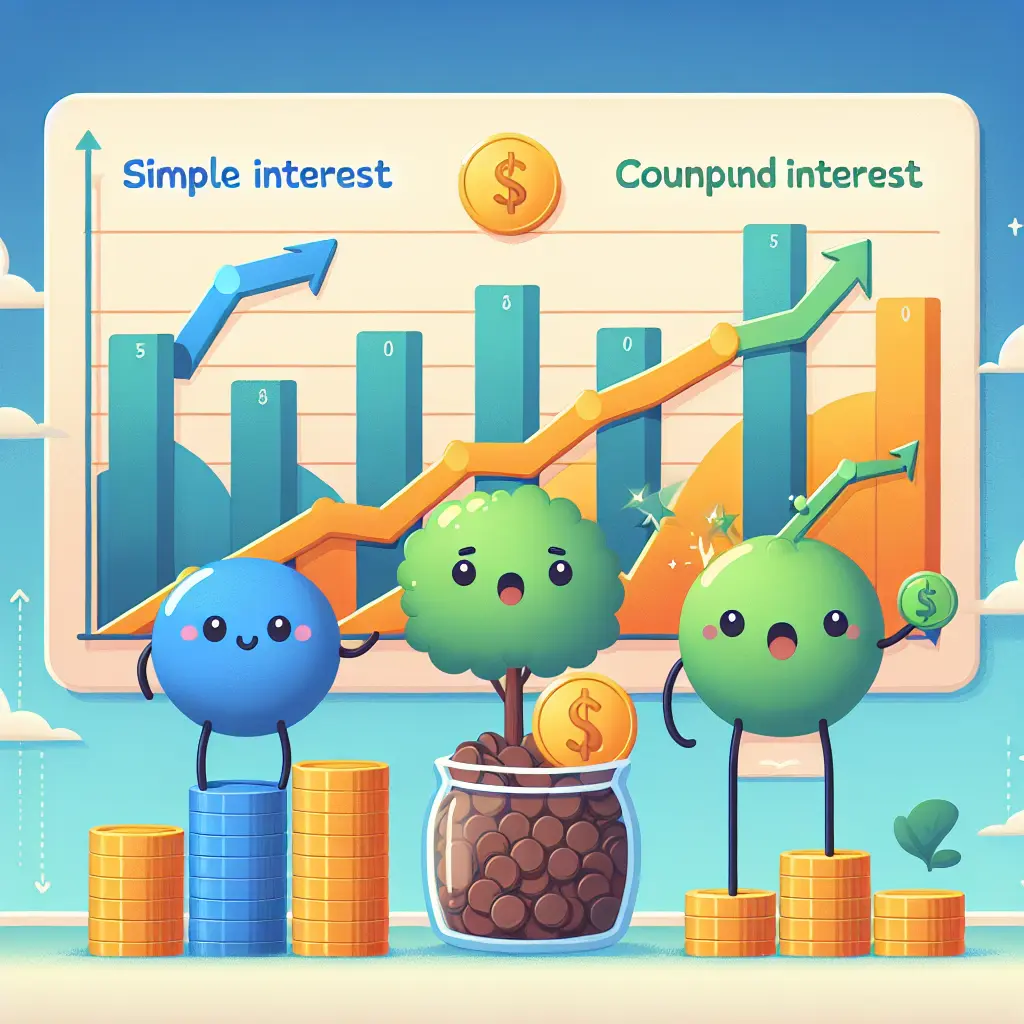
Simple interest is calculated only on the original amount of money (principal) invested or borrowed, resulting in a fixed amount of interest each period. Compound interest, on the other hand, is calculated on both the principal and any previously earned interest, causing the interest to accumulate and grow faster over time. Compound interest generally results in higher returns or costs compared to simple interest, especially over long periods.
Simple vs Compound Interest
Simple interest is calculated only on the original amount of money (principal) invested or borrowed, resulting in a fixed amount of interest each period. Compound interest, on the other hand, is calculated on both the principal and any previously earned interest, causing the interest to accumulate and grow faster over time. Compound interest generally results in higher returns or costs compared to simple interest, especially over long periods.
💡 Key Takeaways
- Understand the key difference: simple interest is earned on the principal only, while compound interest is earned on both the principal and accumulated interest.
- Learn the basic formulas: simple interest = P * r * t; compound interest uses A = P(1 + r/n)^(n t).
- Explore how compounding frequency (annual, monthly, daily) changes the final amount.
- Compare growth over time: compound interest typically yields more total interest than simple interest due to interest-on-interest.
❓ Frequently Asked Questions
What is simple interest?
Simple interest is calculated only on the original principal, giving a fixed amount of interest per period. Formula: I = P × r × t, where P is principal, r is the rate per period, and t is time.
What is compound interest?
Compound interest is calculated on the principal plus any previously earned interest, so interest earns interest over time. With periodic compounding: A = P(1 + r/n)^(nt) and I = A - P.
How do simple and compound interest differ?
Simple interest grows linearly with time, while compound interest grows faster because interest itself earns interest. The difference increases with longer time or more frequent compounding.
When is simple interest vs. compound interest typically used?
Simple interest is common for short-term loans or fixed-rate investments, whereas compound interest is standard for most savings, loans, and investments where interest is reinvested.