SLAM (Simultaneous Localization and Mapping), motion planning, and autonomous navigation are crucial fields in engineering and technology careers focused on robotics and intelligent systems. SLAM enables robots to build maps and track their position in unknown environments. Motion planning involves determining safe and efficient paths for movement, while autonomous navigation integrates these technologies to allow robots, drones, or vehicles to move independently and reliably in complex, dynamic settings.
SLAM, Motion Planning & Autonomous Navigation
SLAM (Simultaneous Localization and Mapping), motion planning, and autonomous navigation are crucial fields in engineering and technology careers focused on robotics and intelligent systems. SLAM enables robots to build maps and track their position in unknown environments. Motion planning involves determining safe and efficient paths for movement, while autonomous navigation integrates these technologies to allow robots, drones, or vehicles to move independently and reliably in complex, dynamic settings.
💡 Key Takeaways
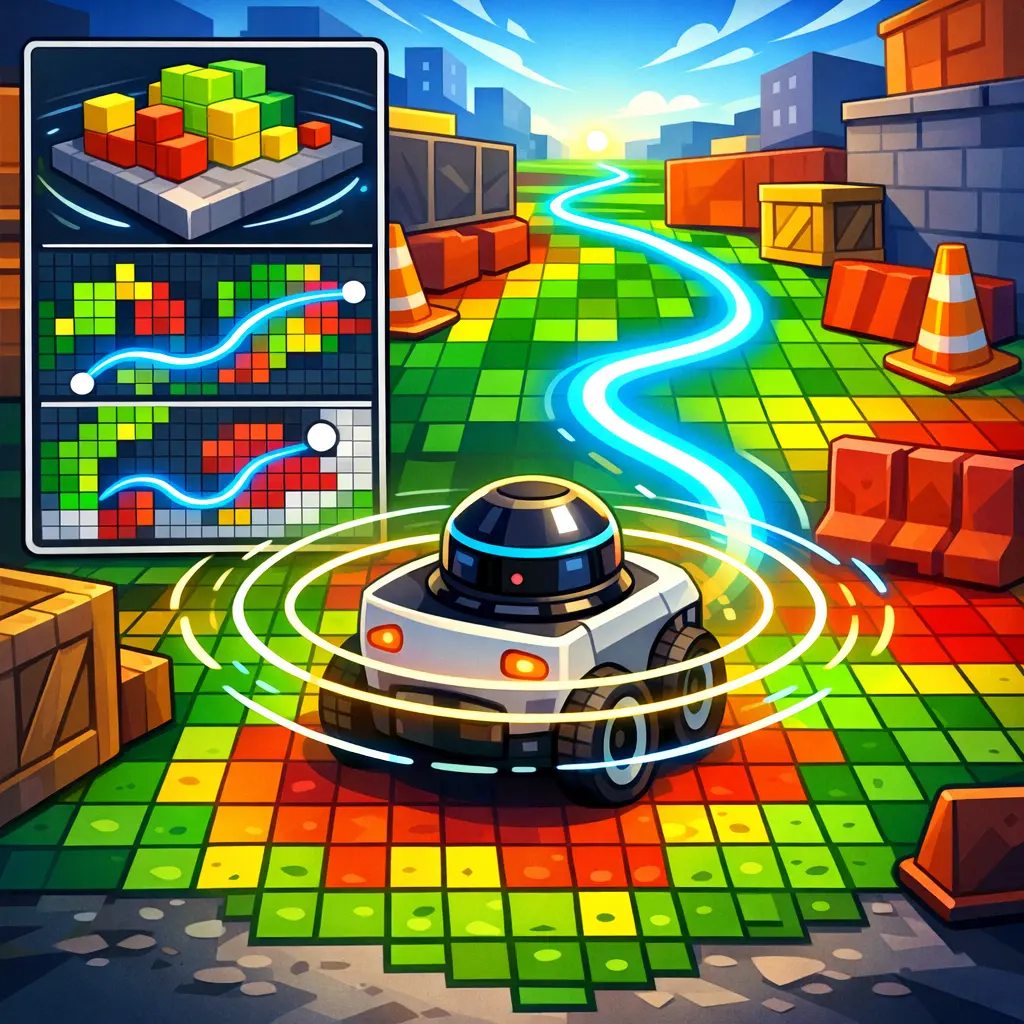
- Understand how SLAM localizes the robot while building a map from sensor data
- Learn how motion planning computes safe, feasible paths to a goal
- See how autonomous navigation combines perception, localization, and planning to reach goals safely
- Identify common SLAM and navigation challenges (drift, loop closure, dynamic obstacles) and mitigation strategies
❓ Frequently Asked Questions
What does SLAM stand for and what does it do?
SLAM stands for Simultaneous Localization and Mapping. It builds a map of the robot's surroundings while estimating the robot's pose, using sensor data; loop closure helps reduce drift.
What is motion planning in robotics?
Motion planning computes a collision-free path from a start pose to a goal, considering the robot's kinematics/dynamics and known obstacles, often via a global plan plus local adjustments.
What is autonomous navigation?
Autonomous navigation combines perception, localization, mapping, planning, and control to move a robot to a goal while avoiding obstacles.
What are common global and local planning methods?
Global methods include A* and Dijkstra on maps/graphs; local methods include Dynamic Window Approach (DWA) or Pure Pursuit to adapt to nearby obstacles; sampling-based planners like RRT/RRT* are also used.