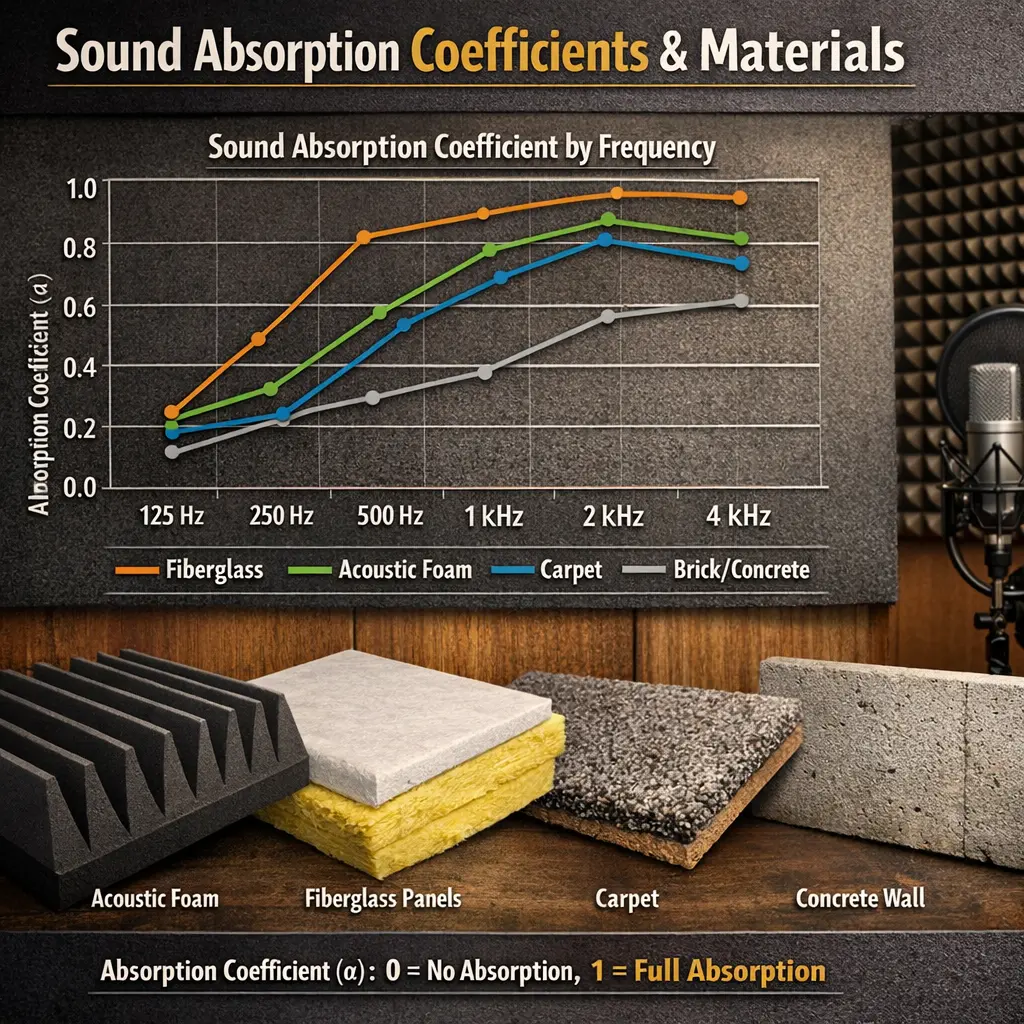
Sound absorption coefficients measure how effectively a material absorbs sound energy, rather than reflecting it. Values range from 0 (total reflection) to 1 (total absorption). Different materials, such as fiberglass, foam, and acoustic panels, have varying coefficients depending on their structure and thickness. These coefficients are crucial in designing spaces like theaters, studios, and offices to control noise and improve acoustics by selecting appropriate sound-absorbing materials.
Sound Absorption Coefficients and Materials
Sound absorption coefficients measure how effectively a material absorbs sound energy, rather than reflecting it. Values range from 0 (total reflection) to 1 (total absorption). Different materials, such as fiberglass, foam, and acoustic panels, have varying coefficients depending on their structure and thickness. These coefficients are crucial in designing spaces like theaters, studios, and offices to control noise and improve acoustics by selecting appropriate sound-absorbing materials.
💡 Key Takeaways
- Understand what the sound absorption coefficient represents (0 to 1) and how it's measured in rooms and labs.
- Identify common absorption materials (mineral wool, fiberglass, acoustic foam, fabric-wrapped panels) and how their structure affects performance.
- Learn how absorption depends on frequency and how thickness, density, and air gaps influence effectiveness.
- Know how to choose materials and thicknesses to control reverberation time and reduce echoes, using basic specs like alpha values and NRC.
❓ Frequently Asked Questions
What is a sound absorption coefficient?
It is the fraction of incident sound energy absorbed by a material at a given frequency, ranging from 0 (no absorption) to 1 (total absorption).
How is the absorption coefficient measured?
It is measured in standard tests using a reverberation chamber or impedance tube, reported for specific frequencies or frequency bands.
What is NRC and how is it used?
NRC (Noise Reduction Coefficient) is the average of a material's absorption coefficients at 250, 500, 1000, and 2000 Hz, giving a single-value indication of overall room absorption.
How do material properties affect absorption?
Porous, open-cell materials (like foam, fiberglass, and mineral wool) absorb sound through viscous and thermal losses. Thickness, porosity, and backing influence performance; thicker or more porous materials generally absorb more, especially at lower frequencies.
Do absorption coefficients vary with frequency?
Yes. A material may absorb well at high frequencies but not at low frequencies, so multiple frequency values or ratings (like NRC) are used for design.