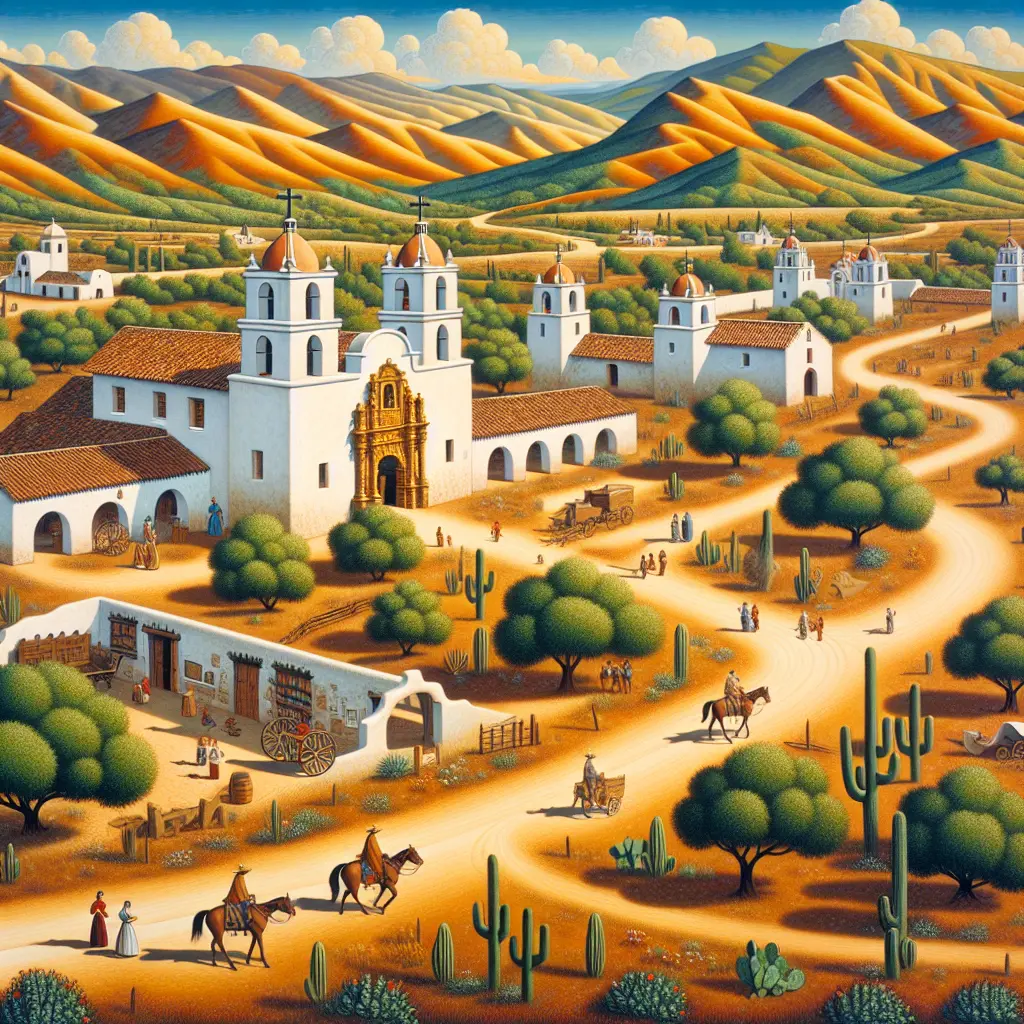
Spanish Colonial Missions: Camino Real Networks refers to the system of religious and military outposts established by Spanish colonizers across the Americas, connected by the "Camino Real" or "Royal Road." These missions aimed to convert Indigenous peoples to Christianity, expand Spanish territory, and facilitate trade and communication. The Camino Real served as a vital transportation route, linking missions, presidios, and settlements, shaping cultural and economic landscapes that still influence regions today.
Spanish Colonial Missions: Camino Real Networks
Spanish Colonial Missions: Camino Real Networks refers to the system of religious and military outposts established by Spanish colonizers across the Americas, connected by the "Camino Real" or "Royal Road." These missions aimed to convert Indigenous peoples to Christianity, expand Spanish territory, and facilitate trade and communication. The Camino Real served as a vital transportation route, linking missions, presidios, and settlements, shaping cultural and economic landscapes that still influence regions today.
💡 Key Takeaways
- Define the Camino Real network as a chain of mission outposts connected by the Royal Road across the Americas.
- Explain the missions' dual roles as religious centers and military-administrative hubs during colonial expansion.
- Understand the goals of Spanish colonization: religious conversion and territorial expansion, and their impact on Indigenous communities.
- Identify iconic landmarks today that originated from these missions and their lasting cultural and architectural influence.
- Discover hidden gem mission sites and discuss preservation challenges and ongoing scholarship.
❓ Frequently Asked Questions
What were the Spanish colonial missions and what were their goals?
They were religious and military outposts established by Spanish colonizers across the Americas, built to convert Indigenous peoples to Christianity, promote settlement, and defend claimed territory.
What is the Camino Real and why was it important?
The Camino Real, or Royal Road, was a network of routes connecting missions and presidios. It enabled travel, supply lines, trade, and cultural exchange across vast colonial lands.
Where were the main Camino Real networks located, and what is their legacy today?
The strongest networks ran through Alta California in present-day California, linking missions from San Diego to Sonoma. Many sites survive as landmarks and offer a window into the colonial era.
Name an iconic mission and a hidden-gem site along the Camino Real.
Iconic: Mission San Juan Capistrano. Hidden gem: Mission San Miguel Arcángel in San Miguel.