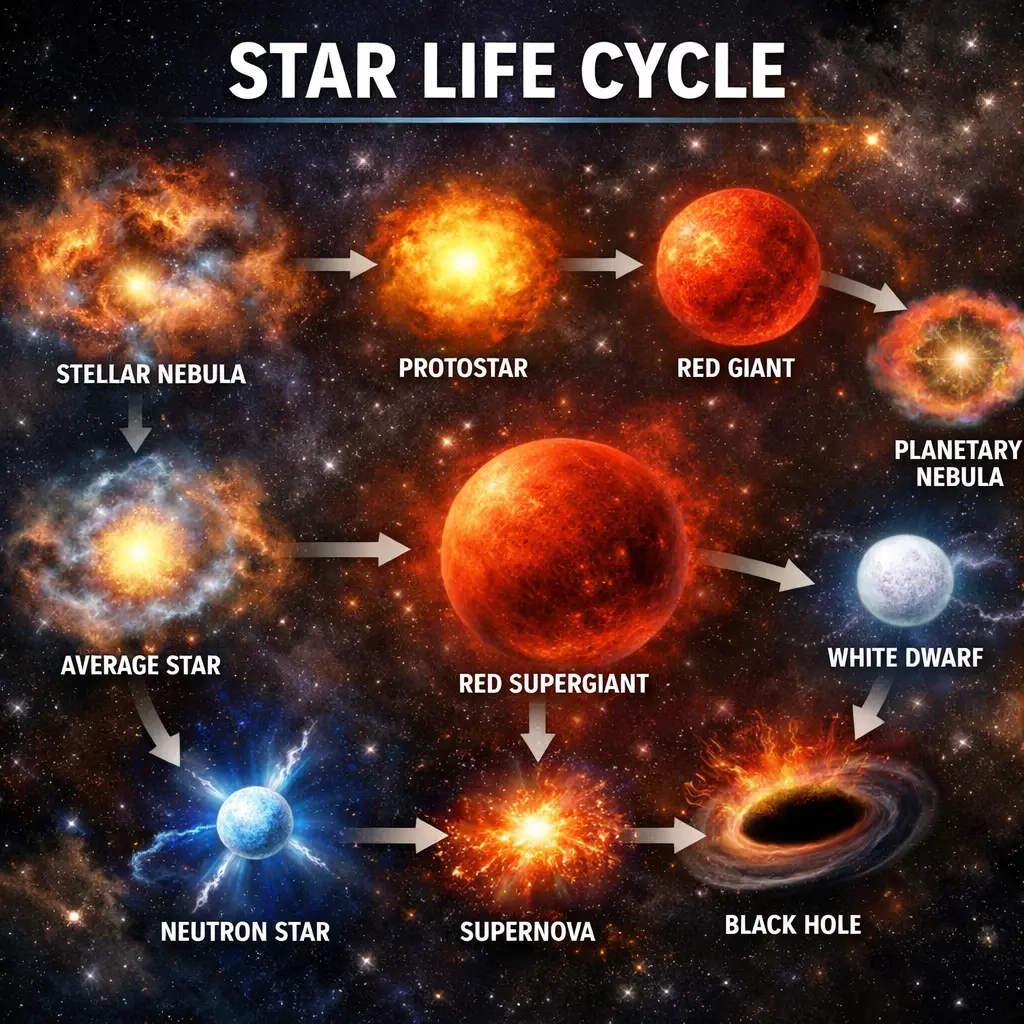
The star life cycle refers to the stages a star undergoes from its formation to its death. It begins as a nebula, condensing into a protostar, then igniting as a main sequence star. Depending on its mass, it may expand into a red giant or supergiant, then shed its outer layers, forming a white dwarf, neutron star, or black hole. This cycle illustrates how stars change and evolve over millions or billions of years.
Star Life Cycle
The star life cycle refers to the stages a star undergoes from its formation to its death. It begins as a nebula, condensing into a protostar, then igniting as a main sequence star. Depending on its mass, it may expand into a red giant or supergiant, then shed its outer layers, forming a white dwarf, neutron star, or black hole. This cycle illustrates how stars change and evolve over millions or billions of years.
💡 Key Takeaways
- Identify the main stages of a star's life: protostar, main sequence, giant/supergiant, and remnant.
- Explain how a star's mass determines its ultimate fate (white dwarf, neutron star, or black hole).
- Describe the nuclear fusion processes that power stars in different life stages (hydrogen burning in the main sequence, helium burning in later stages).
- Understand how a star's luminosity and surface temperature change as it evolves.
❓ Frequently Asked Questions
What is the star life cycle?
The star life cycle is the sequence from birth in a stellar nebula through stages like protostar, main sequence, post-main-sequence evolution (giant or supergiant), and finally the star's remnant fate (white dwarf, neutron star, or black hole), depending on its mass.
What determines a star's final fate?
Initial mass is the key. Low- to intermediate-mass stars become white dwarfs after shedding outer layers; high-mass stars end their lives in supernovae, leaving neutron stars or black holes.
What is a planetary nebula?
A glowing shell of gas ejected by a dying low- to intermediate-mass star, surrounding a hot core that will become a white dwarf.
What is a protostar and what happens on the main sequence?
A protostar is a collapsing cloud of gas not yet hot enough for fusion. When core temperatures rise and hydrogen fusion begins, the object becomes a main-sequence star, fusing hydrogen into helium for most of its life.