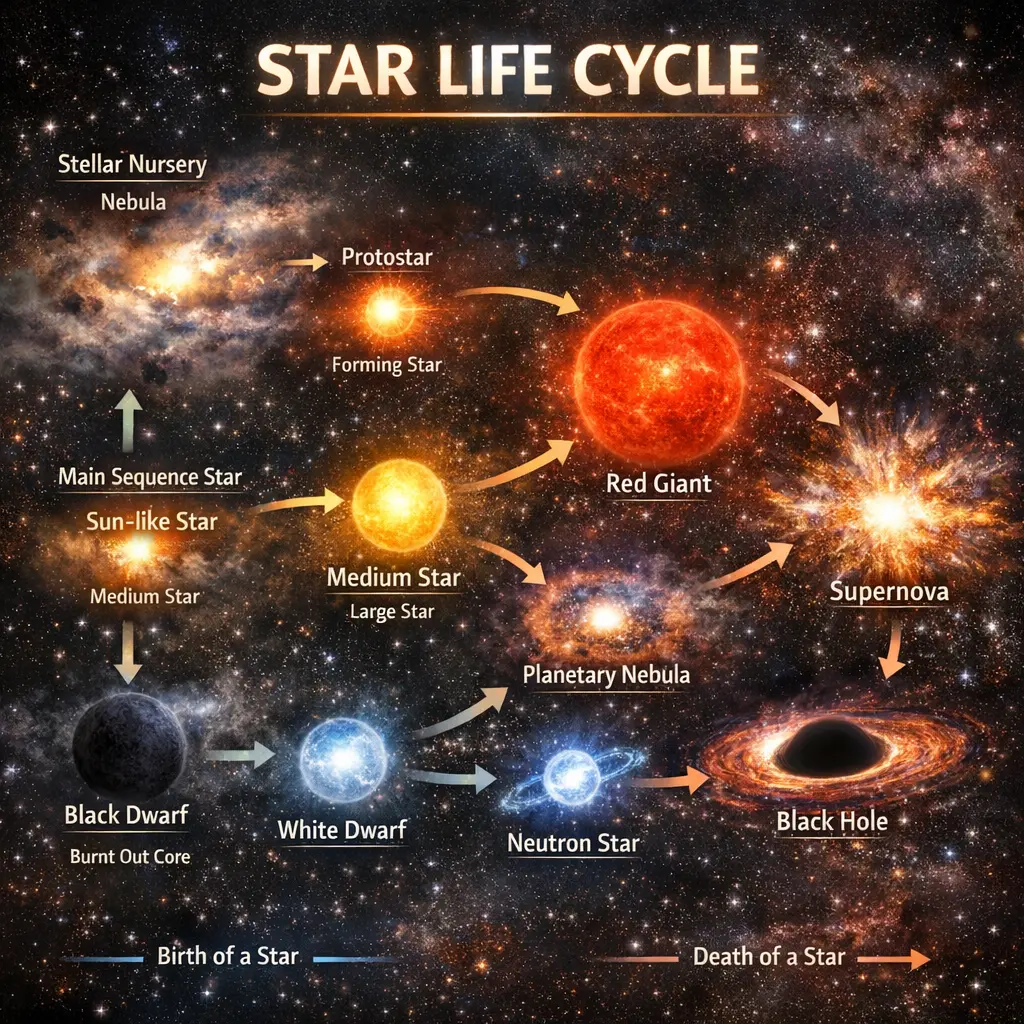
The star life cycle refers to the stages a star undergoes from its birth to its death. It begins as a cloud of gas and dust, called a nebula, which contracts under gravity to form a protostar. As nuclear fusion starts, the star enters the main sequence phase, shining for millions or billions of years. Eventually, it expands into a red giant or supergiant before shedding its outer layers and ending as a white dwarf, neutron star, or black hole.
Star Life Cycle
The star life cycle refers to the stages a star undergoes from its birth to its death. It begins as a cloud of gas and dust, called a nebula, which contracts under gravity to form a protostar. As nuclear fusion starts, the star enters the main sequence phase, shining for millions or billions of years. Eventually, it expands into a red giant or supergiant before shedding its outer layers and ending as a white dwarf, neutron star, or black hole.
💡 Key Takeaways
- Explain how stars form from cooling gas clouds and ignite fusion in their cores.
- Describe the main sequence phase and hydrogen burning, and how a star's mass shapes its lifetime.
- Explain the different end states: low- and intermediate-mass stars become white dwarfs; massive stars explode as supernovae, leaving neutron stars or black holes.
- Summarize the role of stellar evolution in cosmic chemistry and galactic enrichment.
❓ Frequently Asked Questions
What is the star life cycle?
The star life cycle is the sequence from birth in a nebula, through hydrogen fusion on the main sequence, to later stages such as red giants or supergiants, and finally to end states like white dwarfs, neutron stars, or black holes depending on mass.
What determines a star's fate?
The initial mass of the star is the primary factor; low- to medium-mass stars become white dwarfs, while high-mass stars can explode as supernovae and leave neutron stars or black holes.
What happens to Sun-like stars after the main sequence?
They expand into red giants, fuse helium in their cores, shed outer layers as planetary nebulae, and leave behind a white dwarf.
How do massive stars end their lives?
They undergo a core-collapse supernova, leaving behind a neutron star or black hole depending on the remnant core mass.