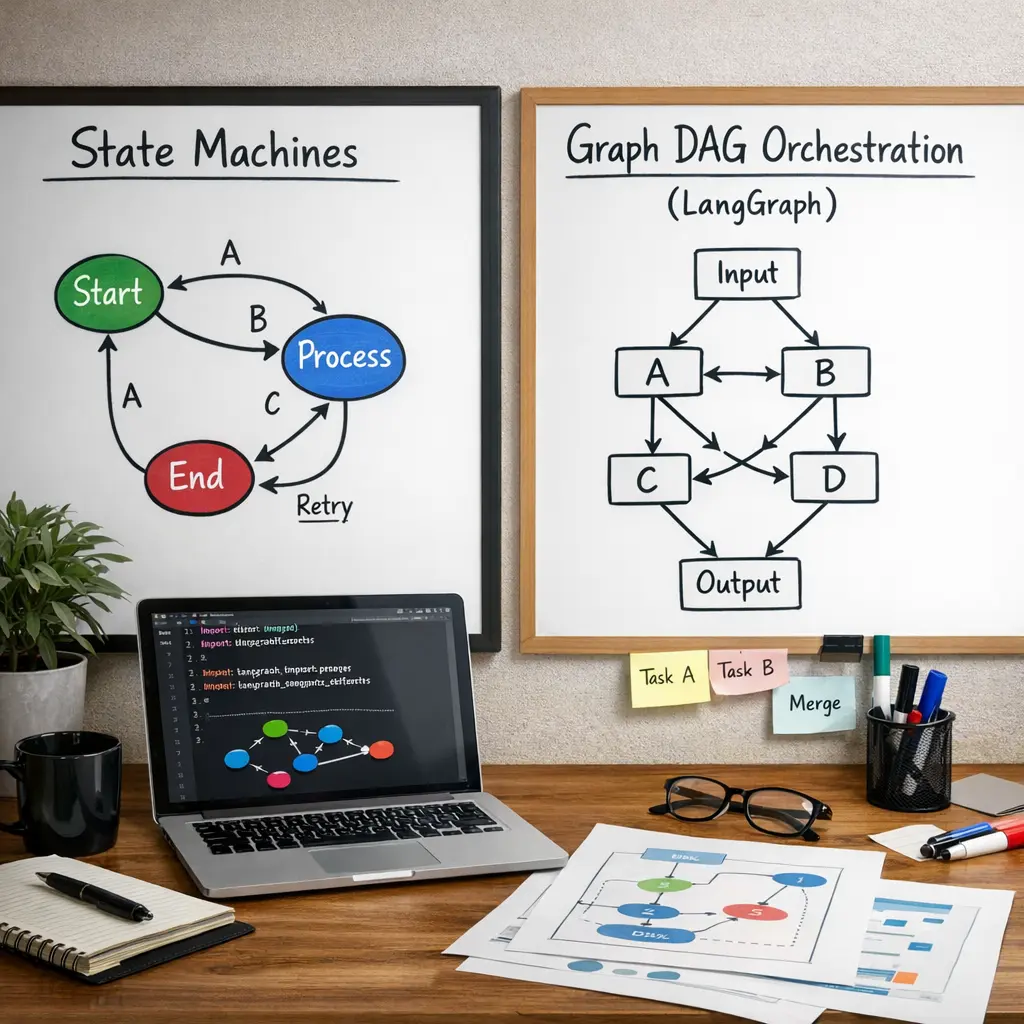
State Machines & Graph DAG Orchestration, as used in agent architecture like LangGraph, refers to structuring agent workflows as directed acyclic graphs (DAGs) or finite state machines. This approach enables agents to manage complex, multi-step tasks by defining states, transitions, and dependencies between actions. Orchestration ensures that tasks are executed in the correct order, allowing for dynamic decision-making, error handling, and scalability within automated or AI-driven processes.
State Machines & Graph DAG Orchestration (e.g., LangGraph)
State Machines & Graph DAG Orchestration, as used in agent architecture like LangGraph, refers to structuring agent workflows as directed acyclic graphs (DAGs) or finite state machines. This approach enables agents to manage complex, multi-step tasks by defining states, transitions, and dependencies between actions. Orchestration ensures that tasks are executed in the correct order, allowing for dynamic decision-making, error handling, and scalability within automated or AI-driven processes.
💡 Key Takeaways
- Understand the core concepts of state machines for controlling workflow progression with states, transitions, and events.
- Learn how DAG-based orchestration models task dependencies, parallelism, and fault-tolerance in large workflows.
- Explore patterns used in LangGraph-like systems for composing, triggering, and observing distributed tasks.
- Recognize best practices for retries, error handling, idempotency, and observability in state-machine and DAG-based workflows.
❓ Frequently Asked Questions
What is a state machine?
A model with a finite set of states and transitions triggered by events, used to enforce predictable, rule-based control flow in workflows.
What is a DAG and why is it used in orchestration?
A directed acyclic graph (DAG) represents tasks as nodes and dependencies as edges; it ensures an acyclic execution order and enables safe parallelism by enforcing prerequisites.
How do state machines relate to DAG-based orchestration like LangGraph?
State machines handle high-level state transitions, while DAG orchestration manages task dependencies and execution order. Together they model both stages and the sequence of tasks.
What features are common in graph DAG orchestration systems?
Task definitions, dependency graphs, parallel execution, retries and timeouts, failure handling, idempotent tasks, and observability of progress and state.