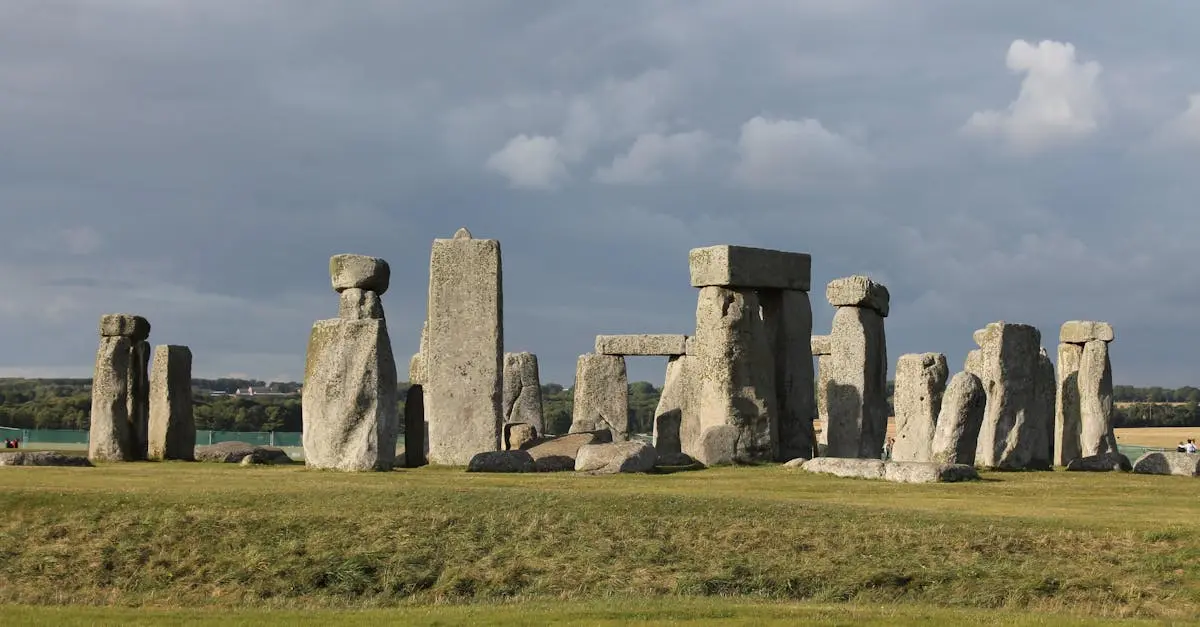
Stonehenge is a prehistoric monument located in Wiltshire, England, consisting of a ring of massive standing stones set within earthworks. Believed to have been constructed between 3000 and 2000 BCE, its purpose remains a mystery, though it is thought to have served as a ceremonial or religious site. Stonehenge is renowned for its impressive engineering, astronomical alignments, and cultural significance, attracting visitors and researchers from around the world.
Stonehenge+50
Stonehenge is a prehistoric monument located in Wiltshire, England, consisting of a ring of massive standing stones set within earthworks. Believed to have been constructed between 3000 and 2000 BCE, its purpose remains a mystery, though it is thought to have served as a ceremonial or religious site. Stonehenge is renowned for its impressive engineering, astronomical alignments, and cultural significance, attracting visitors and researchers from around the world.
💡 Key Takeaways
- Identify Stonehenge’s basic layout: a circular ring of standing stones within surrounding earthworks.
- Learn the estimated construction window (about 3000–2000 BCE) and what it suggests about prehistoric Britain.
- Explore main ideas about its purpose, including ceremonial/religious use and possible astronomical alignments.
- Recognize the key materials and structure, such as sarsen stones, bluestones, lintels, trilithons, and the surrounding ditch and bank.
❓ Frequently Asked Questions
What is Stonehenge and where is it located?
Stonehenge is a prehistoric monument on Salisbury Plain in Wiltshire, England, consisting of a ring of massive standing stones set within earthworks.
When was Stonehenge built?
Construction is believed to have taken place between about 3000 BCE and 2000 BCE, with the main circle completed in the late Neolithic to early Bronze Age.
What is Stonehenge made of?
The monument features large sarsen stones arranged in a circular ring, with some smaller bluestones, all set within earthworks.
What are common theories about Stonehenge's purpose?
Scholars think it served ceremonial or religious purposes, and may have been used for astronomical observations, seasonal rites, or as a burial site; the exact purpose remains uncertain.