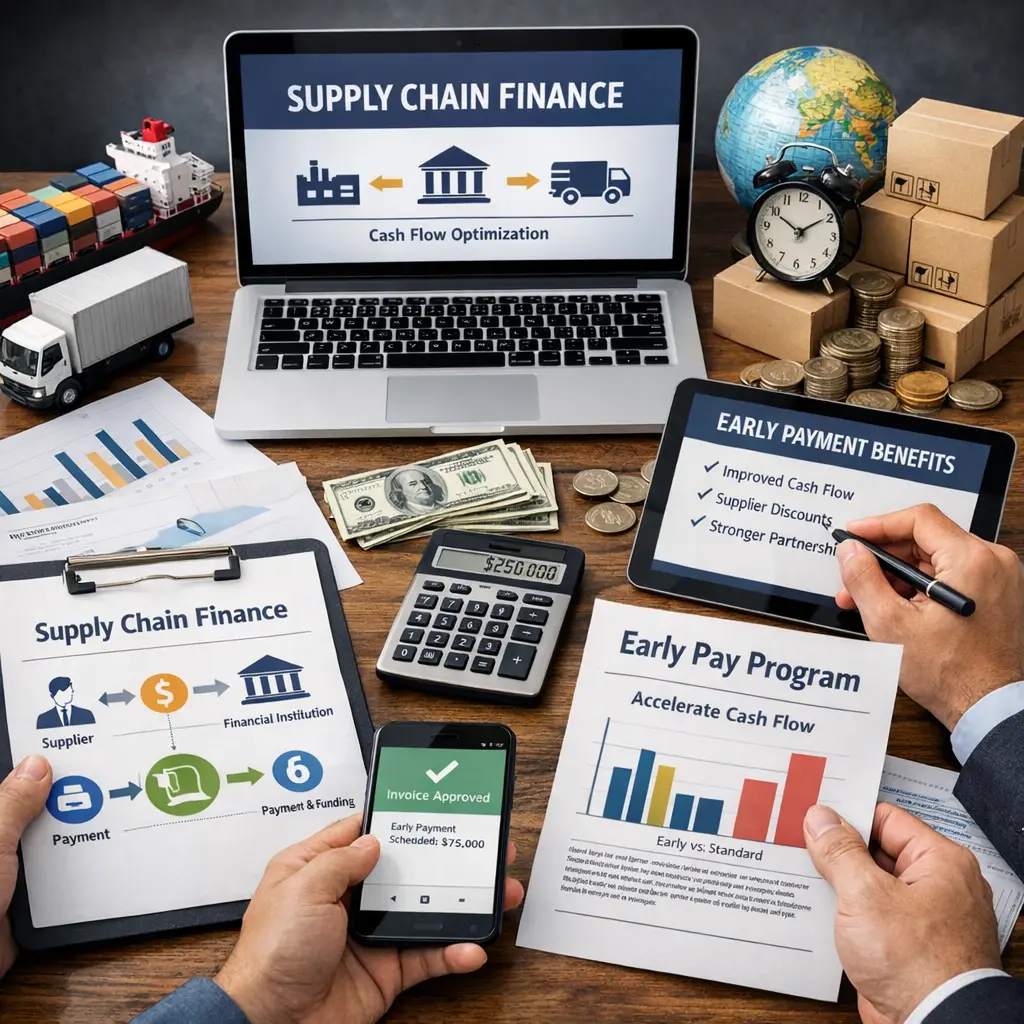
Supply Chain Finance and Early Pay Programs are financial strategies that optimize cash flow and strengthen supplier relationships. By allowing suppliers to receive early payment on invoices, often at a discount, businesses improve supplier liquidity while extending their own payment terms. These programs leverage third-party financing, reduce risk, and streamline operations, supporting overall financial management and efficient business practices across the supply chain.
Supply Chain Finance & Early Pay Programs
Supply Chain Finance and Early Pay Programs are financial strategies that optimize cash flow and strengthen supplier relationships. By allowing suppliers to receive early payment on invoices, often at a discount, businesses improve supplier liquidity while extending their own payment terms. These programs leverage third-party financing, reduce risk, and streamline operations, supporting overall financial management and efficient business practices across the supply chain.
💡 Key Takeaways
- Grasp the basics of supply chain finance and how it helps buyers and suppliers optimize cash flow.
- Understand how early pay programs (e.g., dynamic discounting, reverse factoring) accelerate payments and reduce costs.
- Identify the benefits, risks, and stakeholder considerations (buyers, suppliers, financiers) of early payment arrangements.
- Learn how to evaluate key metrics (DSO, days payable outstanding, discount rates, ROI) to decide on implementing an early pay program.
❓ Frequently Asked Questions
What is supply chain finance?
A set of financing tools that lets buyers improve cash flow by paying suppliers earlier or on favorable terms, often through banks or fintechs, while suppliers receive faster payments.
What is an early pay program?
A program that lets suppliers receive payment earlier than the original due date in exchange for a discount; buyers may optimize cash flow and supplier terms using a platform.
What is the difference between reverse factoring and dynamic discounting?
Reverse factoring (supplier finance) is buyer-approved early payment funded by a lender; the supplier is paid early at a discount, and the buyer pays the lender on the original term. Dynamic discounting is buyer-initiated early payment with a discount that varies by how many days early the payment is made, often funded by the buyer or via a platform.
Who participates in supply chain finance and what are common benefits and risks?
Participants typically include the buyer, supplier, and financing providers (banks/fintechs). Benefits: faster supplier cash, improved buyer working capital and supplier relationships. Risks: costs or discounts, program complexity, dependence on the platform, and data/security considerations.