Support Vector Machines (SVM) are supervised learning models used for classification and regression tasks in machine learning. They work by finding the optimal hyperplane that separates data points of different classes with the maximum margin. SVMs are effective in high-dimensional spaces and can use kernel functions to handle non-linear relationships. They are widely applied in areas like text classification, image recognition, and bioinformatics due to their robustness and accuracy.
Support Vector Machines
Support Vector Machines (SVM) are supervised learning models used for classification and regression tasks in machine learning. They work by finding the optimal hyperplane that separates data points of different classes with the maximum margin. SVMs are effective in high-dimensional spaces and can use kernel functions to handle non-linear relationships. They are widely applied in areas like text classification, image recognition, and bioinformatics due to their robustness and accuracy.
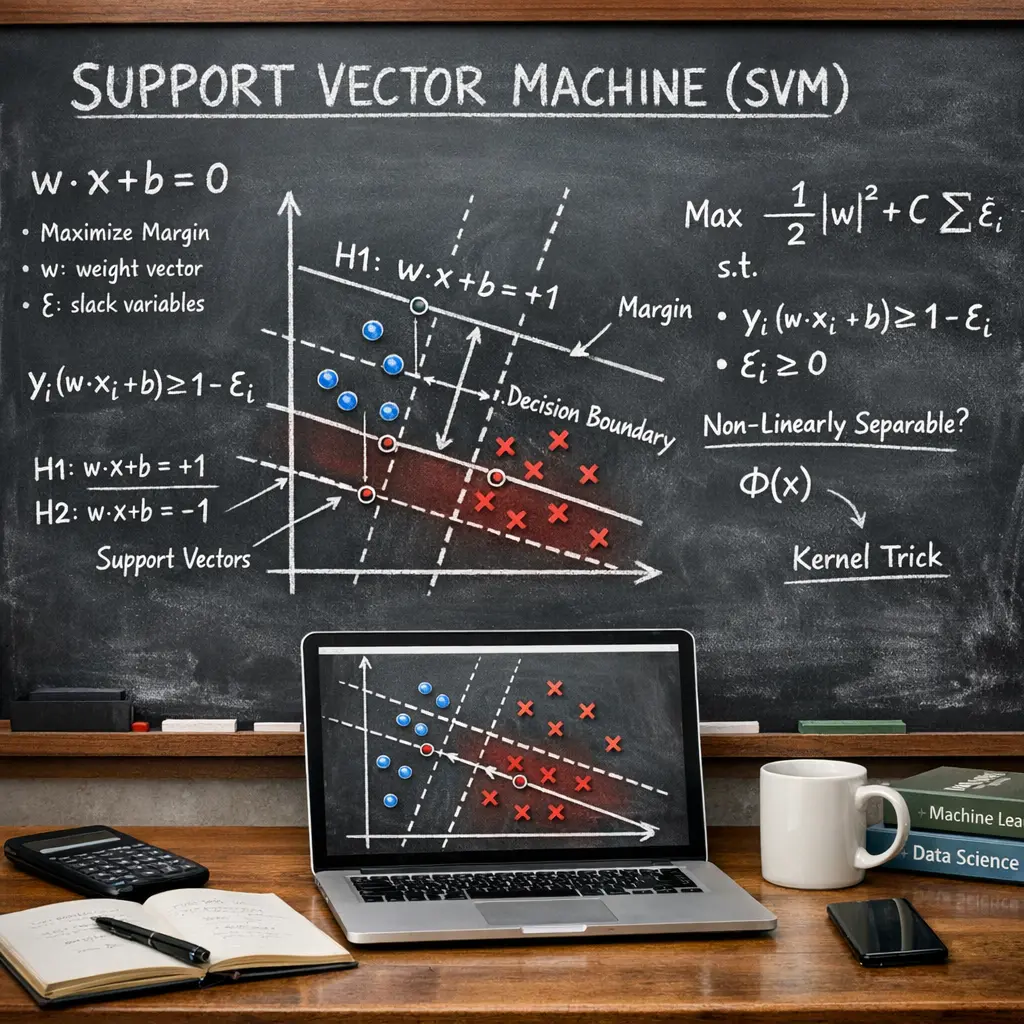
💡 Key Takeaways
- Understand the primary goal of SVMs: to separate classes with the widest possible margin using a decision boundary.
- Learn about support vectors: the critical data points that define the boundary.
- Explore the kernel trick: enable non-linear separation by mapping data into higher-dimensional space using kernels like RBF, polynomial, or linear.
- Recognize practical tuning: the regularization parameter C and kernel choice influence bias/variance and can enable soft margins.
❓ Frequently Asked Questions
What is a Support Vector Machine (SVM)?
A supervised learning model that finds a decision boundary (hyperplane) that best separates classes by maximizing the margin using data points called support vectors.
What are support vectors and what is the margin in SVM?
Support vectors are the training points closest to the decision boundary that define it; the margin is the distance from the boundary to these points, which SVM aims to maximize.
How does the kernel trick enable nonlinear classification?
Kernel functions implicitly map data into a higher-dimensional space where a linear separator may exist, without computing the coordinates in that space (examples: linear, polynomial, RBF).
What are common SVM hyperparameters to tune?
C controls the trade-off between margin width and classification error; kernel type and its parameters (e.g., gamma for RBF, degree for polynomial) shape the boundary.
When should you use a linear SVM versus a nonlinear SVM?
Use linear SVM for high-dimensional or roughly linearly separable data; use a kernel (nonlinear SVM) when the data has complex, nonlinear boundaries.