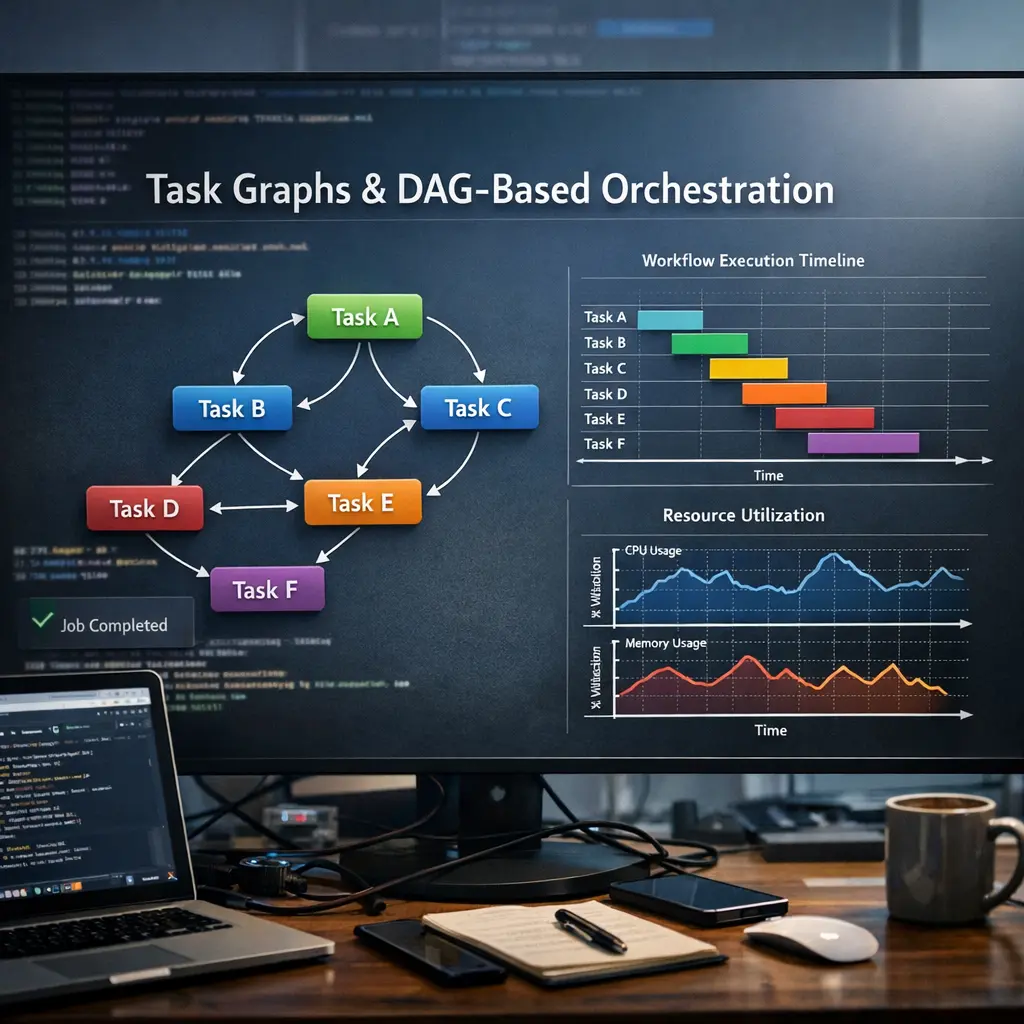
Task Graphs & DAG-based Orchestration (Agent Architecture) refers to structuring computational tasks as nodes in a directed acyclic graph (DAG), where edges define dependencies between tasks. In agent architectures, this approach enables efficient scheduling, parallel execution, and fault tolerance. Each agent can process tasks based on their dependencies, ensuring that prerequisite steps are completed first, optimizing workflows, and simplifying complex automation or data processing pipelines.
Task Graphs & DAG-based Orchestration
Task Graphs & DAG-based Orchestration (Agent Architecture) refers to structuring computational tasks as nodes in a directed acyclic graph (DAG), where edges define dependencies between tasks. In agent architectures, this approach enables efficient scheduling, parallel execution, and fault tolerance. Each agent can process tasks based on their dependencies, ensuring that prerequisite steps are completed first, optimizing workflows, and simplifying complex automation or data processing pipelines.
💡 Key Takeaways
- Define what a task graph is and how tasks and dependencies are represented in a DAG-based workflow.
- Explain why a Directed Acyclic Graph (DAG) is used to enforce order and prevent cycles in orchestration.
- Describe how DAG-based orchestration schedules tasks, supports parallel execution, and handles retries and failures.
- Identify common design patterns and pitfalls in DAG workflows, such as ensuring idempotence, managing dependencies, and maintaining observability.
❓ Frequently Asked Questions
What is a task graph in the context of orchestration?
A representation where nodes are tasks and edges indicate dependencies; the graph defines the required execution order and data flow.
What does DAG mean and why is it important for orchestration?
DAG stands for Directed Acyclic Graph. It has no cycles, which prevents infinite loops and enables a clear, computable execution order for tasks.
How is execution order determined in DAG-based orchestration?
A task can start once all its dependencies are finished. The scheduler typically uses a topological ordering to plan execution and allows independent tasks to run in parallel.
What are common benefits and challenges of DAG-based orchestration?
Benefits include explicit dependency handling, parallelism, and repeatable runs. Challenges include managing complex graphs, handling failures, and re-running specific tasks without redoing everything.