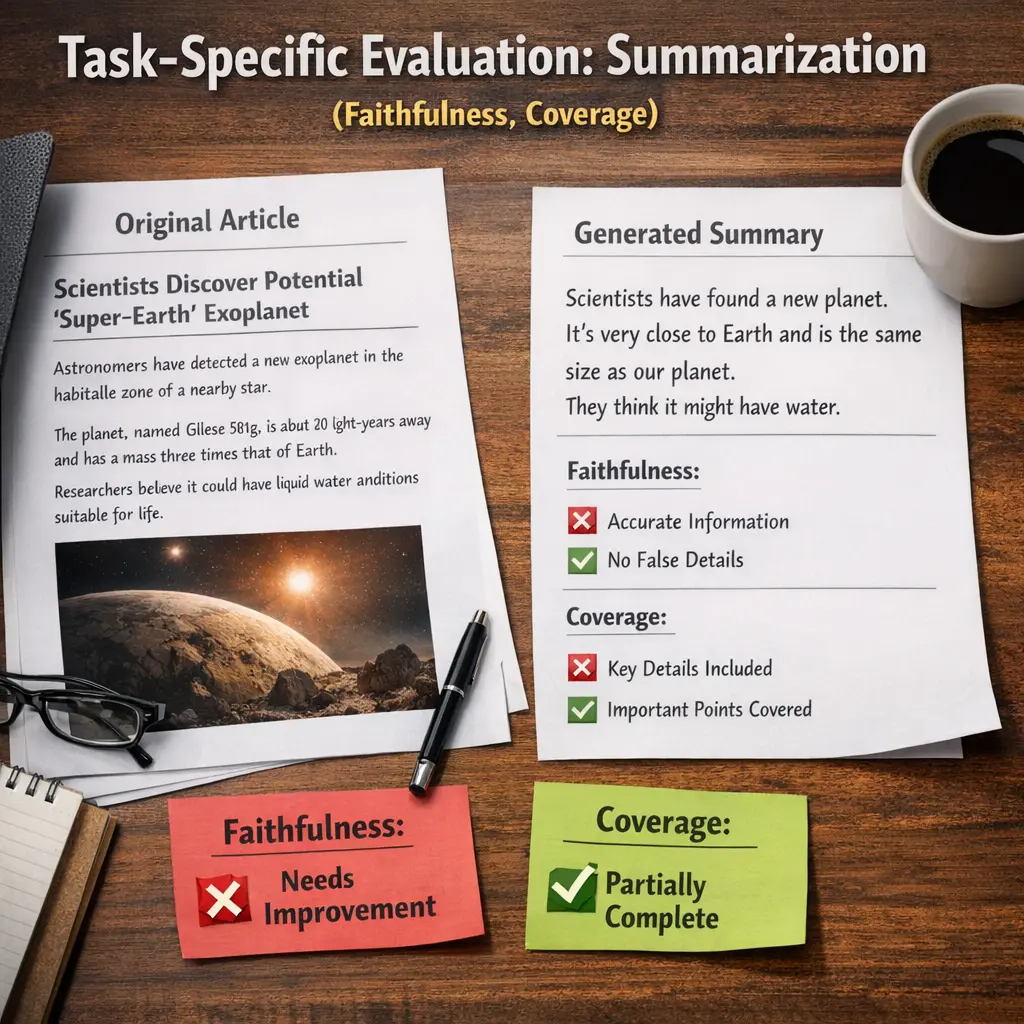
Task-specific evaluation for summarization in the context of LLM evaluations focuses on assessing how well a summary maintains faithfulness and coverage. Faithfulness measures whether the summary accurately represents the original content without introducing errors or fabrications. Coverage evaluates how comprehensively the summary captures the main points and important details of the source material. Together, these criteria ensure that generated summaries are both reliable and informative.
Task-specific Evaluation: Summarization (faithfulness, coverage)
Task-specific evaluation for summarization in the context of LLM evaluations focuses on assessing how well a summary maintains faithfulness and coverage. Faithfulness measures whether the summary accurately represents the original content without introducing errors or fabrications. Coverage evaluates how comprehensively the summary captures the main points and important details of the source material. Together, these criteria ensure that generated summaries are both reliable and informative.
💡 Key Takeaways
- Define faithfulness and coverage in summarization and why they matter for task-specific evaluation.
- Identify practical methods to assess faithfulness, including factual alignment checks and detecting hallucinations.
- Identify practical methods to assess coverage, ensuring key ideas and essential details are included.
- Learn evaluation approaches and metrics focused on faithfulness and coverage, including when to use human judgments and automated checks.
❓ Frequently Asked Questions
What is task-specific evaluation for summarization?
Task-specific evaluation assesses how well a summarization model performs on the summarization task, focusing on how faithfully and comprehensively the summary reflects the source.
What does faithfulness mean in summarization evaluation?
Faithfulness means the summary accurately represents facts from the source, without adding, omitting, or changing meaning.
What does coverage mean in summarization evaluation?
Coverage measures how much of the source's important information is included in the summary, ensuring key points and perspectives are not omitted.
How are faithfulness and coverage measured in practice?
Use a mix of automatic metrics (e.g., ROUGE, BERTScore, factuality metrics) and human judgments to assess factuality and completeness, ideally with multiple references and content-coverage checks.