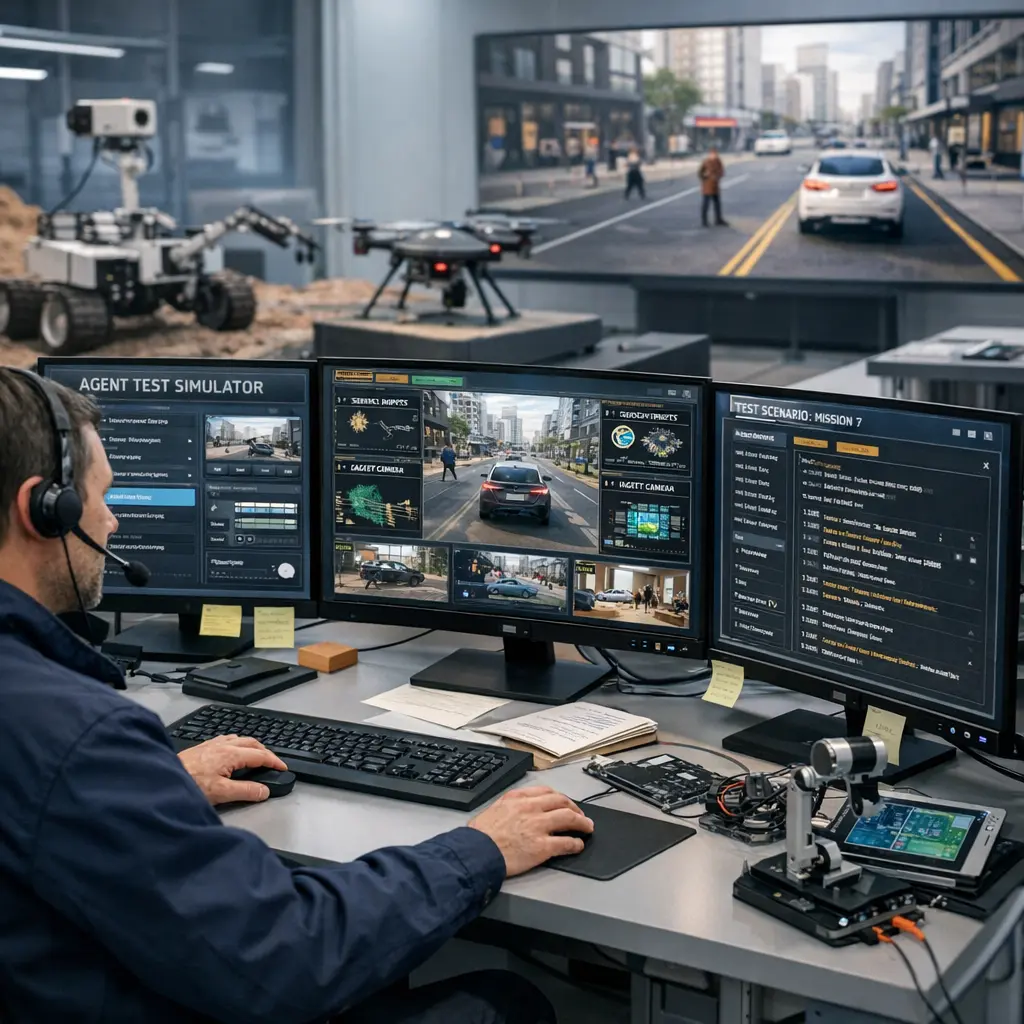
Testing mocks and simulators for agents within agent architecture refers to the use of artificial environments and modelled components to evaluate and validate the behavior of autonomous agents. Mocks replicate specific functions or interactions, while simulators provide a controlled, often virtual, environment for agents to operate. This approach allows developers to test agent responses, decision-making, and performance safely and efficiently before deploying them into real-world or production scenarios.
Testing Mocks & Simulators for Agents
Testing mocks and simulators for agents within agent architecture refers to the use of artificial environments and modelled components to evaluate and validate the behavior of autonomous agents. Mocks replicate specific functions or interactions, while simulators provide a controlled, often virtual, environment for agents to operate. This approach allows developers to test agent responses, decision-making, and performance safely and efficiently before deploying them into real-world or production scenarios.
💡 Key Takeaways
- Understand the difference between mocks (fake dependencies) and simulators (environment models) and when to use each in agent testing.
- Learn how to validate agent decision-making with mocks for dependencies and simulators for environment interactions.
- Design deterministic, reproducible test environments and mock data to ensure reliable results.
- Identify metrics and best practices to assess agent behavior, robustness, and performance across varied scenarios.
❓ Frequently Asked Questions
What is a mock in software testing and why use mocks for testing agents?
A mock is a fake object that imitates real components, providing controlled responses and verifying interactions. For agent testing, mocks simulate sensors, environments, or external services, enabling repeatable, isolated tests without real hardware or networks.
What is a simulator, and how does it differ from a mock?
A simulator is a model of a system used to run realistic scenarios and drive an agent with dynamic state. Unlike mocks, simulators provide evolving behavior and can be validated against real-world data, not just fixed responses.
How do you design effective mocks for agent behaviors?
Identify critical interactions, expose controllable outputs and timing, use realistic edge cases, keep mocks lightweight, and document expectations. Use separate mocks for sensors, actuators, and services; test both success and failure paths.
What are best practices for testing agent interactions with simulators?
Use deterministic scenarios, maintain versioned simulator models, and contract-test agent–simulator interfaces; simulate failures, latency, and partial observability; run repeatable suites and record results.
How do you ensure mocks and simulators stay accurate as the system evolves?
Regularly update models with real data, run regression tests, monitor drift between simulator outputs and actual measurements, and maintain compatibility tests when APIs or expected behaviors change.