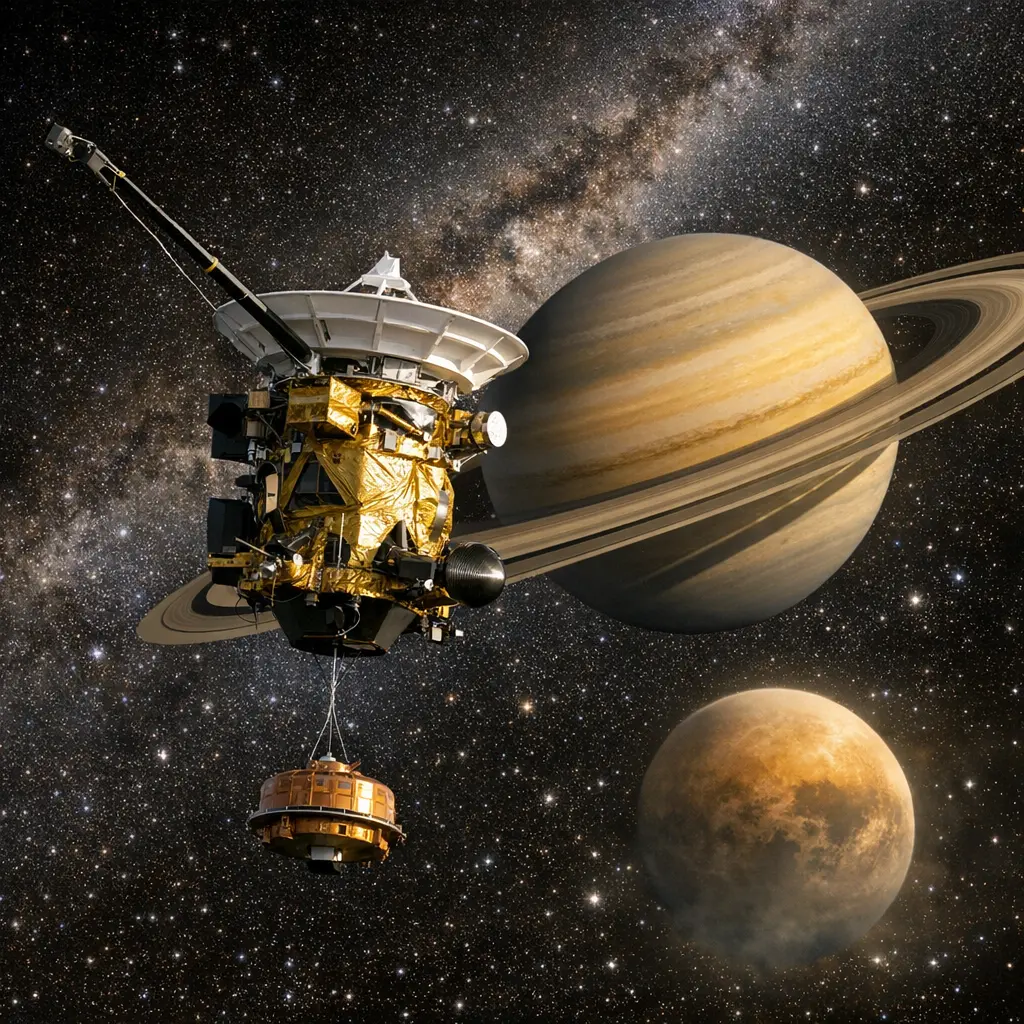
The Cassini-Huygens Mission was a collaborative project between NASA, ESA, and ASI, launched in 1997 to study Saturn and its system. Cassini orbited Saturn, sending back detailed images and data about the planet, its rings, and moons. The Huygens probe landed on Titan, Saturn’s largest moon, in 2005, providing the first direct observations of its surface and atmosphere. This mission greatly expanded our understanding of the outer solar system.
The Cassini-Huygens Mission
The Cassini-Huygens Mission was a collaborative project between NASA, ESA, and ASI, launched in 1997 to study Saturn and its system. Cassini orbited Saturn, sending back detailed images and data about the planet, its rings, and moons. The Huygens probe landed on Titan, Saturn’s largest moon, in 2005, providing the first direct observations of its surface and atmosphere. This mission greatly expanded our understanding of the outer solar system.
💡 Key Takeaways
- Understand the two-part Cassini-Huygens mission (orbiter and Huygens lander) and how they worked together to study Saturn, its rings, and Titan.
- Learn how Cassini studied Saturn’s rings, atmosphere, and magnetosphere, plus Titan’s surface and methane lakes.
- Discover key discoveries, such as Enceladus’ geysers with a possible subsurface ocean and Titan’s methane lakes.
- Trace the mission timeline from the 1997 launch to Saturn arrival in 2004 and the 2017 Grand Finale.
❓ Frequently Asked Questions
What was the Cassini-Huygens mission?
A joint NASA/ESA/ASI mission to study Saturn, its rings, and moons, using two main elements: the Cassini orbiter and the Huygens lander. Launched in 1997, it reached Saturn in 2004, and Huygens landed on Titan in 2005; the mission continued until 2017.
When and how did Cassini-Huygens reach Saturn?
Launched in October 1997; it used gravity assists from Venus, Earth, and Jupiter to reach Saturn, arriving on July 1, 2004.
What are some key discoveries from the mission?
Titan hosts lakes of methane/ethane; Enceladus has water-ice plumes suggesting a subsurface ocean; the mission also revealed detailed dynamics of Saturn’s rings and magnetosphere.
What were the two main components and their roles?
Cassini was the orbiter that studied Saturn, its rings, and moons from space; Huygens was a lander that descended to Titan to directly measure its atmosphere and surface.