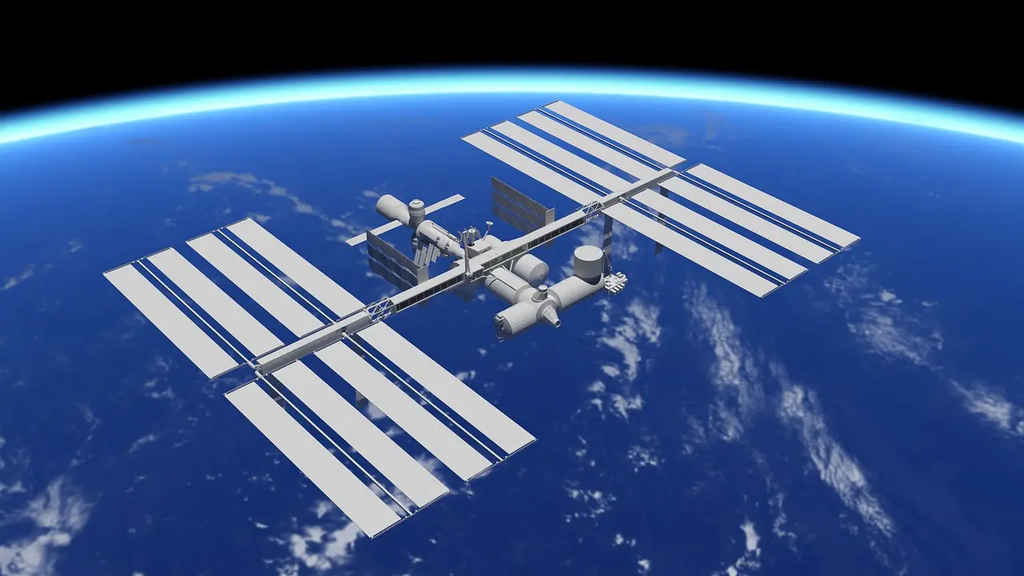
The International Space Station (ISS) is a large spacecraft orbiting Earth, serving as a unique research laboratory where astronauts from around the world live and work. As highlighted in "Space Quest: Explore the Planets and Stars," the ISS enables scientific experiments in microgravity, advancing our understanding of space and life sciences. It also acts as a stepping stone for future missions to the Moon, Mars, and beyond, fostering international cooperation in space exploration.
The International Space Station
The International Space Station (ISS) is a large spacecraft orbiting Earth, serving as a unique research laboratory where astronauts from around the world live and work. As highlighted in "Space Quest: Explore the Planets and Stars," the ISS enables scientific experiments in microgravity, advancing our understanding of space and life sciences. It also acts as a stepping stone for future missions to the Moon, Mars, and beyond, fostering international cooperation in space exploration.
💡 Key Takeaways
- Understand what the International Space Station is and its role as a modular, multinational research outpost in low Earth orbit.
- Learn what daily life on the ISS is like for astronauts, including routines, exercise, and life-support systems.
- Identify the main ISS modules and components (lab modules, habitation, solar arrays) and how they function together.
- Discover how the ISS orbits Earth, is powered and resupplied, and how international collaboration enables its operations.
❓ Frequently Asked Questions
What is the International Space Station (ISS)?
A multinational space laboratory that orbits Earth and hosts experiments in microgravity.
Where does the ISS orbit?
In low Earth orbit, typically about 400 km (roughly 250 miles) above Earth, circling about every 90 minutes.
Since when has the ISS had humans on board continuously?
Humans have lived on the ISS since November 2000, with continuous occupancy since Expedition 1.
Which agencies collaborate on the ISS?
NASA (USA), Roscosmos (Russia), ESA (Europe), JAXA (Japan), and CSA (Canada).
What kinds of research are conducted on the ISS?
Experiments in biology, physics, materials science, Earth observation, and technology demonstrations in microgravity.