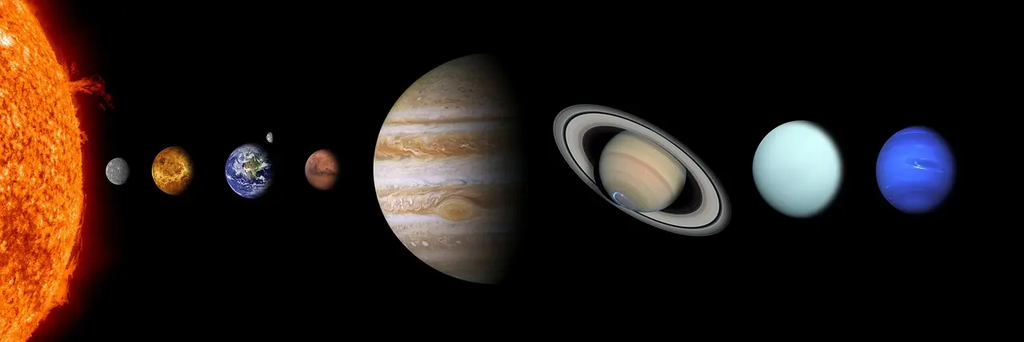
The Solar System's formation began about 4.6 billion years ago from a giant cloud of gas and dust called the solar nebula. Gravity caused the nebula to collapse, forming the Sun at its center. Surrounding material flattened into a spinning disk, where particles collided and stuck together, gradually forming planets, moons, asteroids, and other bodies. Over millions of years, these objects cooled and settled into the orbits we observe today.
The Solar System's Formation+50
The Solar System's formation began about 4.6 billion years ago from a giant cloud of gas and dust called the solar nebula. Gravity caused the nebula to collapse, forming the Sun at its center. Surrounding material flattened into a spinning disk, where particles collided and stuck together, gradually forming planets, moons, asteroids, and other bodies. Over millions of years, these objects cooled and settled into the orbits we observe today.
💡 Key Takeaways
- Explain the nebular hypothesis: the Sun and planets formed from a rotating disk of gas and dust.
- Describe how dust clumped into planetesimals and then protoplanets through accretion.
- Explain why inner planets are rocky and smaller while outer planets are gas/ice giants, due to temperature and materials in the disk.
- Identify key evidence for solar system formation, such as meteorites and observed protoplanetary disks, and typical formation timescales (a few to tens of millions of years).
❓ Frequently Asked Questions
What is the leading theory for the Solar System's formation?
The solar nebula hypothesis: a rotating cloud of gas and dust collapsed under gravity, forming the Sun at the center and a surrounding protoplanetary disk from which planets formed.
What is a protoplanetary disk and how do planets form in it?
A disk of gas and dust around a young star. Dust grains stick together to form planetesimals, which merge into protoplanets and eventually planets through collisions and accretion.
What is the frost line (snow line) and why is it important for planet types?
The frost line is the distance in the disk where temperatures are low enough for ices to condense. Inside it rocks dominate; beyond it ices allow rapid growth, helping form gas-giant cores.
What evidence supports the solar system formation model?
Dating of meteorites (~4.6 billion years old), observations of protoplanetary disks around young stars, and models showing the current planetary layout and composition align with the nebula formation scenario.