Thermo-hygro-mechanical coupling effects refer to the interconnected influence of temperature (thermal), moisture (hygro), and mechanical forces on the behavior of materials. In science and materials engineering, these effects describe how changes in heat and humidity can alter a material’s mechanical properties, such as strength, deformation, or durability. Understanding this coupling is crucial for predicting material performance in environments where temperature and moisture vary, such as construction, aerospace, and packaging industries.
Thermo-Hygro-Mechanical Coupling Effects
Thermo-hygro-mechanical coupling effects refer to the interconnected influence of temperature (thermal), moisture (hygro), and mechanical forces on the behavior of materials. In science and materials engineering, these effects describe how changes in heat and humidity can alter a material’s mechanical properties, such as strength, deformation, or durability. Understanding this coupling is crucial for predicting material performance in environments where temperature and moisture vary, such as construction, aerospace, and packaging industries.
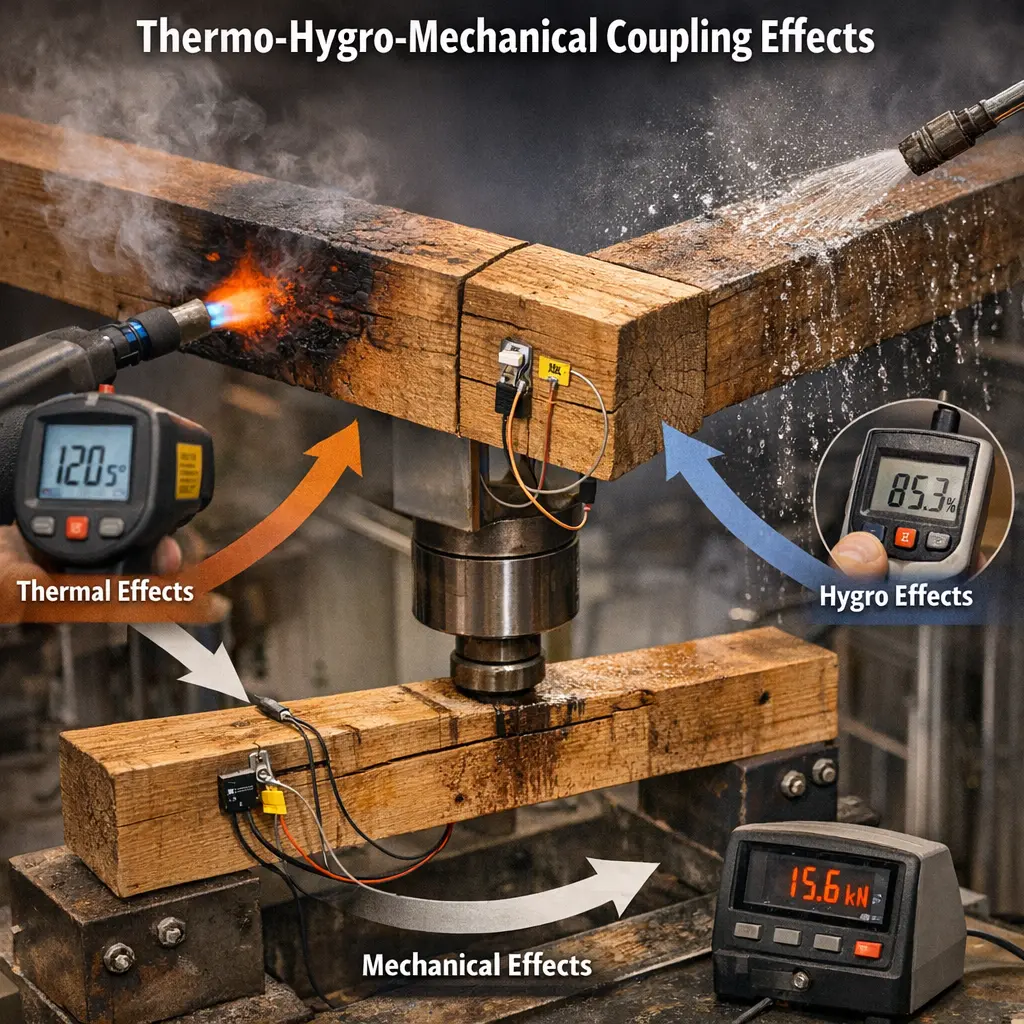
💡 Key Takeaways
- Understand how temperature, moisture, and mechanical stress interact in thermo-hygro-mechanical (THM) coupling.
- Identify how THM coupling affects material properties such as stiffness, strength, and swelling/shrinkage under environmental changes.
- Learn approaches to model THM behavior using coupled constitutive relationships and experimental characterization.
- Apply THM concepts to engineering contexts (e.g., soils, concrete, polymers) to predict performance under varying conditions.
❓ Frequently Asked Questions
What is thermo-hygro-mechanical coupling?
It describes how temperature, moisture, and mechanical state interact, causing changes in material properties, expansion or contraction, and stress development.
How do temperature and humidity affect material behavior?
Temperature can soften or stiffen materials and influence creep; humidity causes swelling or shrinkage and can alter strength. Together, they produce coupled strains and evolving stresses.
Why is coupling important in design and analysis?
Ignoring coupling can mispredict deformations and failure, especially in soils, wood, concrete, and moisture-sensitive structures where heat and moisture drive damage.
How are thermo-hygro-mechanical effects modeled?
Using coupled constitutive laws and diffusion-mechanics equations solved with methods like finite element analysis, applying boundary conditions for temperature, moisture, and mechanical constraints.