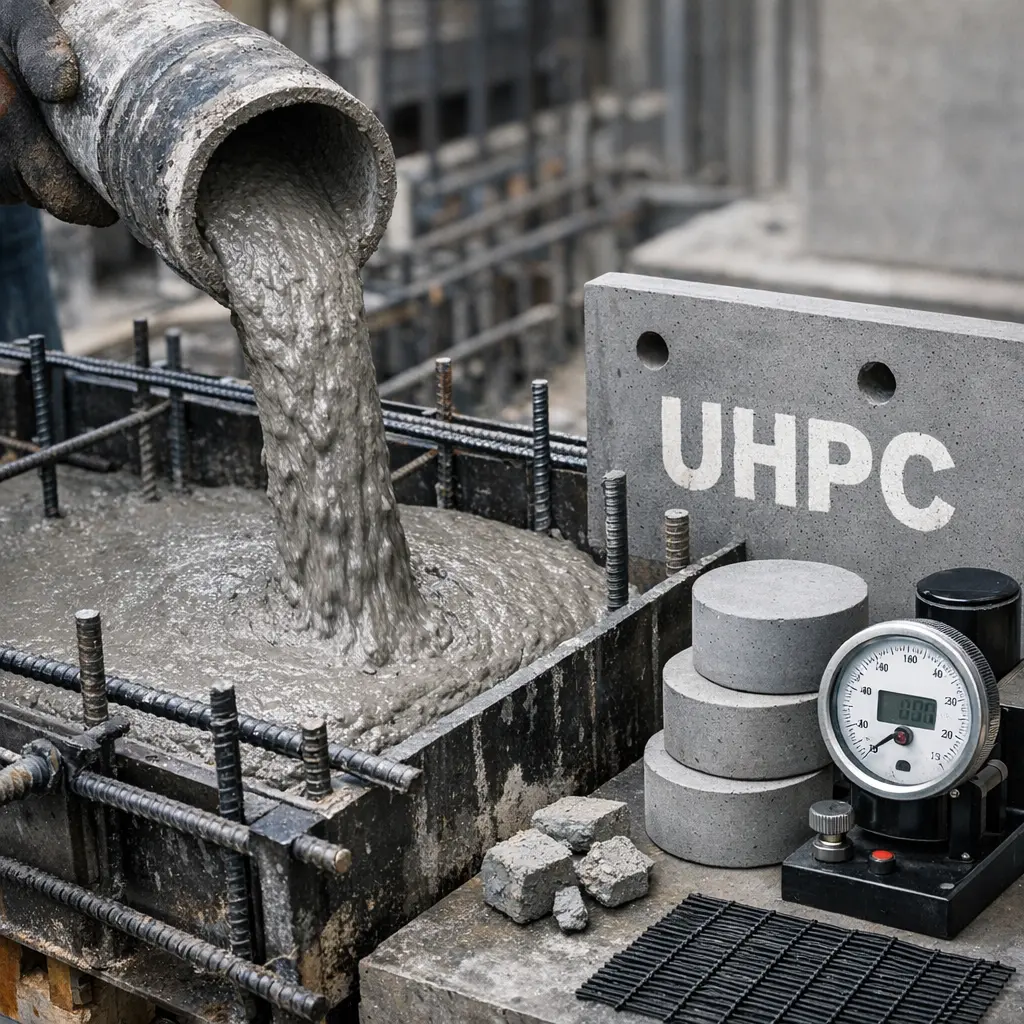
Ultra-High-Performance Concrete (UHPC) is an advanced construction material known for its exceptional strength, durability, and resilience compared to conventional concrete. It incorporates fine powders, fibers, and superplasticizers, resulting in a dense microstructure with superior mechanical properties and resistance to environmental degradation. UHPC is widely used in demanding infrastructure projects, such as bridges and high-rise buildings, where enhanced load-bearing capacity, longevity, and reduced maintenance are critical requirements.
Ultra-High-Performance Concrete (UHPC)
Ultra-High-Performance Concrete (UHPC) is an advanced construction material known for its exceptional strength, durability, and resilience compared to conventional concrete. It incorporates fine powders, fibers, and superplasticizers, resulting in a dense microstructure with superior mechanical properties and resistance to environmental degradation. UHPC is widely used in demanding infrastructure projects, such as bridges and high-rise buildings, where enhanced load-bearing capacity, longevity, and reduced maintenance are critical requirements.
💡 Key Takeaways
- Understand what UHPC is and how it differs from conventional concrete in strength, durability, and composition
- Identify the typical constituents of UHPC (advanced cementitious matrix, silica fume, micro-fillers, and fiber reinforcement) and their roles
- Recognize the key performance benefits of UHPC (high strength, ductility, low permeability, and enhanced durability) and where it adds value
- Describe common UHPC applications and the design and construction considerations, including curing, fiber distribution, and joints
- Discuss practical challenges and best practices for using UHPC, including cost implications, quality control, and testing
❓ Frequently Asked Questions
What is Ultra-High-Performance Concrete (UHPC)?
UHPC is an advanced cementitious material with exceptionally high strength and durability, achieved through refined particle packing, a very low water-to-cement ratio, and often fiber reinforcement (steel or synthetic).
How does UHPC differ from normal concrete?
UHPC typically offers much higher strength (often 150 MPa or more), far lower porosity, and greater toughness due to fibers and specialized admixtures, along with fine aggregates and precise mixing. It may also require controlled curing.
What are common fibers used in UHPC and their purpose?
Steel fibers or synthetic fibers (e.g., PVA) are added to improve post-crack toughness and ductility, enabling slender, more durable structural elements.
Where is UHPC typically used and what are its benefits?
UHPC is used in bridges, precast components, protective barriers, and other demanding structures. Benefits include very high strength, excellent durability, resistance to harsh environments, and the ability to design slimmer, longer-lasting members.