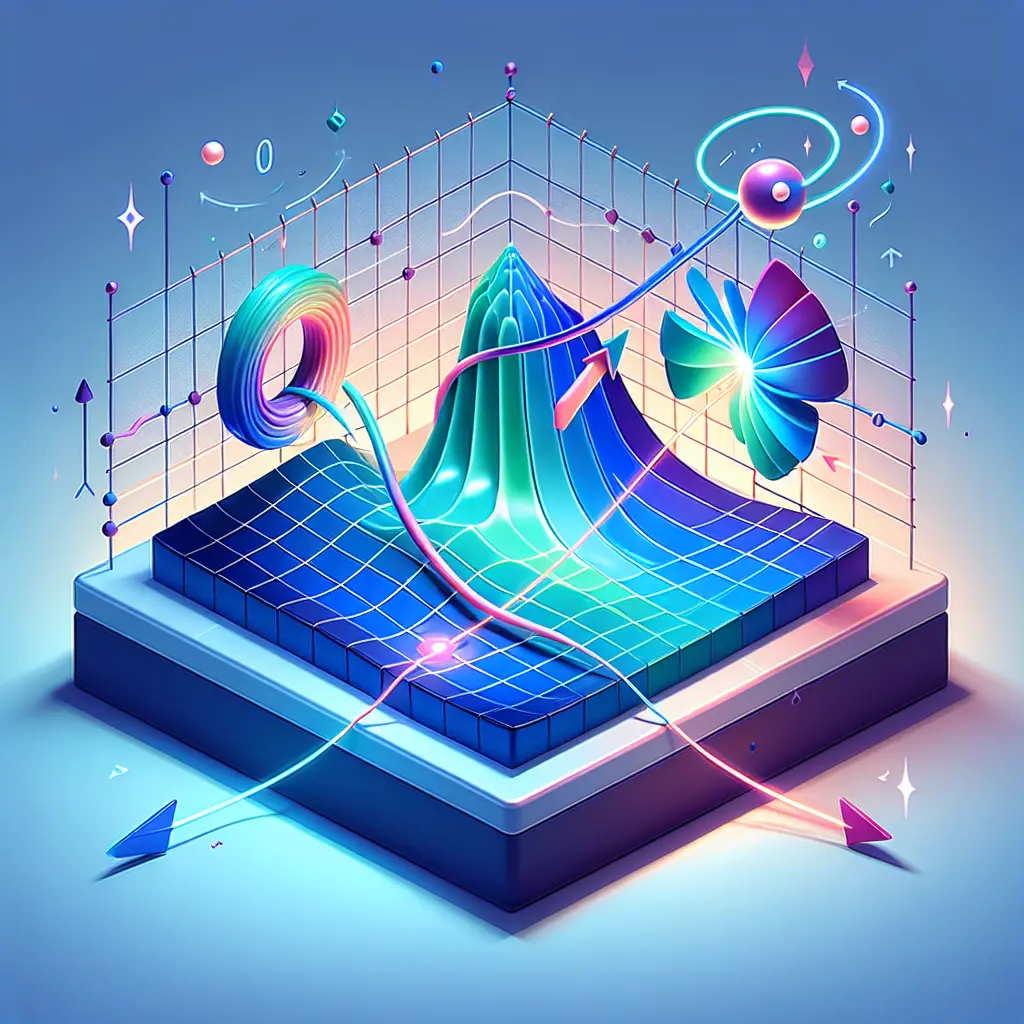
Vector calculus is a branch of mathematics focused on vector fields and differential operators. The gradient (grad) measures the rate and direction of change in a scalar field, producing a vector field. The divergence (div) quantifies the magnitude of a source or sink at a given point in a vector field, resulting in a scalar. The curl measures the rotation or swirling strength of a vector field, producing another vector field.
Vector Calculus: Grad, Div & Curl
Vector calculus is a branch of mathematics focused on vector fields and differential operators. The gradient (grad) measures the rate and direction of change in a scalar field, producing a vector field. The divergence (div) quantifies the magnitude of a source or sink at a given point in a vector field, resulting in a scalar. The curl measures the rotation or swirling strength of a vector field, producing another vector field.
💡 Key Takeaways
- Understand what grad, div, and curl represent in vector fields and how they differ (rate and direction of change, sources/sinks, and rotation).
- Learn to compute the gradient of a scalar field to find the direction of steepest ascent and the corresponding rate of change.
- Learn to compute the divergence of a vector field to quantify net outflow or inflow (sources and sinks) and relate it to flux through a surface.
- Learn to compute the curl of a vector field to measure local rotation or circulation and connect these ideas to foundational theorems like Stokes' and the Divergence Theorem.
❓ Frequently Asked Questions
What is the gradient (grad) and what does it tell you about a scalar field?
The gradient is a vector field pointing in the direction of the steepest increase of the scalar field; its magnitude is the rate of change in that direction and it is perpendicular to level sets.
What is the divergence (div) and what does it represent in a vector field?
Divergence is a scalar function that measures how much the field is expanding or contracting at a point. Positive divergence indicates a net outflow (a source), negative indicates a net inflow (a sink).
What is the curl and what does it indicate about a vector field?
Curl is a vector field that measures the local rotation or swirling of the field around a point; its direction is the axis of rotation and its magnitude is the rotation strength.
How are grad, div, and curl used in applications and related theorems?
Grad describes potential changes, div relates to flux and conservation laws, and curl describes rotation; they connect to integral theorems (Green's, Stokes', Divergence) that link local differential operators to global line and surface integrals.