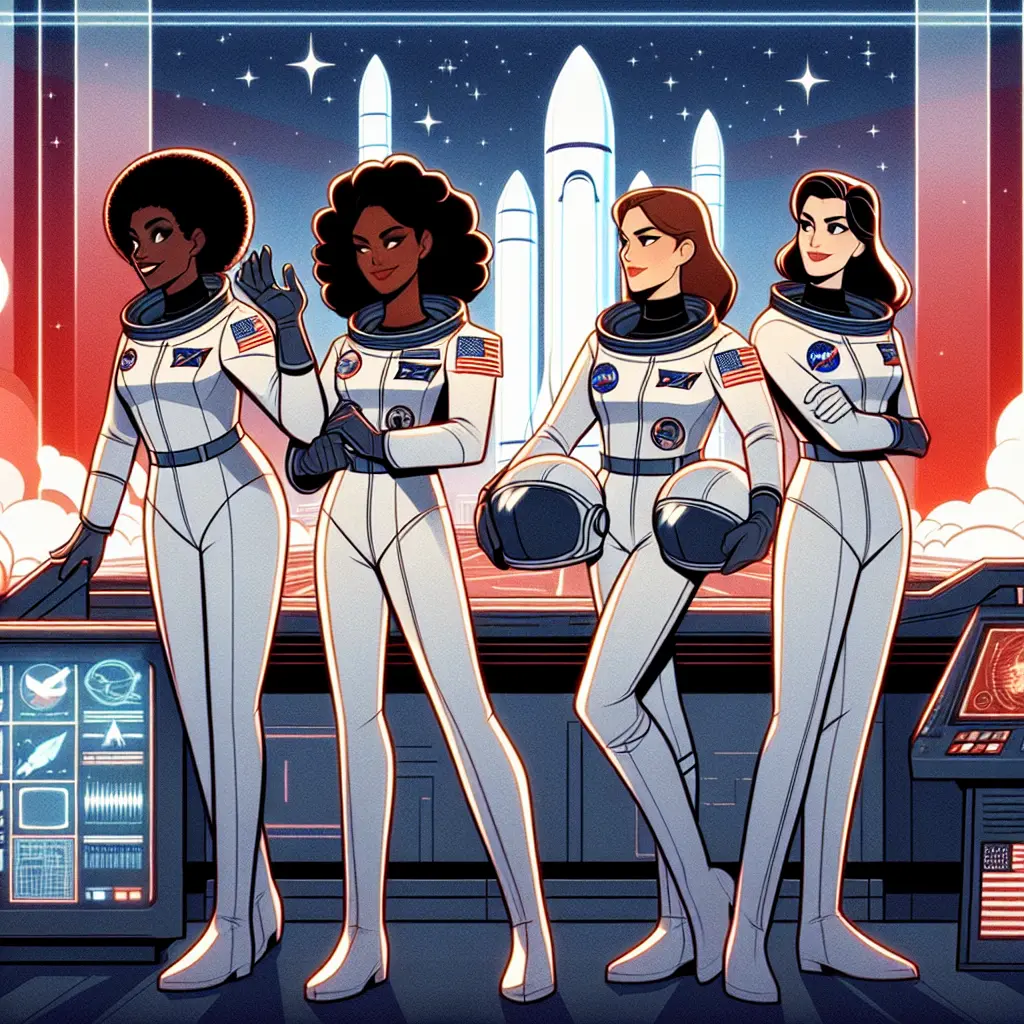
Women in American space programs have played crucial roles as astronauts, engineers, scientists, and mission specialists. Despite facing significant barriers and gender biases, pioneers like Sally Ride, the first American woman in space, and Katherine Johnson, a key mathematician, made groundbreaking contributions. Over time, women’s participation has grown, reflecting greater inclusivity and diversity within NASA and other agencies, inspiring future generations to pursue careers in space exploration and STEM fields.
Women in American Space Programs+50
Women in American space programs have played crucial roles as astronauts, engineers, scientists, and mission specialists. Despite facing significant barriers and gender biases, pioneers like Sally Ride, the first American woman in space, and Katherine Johnson, a key mathematician, made groundbreaking contributions. Over time, women’s participation has grown, reflecting greater inclusivity and diversity within NASA and other agencies, inspiring future generations to pursue careers in space exploration and STEM fields.
💡 Key Takeaways
- Understand the range of roles women have held in American space programs (astronauts, engineers, scientists, mission specialists).
- Explore the barriers and gender biases they faced and how pioneers like Sally Ride and Katherine Johnson challenged them.
- Learn about Sally Ride as the first American woman in space and Katherine Johnson's essential mathematical contributions to NASA missions.
- See how these contributions influenced NASA's missions and shaped ongoing efforts toward greater diversity in space exploration.
❓ Frequently Asked Questions
Who was the first American woman in space?
Sally Ride, who flew aboard the Space Shuttle in 1983 (STS-7), becoming the first American woman in space.
What is Katherine Johnson known for at NASA?
Katherine Johnson was a mathematician whose calculations helped ensure the success of early Mercury and Apollo missions.
Beyond astronauts, how have women contributed to American space programs?
They have served as engineers, scientists, mathematicians, and mission specialists, as well as in roles in design, software, and mission support.
What challenges did early women in American space programs face?
They faced significant gender biases and barriers, including limited opportunities and recognition, which they helped to overcome through their contributions.