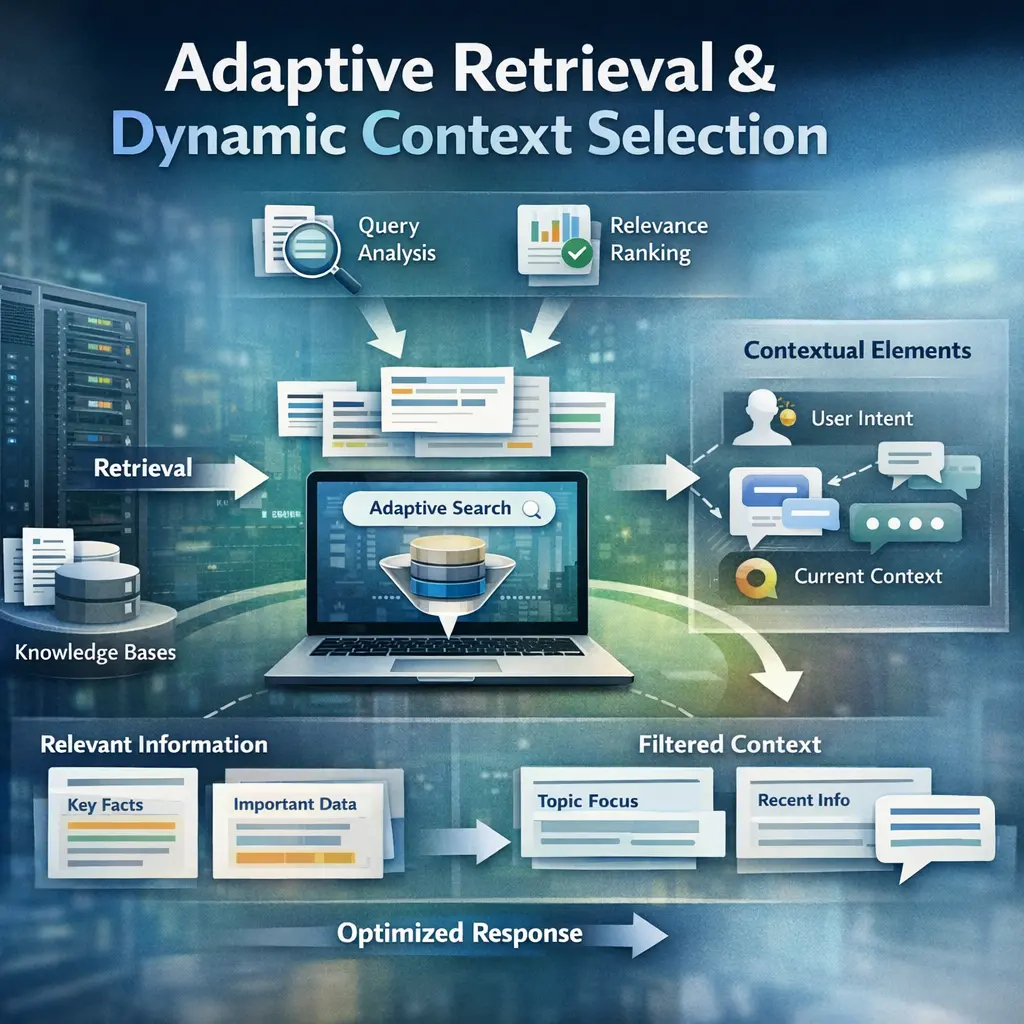
Adaptive Retrieval & Dynamic Context Selection (Advanced RAG Techniques) refer to sophisticated methods in Retrieval-Augmented Generation (RAG) systems that intelligently adjust how information is fetched and selected from external sources. Adaptive retrieval tailors search strategies based on query complexity or user intent, while dynamic context selection prioritizes the most relevant data segments for generation. Together, these techniques improve response accuracy, relevance, and efficiency in AI-driven question answering or content generation tasks.
Adaptive Retrieval & Dynamic Context Selection
Adaptive Retrieval & Dynamic Context Selection (Advanced RAG Techniques) refer to sophisticated methods in Retrieval-Augmented Generation (RAG) systems that intelligently adjust how information is fetched and selected from external sources. Adaptive retrieval tailors search strategies based on query complexity or user intent, while dynamic context selection prioritizes the most relevant data segments for generation. Together, these techniques improve response accuracy, relevance, and efficiency in AI-driven question answering or content generation tasks.
💡 Key Takeaways
- Understand what adaptive retrieval is and why using context improves search results.
- Learn how dynamic context selection determines the most relevant data to retrieve based on the query and user signals.
- Recognize common trade-offs in adaptive retrieval, such as latency, accuracy, and privacy considerations.
- Identify practical techniques for implementing dynamic context (e.g., re-ranking, context-aware indexing, and user intent inference).
❓ Frequently Asked Questions
What is adaptive retrieval?
Adaptive retrieval adjusts what information is fetched based on the query, user context, or feedback to improve relevance.
What is dynamic context selection?
Dynamic context selection chooses the most relevant set of contextual information (documents, snippets, or signals) to use when generating a response, and can change as the task or user needs evolve.
How do adaptive retrieval and dynamic context selection work together?
Together, they guide what data is searched and what context is used, enabling more accurate and efficient answers.
What are common benefits of using these techniques?
Benefits include higher relevance, faster responses, reduced noise from irrelevant data, and better scalability for large knowledge bases.