Advanced Statistical Mechanics: Phase Transitions explores the collective behavior of many-particle systems as they undergo abrupt changes, such as from liquid to gas or from paramagnetic to ferromagnetic states. This field examines critical phenomena, universality, and the mathematical frameworks—like the Ising model and renormalization group theory—that describe how microscopic interactions lead to macroscopic changes in physical properties, highlighting the emergence of order and critical points in complex systems.
Advanced Statistical Mechanics: Phase Transitions
Advanced Statistical Mechanics: Phase Transitions explores the collective behavior of many-particle systems as they undergo abrupt changes, such as from liquid to gas or from paramagnetic to ferromagnetic states. This field examines critical phenomena, universality, and the mathematical frameworks—like the Ising model and renormalization group theory—that describe how microscopic interactions lead to macroscopic changes in physical properties, highlighting the emergence of order and critical points in complex systems.
💡 Key Takeaways
- Understand how collective behavior in many-particle systems leads to abrupt phase changes (e.g., liquid–gas, paramagnetic–ferromagnetic).
- Learn about critical phenomena, scaling near the transition, and the idea of universality across different systems.
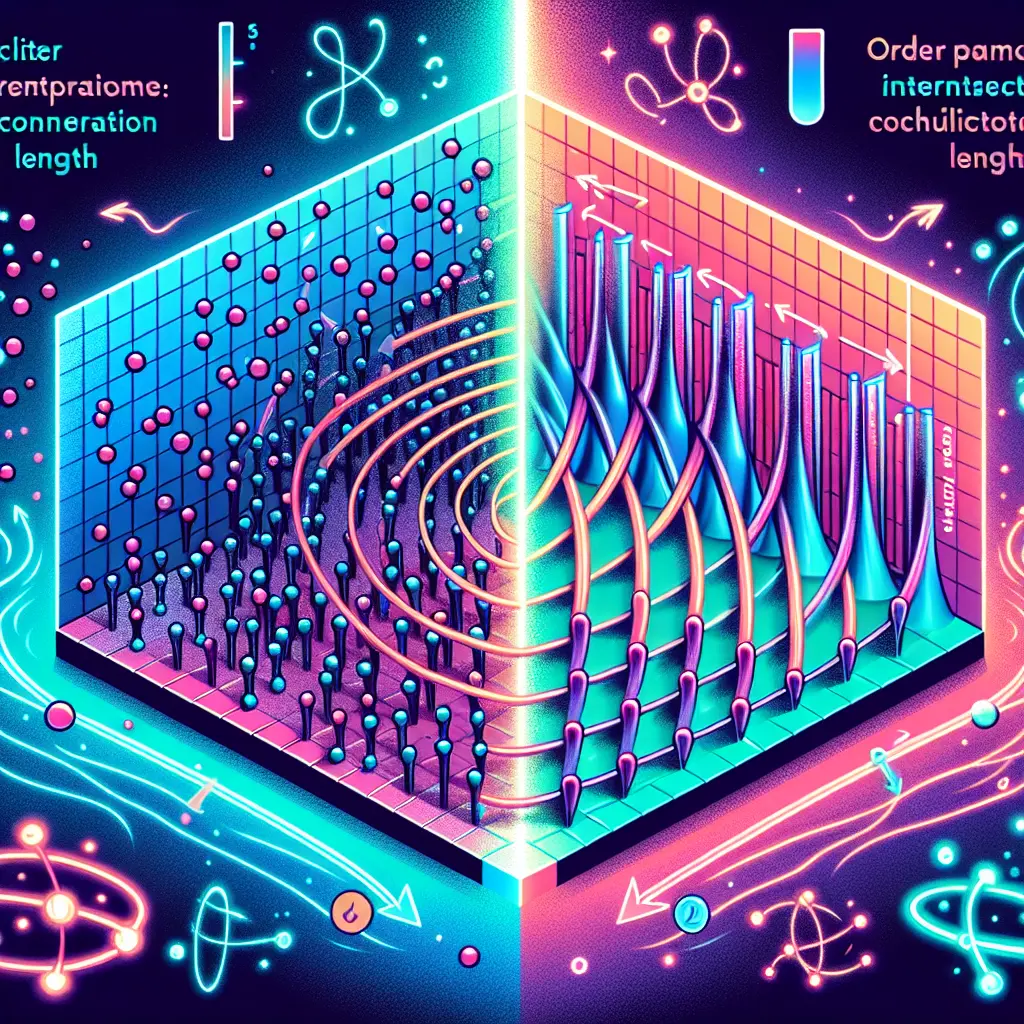
- Get introduced to key mathematical tools used to study phase transitions (order parameters, correlation length, and renormalization group concepts).
- Explore simple models like the Ising model to illustrate phase transitions and practice computing basic quantities such as magnetization and susceptibility.
❓ Frequently Asked Questions
What is a phase transition?
A qualitative change in a system's macroscopic properties as a control parameter (e.g., temperature) is varied, often accompanied by nonanalytic behavior in thermodynamic quantities in very large systems.
What is an order parameter?
A quantity that is zero in one phase and nonzero in another, used to distinguish phases (e.g., magnetization in ferromagnets or density difference in liquid-gas transitions).
What are critical phenomena and scaling?
Near a phase transition, fluctuations become large and correlation lengths grow without bound; observables follow power-law scaling characterized by critical exponents.
What is universality in phase transitions?
Different microscopic systems exhibit the same critical behavior (exponents and scaling) near the transition, determined by general features like dimensionality and symmetry rather than microscopic details.
What mathematical tools are used to study phase transitions?
Statistical ensembles and the partition function, thermodynamic potentials, and theoretical frameworks such as mean-field (Landau) theory and renormalization group to understand scaling and universality.