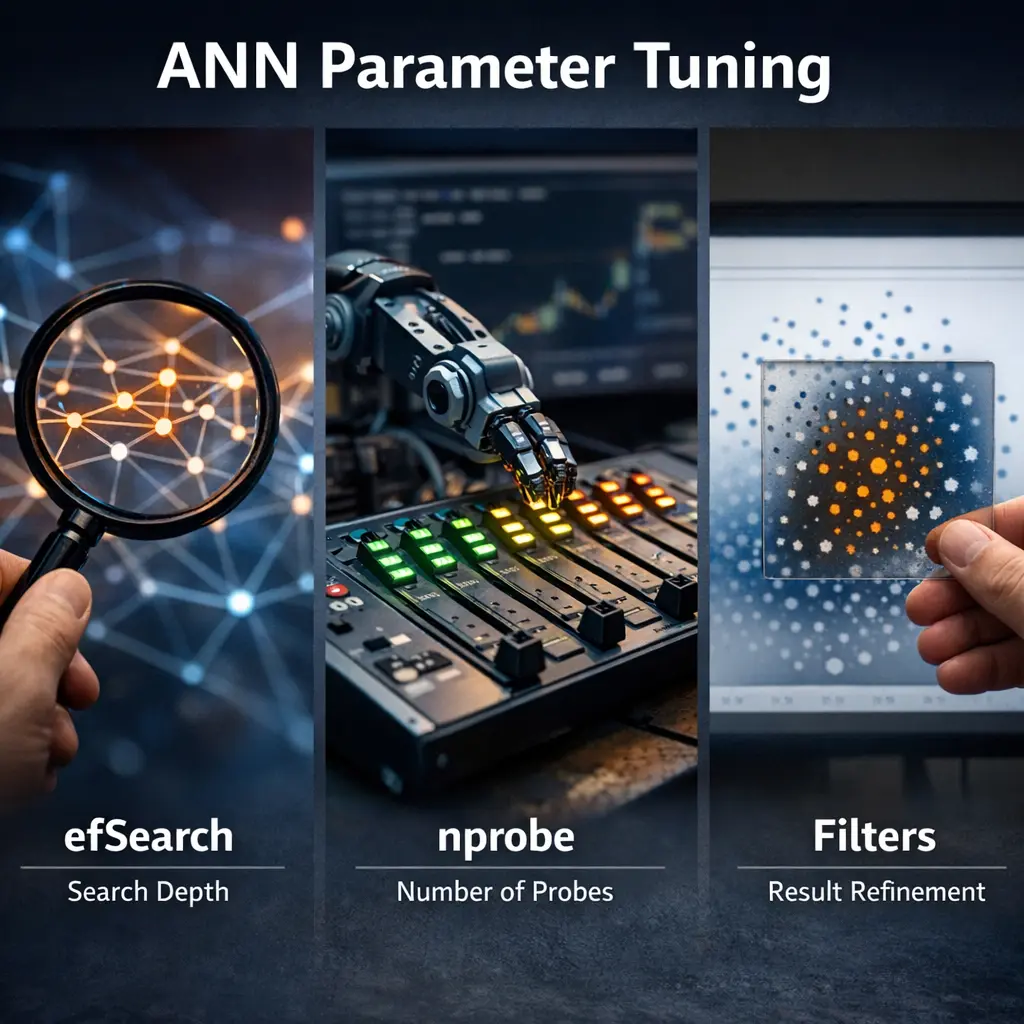
ANN parameter tuning involves optimizing settings like efSearch, nprobe, and filters to enhance retrieval performance in Approximate Nearest Neighbor (ANN) search, crucial for advanced Retrieval-Augmented Generation (RAG) techniques. efSearch (in HNSW) determines how many nodes are explored during search, affecting accuracy and speed. nprobe (in IVF-based methods) controls the number of clusters probed, balancing recall and efficiency. Filters apply additional constraints, refining search results for more relevant, context-aware retrieval.
ANN Parameter Tuning: efSearch, nprobe, filters
ANN parameter tuning involves optimizing settings like efSearch, nprobe, and filters to enhance retrieval performance in Approximate Nearest Neighbor (ANN) search, crucial for advanced Retrieval-Augmented Generation (RAG) techniques. efSearch (in HNSW) determines how many nodes are explored during search, affecting accuracy and speed. nprobe (in IVF-based methods) controls the number of clusters probed, balancing recall and efficiency. Filters apply additional constraints, refining search results for more relevant, context-aware retrieval.
💡 Key Takeaways
- Explain what efSearch controls in your ANN index and how it trades off accuracy for speed.
- Understand how nprobe determines how many coarse centers or clusters are explored during search and its impact on recall and latency.
- Learn how to apply filters to vector search to constrain results by metadata, attributes, or business rules.
- Follow a practical tuning workflow: establish a baseline, measure recall and latency, and adjust efSearch, nprobe, and filters iteratively to meet requirements.
❓ Frequently Asked Questions
What is efSearch and how does it affect ANN search?
efSearch controls the breadth of the search in some ANN indexes (e.g., HNSW/FAISS). Higher values explore more candidates, increasing recall accuracy but with higher latency and memory usage.
What is nprobe and how should I choose its value?
nprobe determines how many inverted lists (clusters) are checked during a query on IVF-based indices. Increasing nprobe generally improves recall and result quality but slows query times and uses more memory.
What are filters in ANN search and when should I use them?
Filters constrain results to items that meet certain metadata or attribute criteria (e.g., category, time, user segment). They improve relevance for constrained queries but may reduce recall if many items are filtered out.
How can I balance efSearch, nprobe, and filters for good performance?
Experiment incrementally: start with defaults, raise efSearch or nprobe when you need higher recall and can spare latency, and apply sensible filters to match constraints. Always test impact on accuracy, latency, and memory.