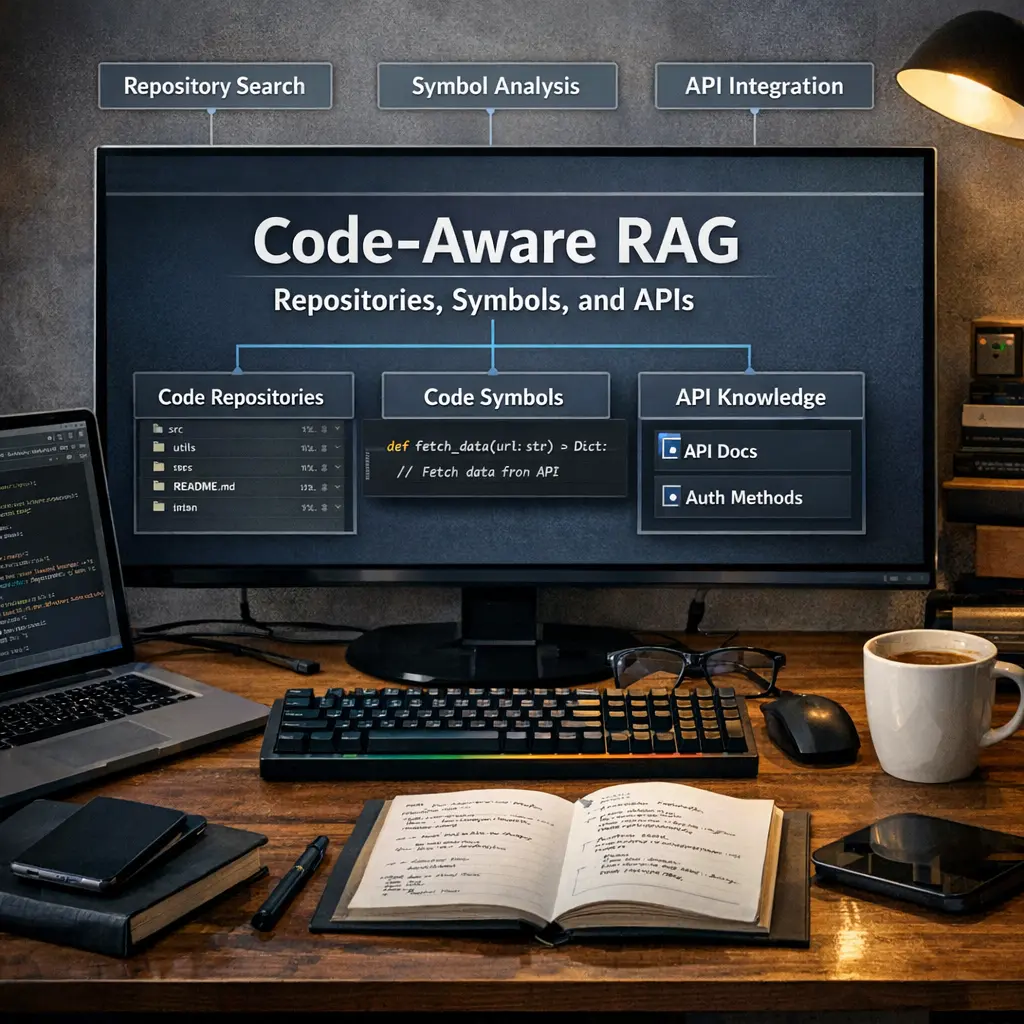
Code-Aware RAG enhances Retrieval-Augmented Generation by integrating code-specific knowledge, focusing on repositories, symbols, and APIs. It enables language models to retrieve and utilize relevant code snippets, documentation, and symbol definitions from large codebases. This approach improves code understanding, generation, and reasoning, allowing models to answer technical queries, suggest code completions, and provide accurate API usage by leveraging structured code data and contextual information during generation.
Code-Aware RAG: Repositories, Symbols, and APIs
Code-Aware RAG enhances Retrieval-Augmented Generation by integrating code-specific knowledge, focusing on repositories, symbols, and APIs. It enables language models to retrieve and utilize relevant code snippets, documentation, and symbol definitions from large codebases. This approach improves code understanding, generation, and reasoning, allowing models to answer technical queries, suggest code completions, and provide accurate API usage by leveraging structured code data and contextual information during generation.
💡 Key Takeaways
- Understand what Code-Aware RAG is and how repositories, symbols, and APIs ground code-based answers.
- Learn how code symbols (functions, classes, variables) are indexed and used to improve retrieval precision.
- Explore repository structure, versioning, and metadata that support effective RAG in coding tasks.
- See how APIs extend Code-Aware RAG by fetching external code sources and updating knowledge in real time.
❓ Frequently Asked Questions
What is Retrieval-Augmented Generation (RAG) in code contexts?
RAG combines a language model with a retrieval component that pulls relevant code, docs, or API references from repositories, then uses that evidence to generate accurate, source-backed responses.
What does "Code-Aware" mean in this context?
It means the system understands code structure, symbols, and APIs, so it can reference the correct identifiers and interfaces when retrieving and generating content.
What are repositories and why are they used?
Repositories are collections of source code and documentation, often versioned, used as sources for retrieval to provide real examples, API usage, and context.
What are symbols and APIs, and why do they matter for Code-Aware RAG?
Symbols are names for code elements (variables, functions, classes); APIs are the interfaces libraries expose. Recognizing them helps fetch precise examples and correct usage patterns.