Construction software applications are digital tools designed to manage, organize, and streamline various aspects of construction projects. These applications facilitate tasks such as project planning, scheduling, budgeting, document management, collaboration, and real-time communication among stakeholders. By centralizing construction information and automating workflows, they enhance efficiency, accuracy, and transparency throughout the project lifecycle, ultimately improving productivity and reducing errors or delays in construction processes.
Construction Software Applications+50
Construction software applications are digital tools designed to manage, organize, and streamline various aspects of construction projects. These applications facilitate tasks such as project planning, scheduling, budgeting, document management, collaboration, and real-time communication among stakeholders. By centralizing construction information and automating workflows, they enhance efficiency, accuracy, and transparency throughout the project lifecycle, ultimately improving productivity and reducing errors or delays in construction processes.
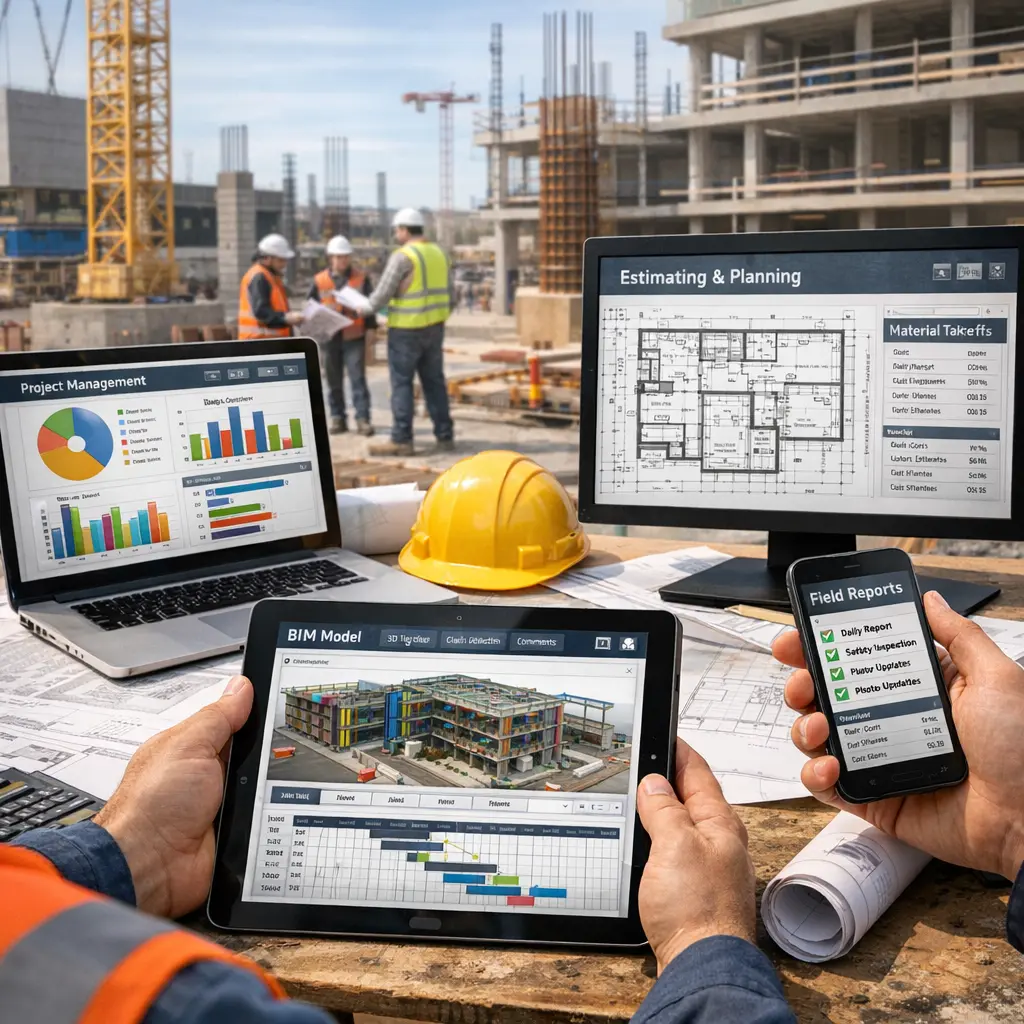
💡 Key Takeaways
- Identify the main categories of construction software (BIM, project management, estimating, scheduling) and how they differ.
- Understand how construction software improves collaboration between field teams and office staff.
- Recognize essential features like cost estimation, subcontractor management, document control, and progress tracking.
- Learn how to select and implement construction software that fits your project needs and workflow.
❓ Frequently Asked Questions
What is construction software?
A suite of tools to plan, design, estimate, schedule, coordinate, and document construction projects, from initial modeling to on-site reporting.
What are common categories of construction software?
Design/modeling (CAD/BIM), estimating and cost control, project management and scheduling, field data collection and documentation, procurement/ERP, safety and compliance, and collaboration platforms.
How does BIM differ from CAD in construction?
CAD creates drawings and 3D models; BIM adds data about components, quantities, properties, and enables cross-team coordination with shared information.
What features should I look for in a construction project management tool?
Task scheduling, issue tracking, document control, RFI/submittal workflows, field reporting, progress tracking, and mobile/cloud access with data integration.
What is interoperability and why is it important in construction software?
Interoperability is the ability of different software to exchange data smoothly. It matters for avoiding data loss and ensuring teams can share models, drawings, and schedules.