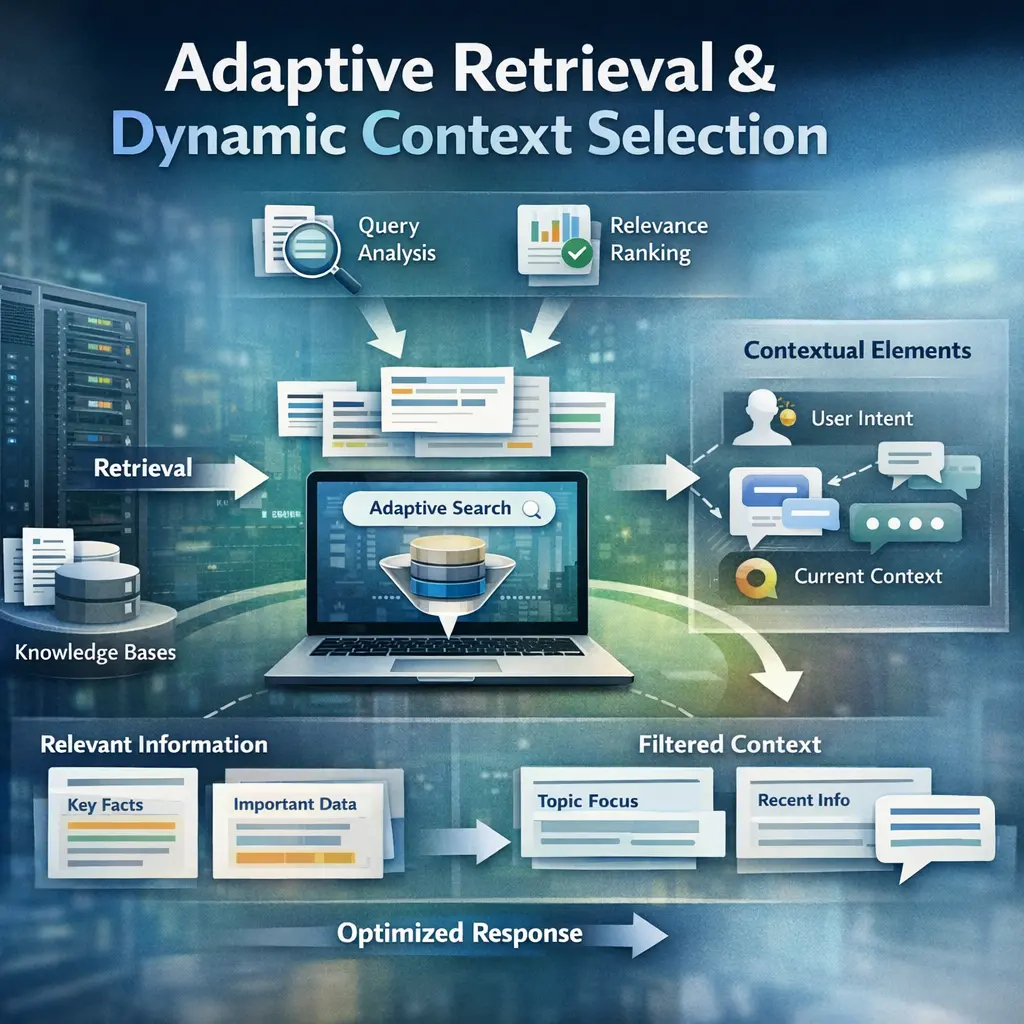
Context Window Management and Token Budgets in advanced Retrieval-Augmented Generation (RAG) techniques involve optimizing how much information (tokens) can be processed by language models at once. Effective management ensures that relevant context is included without exceeding the model's token limit, which is crucial for maintaining coherence and accuracy in responses. Advanced strategies dynamically select, compress, or prioritize information, balancing detail and efficiency to maximize performance within the constraints of the model’s context window.
Context Window Management and Token Budgets+50
Context Window Management and Token Budgets in advanced Retrieval-Augmented Generation (RAG) techniques involve optimizing how much information (tokens) can be processed by language models at once. Effective management ensures that relevant context is included without exceeding the model's token limit, which is crucial for maintaining coherence and accuracy in responses. Advanced strategies dynamically select, compress, or prioritize information, balancing detail and efficiency to maximize performance within the constraints of the model’s context window.

💡 Key Takeaways
- Define what a context window is in language models and why it matters for input length.
- Explain how token budgets cap the total tokens available for prompts and responses in a session.
- Explore techniques to maximize usable context, such as summarization, chunking, and retrieval-augmented generation.
- Compare strategies for managing context under tight token budgets, including truncation, careful prompt design, and incremental/streaming generation.
❓ Frequently Asked Questions
What is a context window?
The context window is the maximum number of tokens a model can consider in a single prompt plus its reply. It limits how much history or content can influence the answer.
What is a token budget?
The token budget is the total number of tokens allowed for both input and output in one interaction. If you exceed it, the model may truncate the response or ignore older content.
How do these limits affect a quiz article?
If the quiz text or history is longer than the context window, earlier details may be forgotten. To mitigate this, prioritize relevant information, summarize longer passages, or split the quiz into smaller parts.
How can I manage token budgets effectively?
Use concise prompts, summarize long passages, and break tasks into steps. Monitor token usage and request shorter responses to stay within the budget.