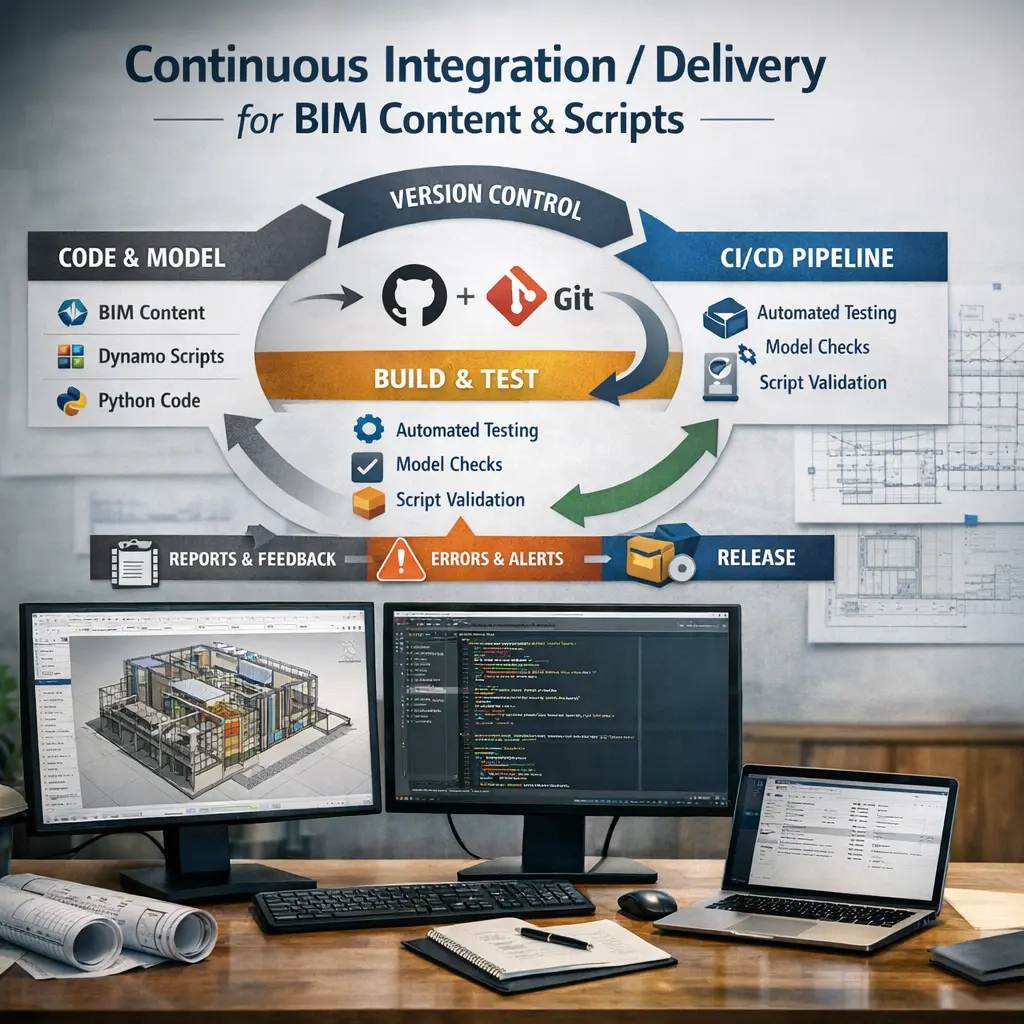
Continuous Integration/Delivery (CI/CD) for BIM content and scripts refers to the automated process of regularly updating, testing, and deploying Building Information Modeling assets and automation scripts within digital construction applications. This approach ensures that BIM data, tools, and workflows remain current, consistent, and error-free, enabling efficient collaboration among project stakeholders and reducing manual intervention. Ultimately, CI/CD enhances productivity, quality, and reliability in managing construction information digitally.
Continuous Integration/Delivery for BIM Content and Scripts
Continuous Integration/Delivery (CI/CD) for BIM content and scripts refers to the automated process of regularly updating, testing, and deploying Building Information Modeling assets and automation scripts within digital construction applications. This approach ensures that BIM data, tools, and workflows remain current, consistent, and error-free, enabling efficient collaboration among project stakeholders and reducing manual intervention. Ultimately, CI/CD enhances productivity, quality, and reliability in managing construction information digitally.
💡 Key Takeaways
- Understand how CI/CD concepts apply to BIM content and automation scripts
- Learn to automate builds, tests, and validation for BIM assets (families, templates) and Dynamo scripts
- Discover version control and artifact management practices for BIM content
- Implement automated checks for model integrity, metadata consistency, and script reliability
- Plan seamless deployment of BIM content to project environments and collaboration platforms
❓ Frequently Asked Questions
What is CI/CD for BIM content and scripts?
CI/CD automates building, testing, validating, and delivering BIM assets (like Revit families) and Dynamo/Python scripts whenever changes occur, ensuring quality and up-to-date libraries across projects.
What types of BIM assets are managed in a CI/CD pipeline?
Artifacts include Revit families (RFA/RVT), templates, Dynamo graphs, Python scripts, add-ins, metadata, and packaged content, along with supporting documentation and version notes.
How can BIM content and scripts be tested automatically?
Run automated checks in CI: verify parameter ranges and naming conventions, ensure metadata completeness, perform geometry sanity checks, validate Dynamo graphs on test models, and test compatibility across target software versions.
How is deployment handled in a BIM CI/CD pipeline?
Upon successful tests, publish artifacts to central libraries (e.g., BIM 360/Forge or shared network folders), update versioned packages, and notify downstream projects or teams.
Which tools are commonly used for BIM CI/CD?
Git hosting (GitHub/GitLab/Bitbucket), CI systems (GitHub Actions, Azure DevOps, Jenkins), Dynamo for scripts, and Autodesk Forge/BIM 360 for publishing and distribution.