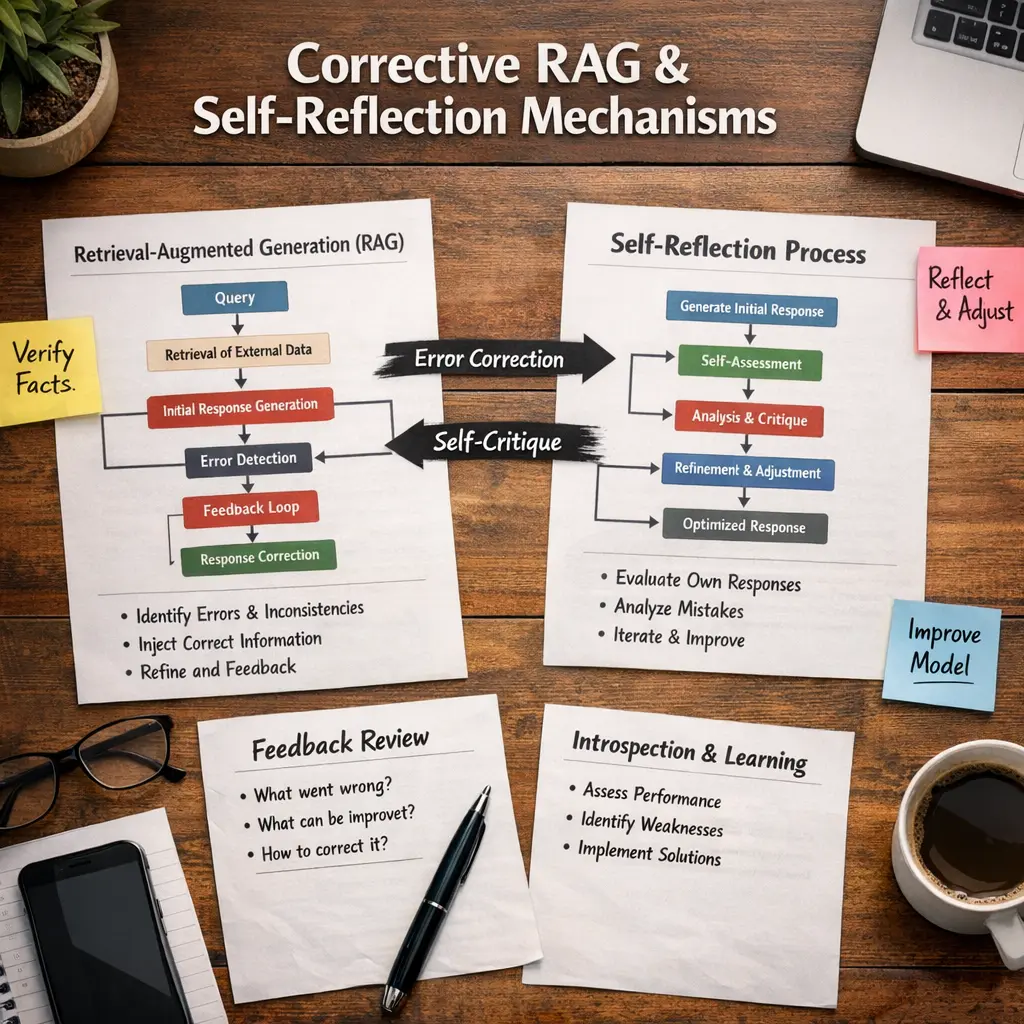
Corrective RAG and self-reflection mechanisms refer to advanced Retrieval-Augmented Generation (RAG) techniques that enhance the accuracy and reliability of AI-generated responses. Corrective RAG involves real-time adjustments to retrieved information, ensuring that outputs are contextually appropriate and factually correct. Self-reflection mechanisms enable the model to evaluate its own responses, identify potential errors or inconsistencies, and iteratively improve its answers, leading to more robust and trustworthy AI systems.
Corrective RAG & Self-Reflection Mechanisms
Corrective RAG and self-reflection mechanisms refer to advanced Retrieval-Augmented Generation (RAG) techniques that enhance the accuracy and reliability of AI-generated responses. Corrective RAG involves real-time adjustments to retrieved information, ensuring that outputs are contextually appropriate and factually correct. Self-reflection mechanisms enable the model to evaluate its own responses, identify potential errors or inconsistencies, and iteratively improve its answers, leading to more robust and trustworthy AI systems.
💡 Key Takeaways
- Understand corrective RAG (Retrieval-Augmented Generation) and how retrieval and self-correction steer model outputs.
- Learn how self-reflection mechanisms enable a model to critique and revise its own answers.
- Explore practical prompts and workflows to implement corrective RAG in real applications.
- Identify evaluation methods and common pitfalls (accuracy, latency, overreliance on retrieved data) when using corrective RAG.
❓ Frequently Asked Questions
What is Retrieval-Augmented Generation (RAG)?
A framework that pairs a language model with a document retriever; it fetches relevant sources and uses them to ground the model’s answers.
What does Corrective RAG mean?
A RAG variant that includes error-detection and correction loops—if the initial answer is uncertain or contradicted by sources, it revises using additional retrieval or feedback.
What are self-reflection mechanisms in AI?
Techniques that let the model assess its own outputs, explain its reasoning, and propose corrections before delivering the final answer.
How do Corrective RAG and Self-Reflection work together?
The system retrieves evidence, generates an answer, then reflects on its quality; if needed, it re-retrieves, revises, or cites sources to improve accuracy.
When should you use these approaches?
In tasks requiring up-to-date, factual information or high reliability, they help reduce hallucinations and improve trust, but require good sources and validation.