Cost Modeling and Throughput Benchmarking in advanced Retrieval-Augmented Generation (RAG) techniques involve analyzing and optimizing the expenses and efficiency associated with deploying RAG systems. Cost modeling assesses resource usage, such as computational power and storage, to estimate operational costs. Throughput benchmarking measures the system’s ability to process queries or generate outputs within a specific time frame. Together, these techniques guide informed decisions for scalable, high-performing, and cost-effective RAG implementations.
Cost Modeling and Throughput Benchmarking
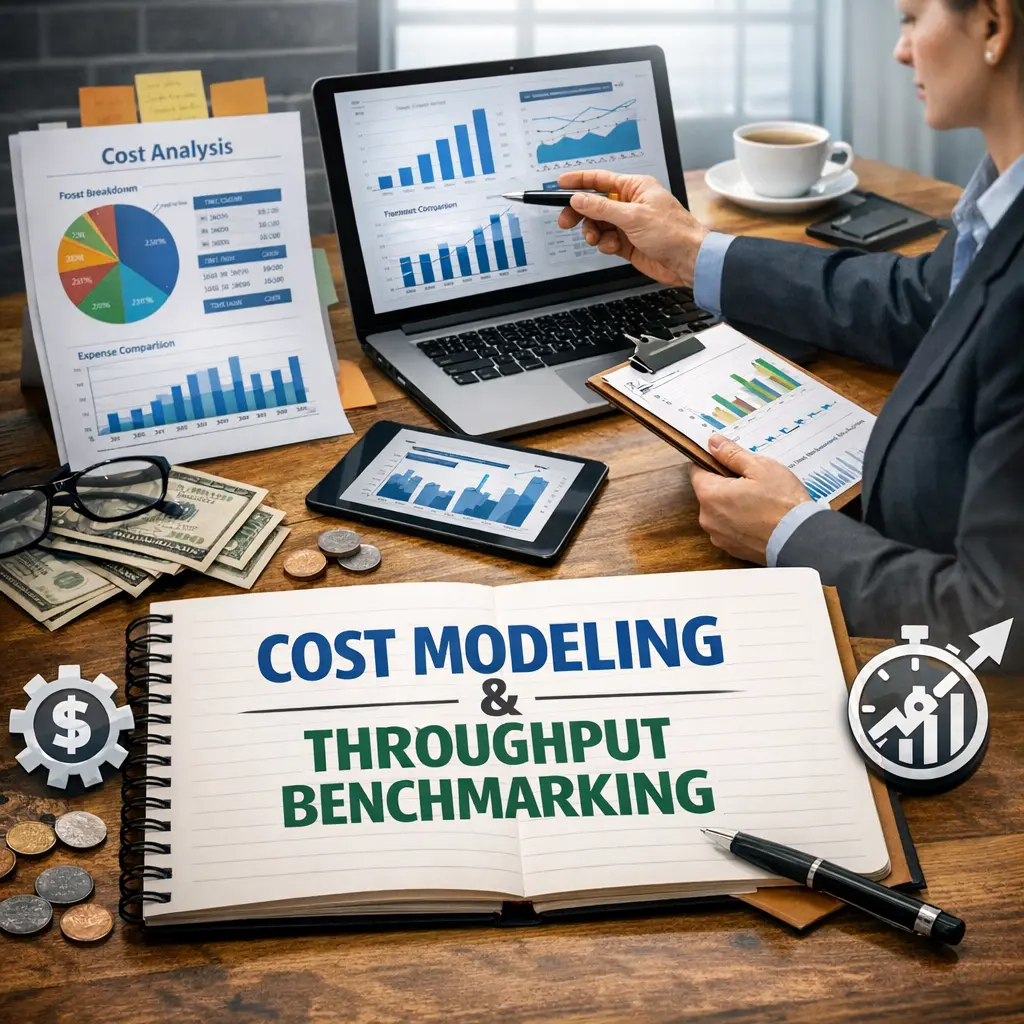
Cost Modeling and Throughput Benchmarking in advanced Retrieval-Augmented Generation (RAG) techniques involve analyzing and optimizing the expenses and efficiency associated with deploying RAG systems. Cost modeling assesses resource usage, such as computational power and storage, to estimate operational costs. Throughput benchmarking measures the system’s ability to process queries or generate outputs within a specific time frame. Together, these techniques guide informed decisions for scalable, high-performing, and cost-effective RAG implementations.
💡 Key Takeaways
- Understand the basics of cost modeling (fixed vs. variable costs) and how they scale with throughput.
- Learn how to define and measure throughput benchmarks (throughput rate, latency, and resource utilization) to identify bottlenecks.
- Explore scenarios for scaling and balancing cost (capex vs. opex) against throughput targets.
- Develop the ability to translate benchmark results into actionable optimization decisions for cost-per-unit throughput.
❓ Frequently Asked Questions
What is cost modeling in the context of this quiz?
Cost modeling estimates all costs associated with a solution (hardware, software, cloud usage, operations, energy, maintenance) over time to compare options and inform budgeting.
What is throughput benchmarking and what does it measure?
Throughput benchmarking measures how many work items a system can process in a given time under defined conditions (e.g., requests/sec, transactions/min) to compare performance.
How are cost modeling and throughput benchmarking connected?
They are linked by cost per unit of throughput. By comparing total cost to achieved throughput, you can assess value, scalability, and break-even points.
What data is needed to perform these analyses?
You need workload profiles, target throughput, resource usage, pricing (cloud, hardware, maintenance), energy costs, and reliability/uptime data.