Cross-Region Replication and Geo-Routing for Low Latency in Retrieval-Augmented Generation (RAG) refers to distributing and synchronizing data or models across multiple geographic regions. This setup ensures that user queries are routed to the nearest server, reducing response times. By replicating retrieval and generation resources globally and using geo-routing, RAG systems can deliver faster, more reliable access to relevant information, enhancing user experience regardless of location.
Cross-Region Replication and Geo-Routing for Low Latency
Cross-Region Replication and Geo-Routing for Low Latency in Retrieval-Augmented Generation (RAG) refers to distributing and synchronizing data or models across multiple geographic regions. This setup ensures that user queries are routed to the nearest server, reducing response times. By replicating retrieval and generation resources globally and using geo-routing, RAG systems can deliver faster, more reliable access to relevant information, enhancing user experience regardless of location.
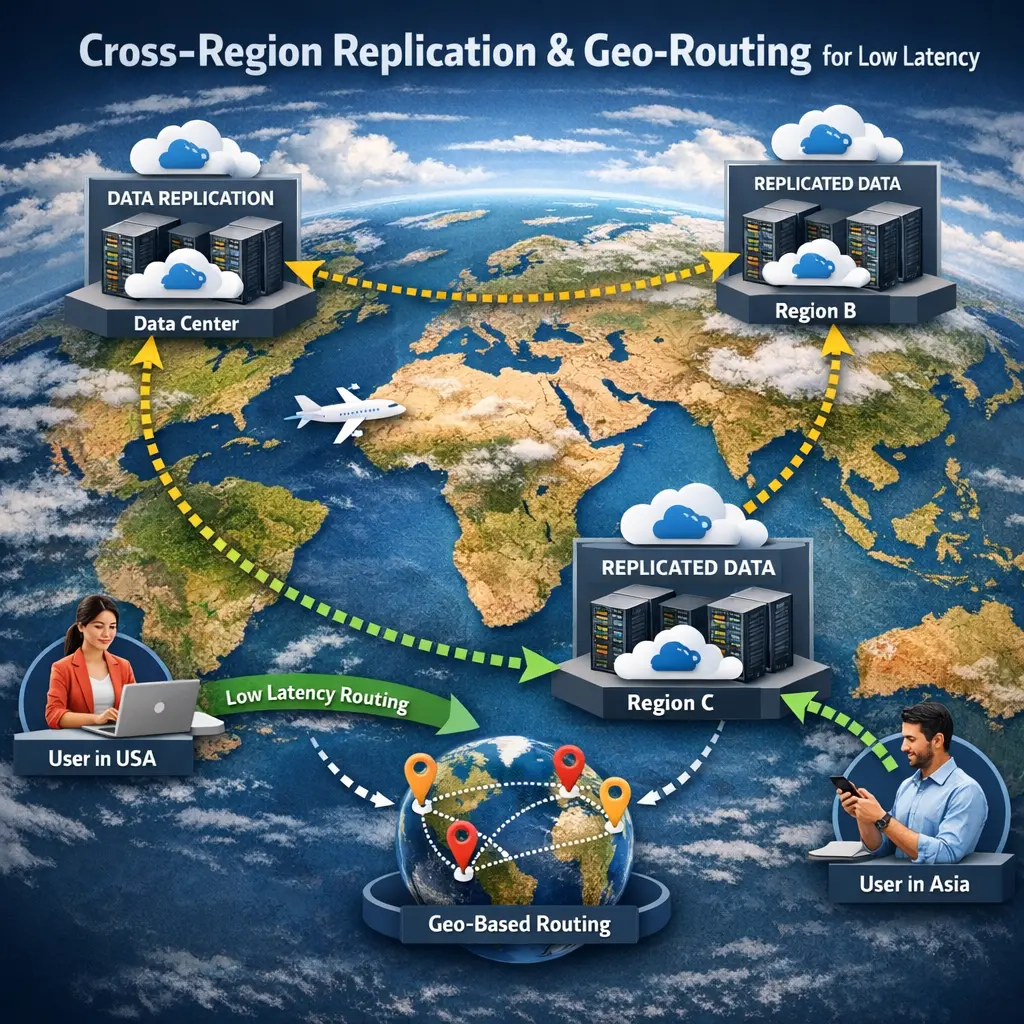
💡 Key Takeaways
- Cross-region replication (CRR) helps keep data copies in multiple regions for availability, disaster recovery, and data sovereignty, with replication lag to consider.
- Geo-routing directs user requests to the closest or lowest-latency region to reduce round-trip time, often via DNS or CDN edge routing.
- Differentiate latency-based routing from geographic (geolocation) routing and know when to apply each in your infrastructure (and how they interact with CRR).
- Account for trade-offs such as replication lag, consistency models, cross-region transfer costs, and regulatory requirements; plan monitoring and testing to ensure consistently low latency.
❓ Frequently Asked Questions
What is cross-region replication (CRR)?
A strategy to automatically copy data from a primary region to one or more secondary regions to improve availability, durability, and disaster recovery.
How does geo-routing improve user experience?
It directs user requests to the nearest or best-performing region, reducing latency and speeding up responses.
What are common geo-routing approaches?
DNS-based routing (geolocation or latency-based), edge/CDN routing with Anycast, or application-level routing using regional endpoints.
What should you consider when using CRR and geo-routing?
Data sovereignty and compliance, replication lag and costs, potential consistency concerns, and the need for monitoring and failover testing.