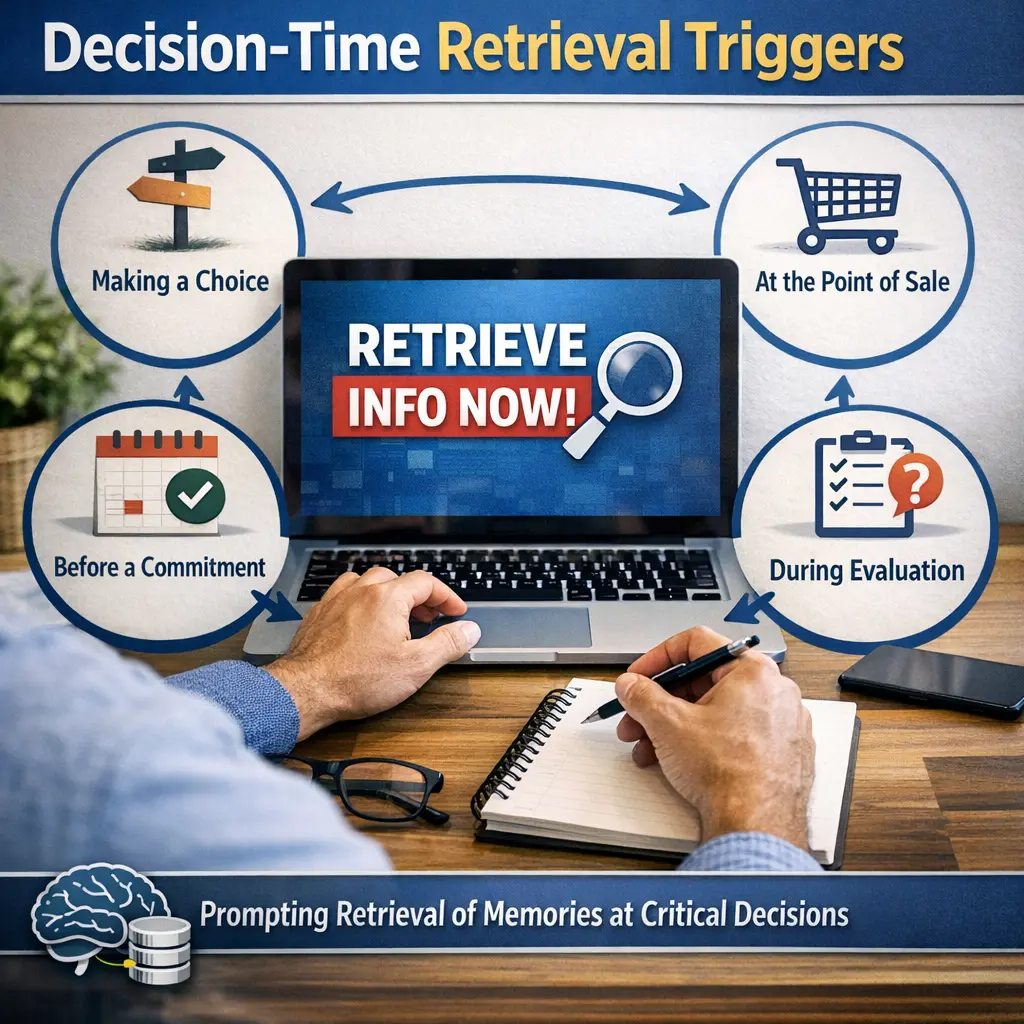
Decision-Time Retrieval Triggers in Advanced RAG (Retrieval-Augmented Generation) techniques refer to mechanisms that dynamically determine when to retrieve external information during the generation process. Instead of always fetching data at fixed steps, these triggers use contextual cues, model uncertainty, or user prompts to initiate retrieval only when necessary. This approach optimizes resource use, improves response relevance, and enables more adaptive, efficient integration of external knowledge into language model outputs.
Decision-Time Retrieval Triggers
Decision-Time Retrieval Triggers in Advanced RAG (Retrieval-Augmented Generation) techniques refer to mechanisms that dynamically determine when to retrieve external information during the generation process. Instead of always fetching data at fixed steps, these triggers use contextual cues, model uncertainty, or user prompts to initiate retrieval only when necessary. This approach optimizes resource use, improves response relevance, and enables more adaptive, efficient integration of external knowledge into language model outputs.
💡 Key Takeaways
- Understand what decision-time retrieval triggers are and why they influence the speed and accuracy of choices.
- Identify common internal triggers (goals, uncertainty, stakes) and external triggers (environment cues, prompts) that prompt retrieval during decisions.
- Learn how to design routines or decision aids that create effective retrieval cues at the moment of decision.
- Apply retrieval-practice principles to improve decision quality and consistency, while reducing cognitive biases.
❓ Frequently Asked Questions
What is decision-time retrieval?
Retrieving relevant memories or knowledge at the moment you need to make a decision, guided by cues and the task context.
What kinds of triggers act at decision time?
Internal cues (uncertainty, recognition) and external cues (context, prompts, new information) that prompt recall.
Why are decision-time retrieval triggers important in a quiz?
They help you recall the right information quickly, improving accuracy and reducing guesswork under time pressure.
How can you improve your use of decision-time retrieval triggers?
Practice retrieval in context, create strong cue associations, study with prompts that resemble test questions, and space your practice.
How is decision-time retrieval different from initial learning and long-term memory?
Initial learning is encoding new facts; decision-time retrieval is recalling those facts when needed, often under time constraints and influenced by cues.