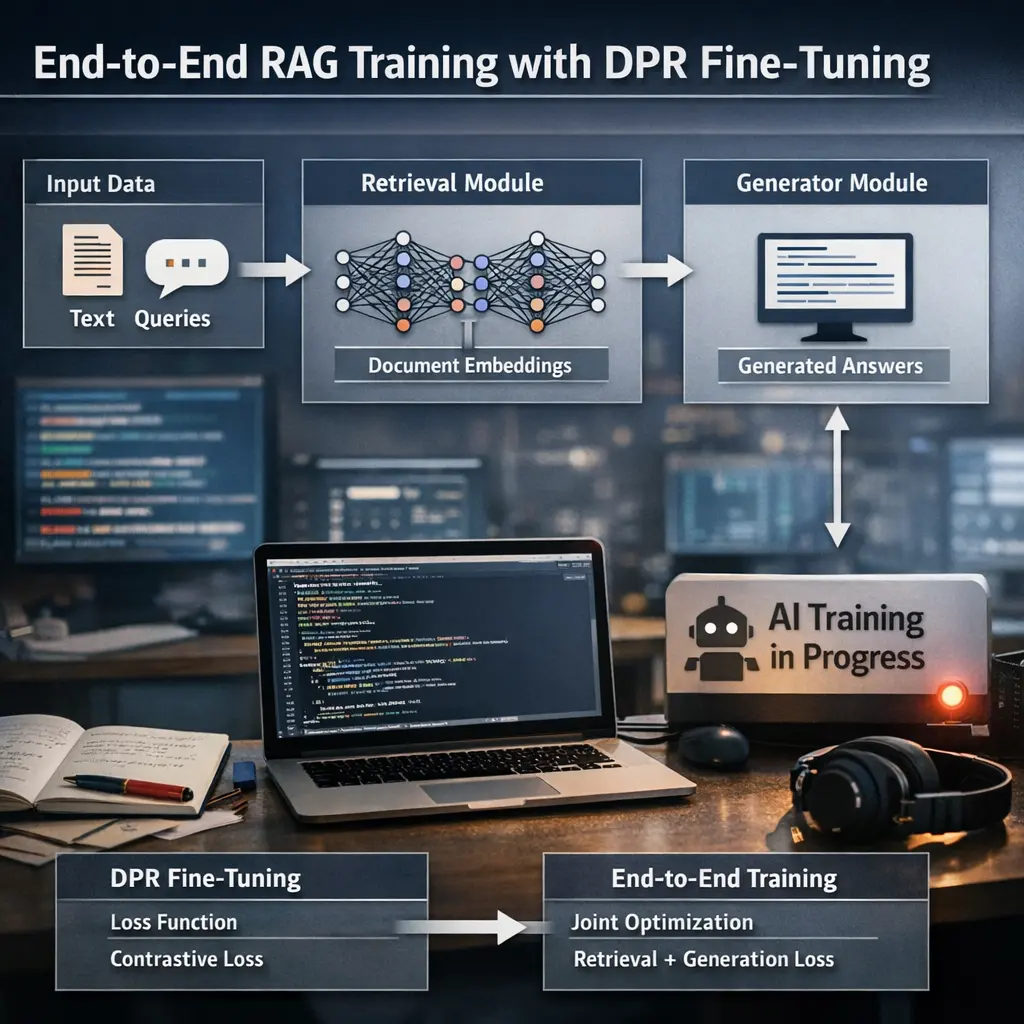
End-to-End RAG Training with DPR Fine-Tuning (Advanced RAG Techniques) refers to a comprehensive process where a Retrieval-Augmented Generation (RAG) model is trained holistically, integrating both its retriever and generator components. In this approach, the Dense Passage Retriever (DPR) is fine-tuned alongside the generator, allowing the system to better select and utilize relevant documents during generation. This advanced method enhances answer accuracy and relevance by optimizing retrieval and generation in tandem.
End-to-End RAG Training with DPR Fine-Tuning
End-to-End RAG Training with DPR Fine-Tuning (Advanced RAG Techniques) refers to a comprehensive process where a Retrieval-Augmented Generation (RAG) model is trained holistically, integrating both its retriever and generator components. In this approach, the Dense Passage Retriever (DPR) is fine-tuned alongside the generator, allowing the system to better select and utilize relevant documents during generation. This advanced method enhances answer accuracy and relevance by optimizing retrieval and generation in tandem.
💡 Key Takeaways
- Understand the end-to-end RAG training workflow and how the retriever (DPR) and generator interact
- Fine-tune Dense Passage Retrieval (DPR) to improve document retrieval quality for RAG
- Integrate retriever and generator components in an end-to-end training loop and monitor retrieval impact
- Evaluate RAG performance, diagnose retrieval/generation bottlenecks, and apply practical DPR fine-tuning tips
❓ Frequently Asked Questions
What is Retrieval-Augmented Generation (RAG)?
RAG combines a retriever that fetches relevant documents with a generator that uses those documents to produce grounded, more factual answers.
What is Dense Passage Retrieval (DPR)?
DPR encodes questions and passages into dense vectors and retrieves passages by vector similarity, enabling scalable retrieval over large corpora.
What does end-to-end training mean in RAG with DPR fine-tuning?
End-to-end training jointly updates both the retriever and the generator so retrieved passages best support the final answer, often through a unified optimization objective.
What are common steps to fine-tune DPR in an end-to-end RAG setup?
Prepare a QA dataset with contexts, choose a RAG variant (e.g., RAG-Token), initialize retriever and generator, define a joint loss, and train while monitoring retrieval quality and answer accuracy.
What are typical challenges in end-to-end RAG with DPR fine-tuning?
High computational and memory requirements, domain adaptation needs, stability of joint training, and ensuring retrieved passages truly improve factual correctness.