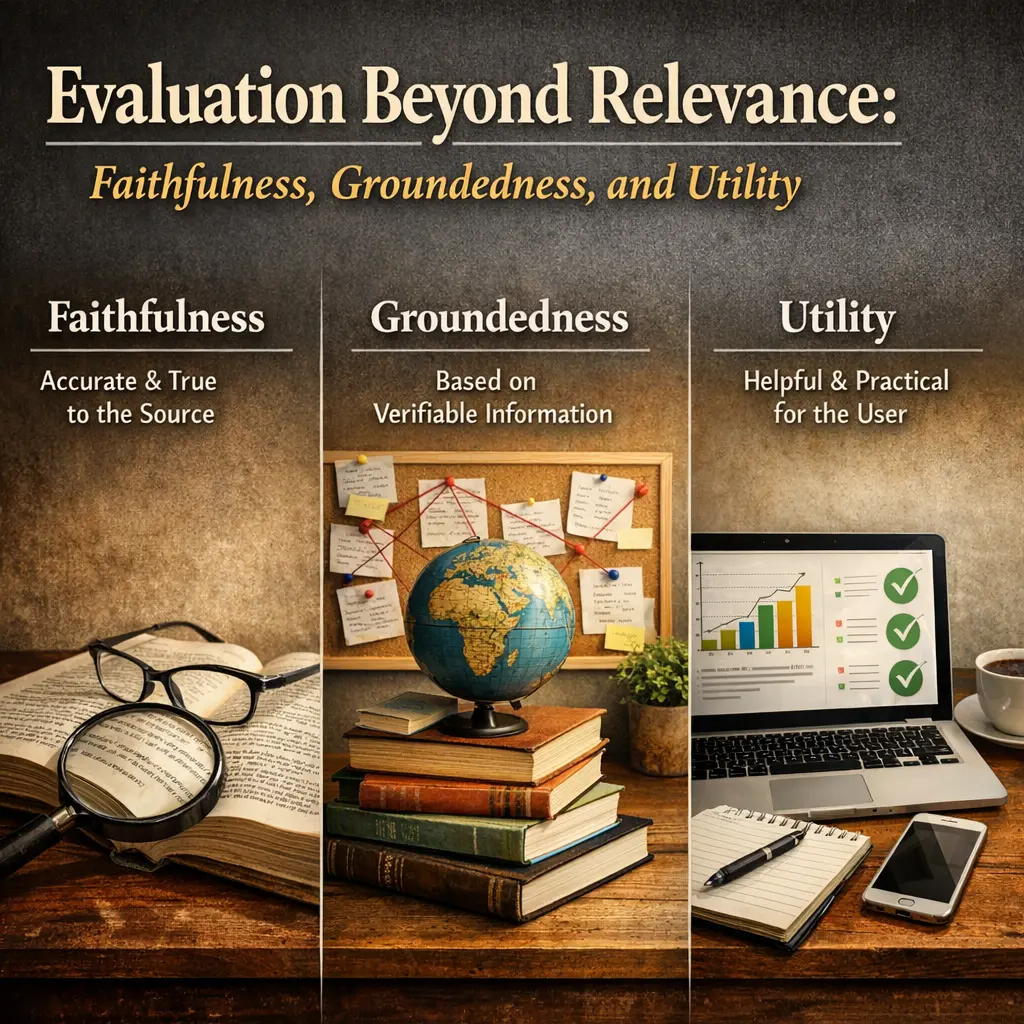
Evaluation beyond relevance in Retrieval-Augmented Generation (RAG) involves assessing not just whether generated content is pertinent to a query, but also its faithfulness (accuracy to source material), groundedness (clear connection to retrieved evidence), and utility (practical usefulness to the user). This comprehensive approach ensures that AI-generated responses are not only relevant, but also reliable, well-supported, and genuinely helpful in addressing user needs.
Evaluation Beyond Relevance: Faithfulness, Groundedness, and Utility
Evaluation beyond relevance in Retrieval-Augmented Generation (RAG) involves assessing not just whether generated content is pertinent to a query, but also its faithfulness (accuracy to source material), groundedness (clear connection to retrieved evidence), and utility (practical usefulness to the user). This comprehensive approach ensures that AI-generated responses are not only relevant, but also reliable, well-supported, and genuinely helpful in addressing user needs.
💡 Key Takeaways
- Define faithfulness and why it matters for truthful outputs.
- Understand groundedness and how evidence and sources support claims.
- Evaluate utility by measuring usefulness, efficiency, and task relevance in real-world contexts.
- Identify common challenges like hallucinations and misalignment, and apply mitigation strategies.
❓ Frequently Asked Questions
What is faithfulness in evaluating AI outputs?
Faithfulness measures how well the model's claims align with the actual evidence or data it references, avoiding contradictions with available sources.
What does groundedness mean in this context?
Groundedness checks that statements are anchored in verifiable information from credible sources or real-world knowledge, rather than being purely speculative.
How is utility defined here?
Utility reflects how helpful and actionable the output is for the user's goals, considering clarity, relevance to tasks, and practicality.
How do faithfulness, groundedness, and utility relate to relevance?
Relevance asks if the response matches the question; faithfulness and groundedness assess truth and evidence alignment; utility focuses on usefulness. Together, they provide a fuller evaluation.