Faithfulness and Attribution Metrics for RAG refer to evaluation methods that assess how accurately a Retrieval-Augmented Generation (RAG) system’s output reflects the retrieved source documents and correctly attributes information to those sources. Advanced RAG techniques leverage these metrics to ensure generated content is trustworthy, minimizes hallucinations, and transparently indicates where specific facts or statements originate, thereby improving the reliability and interpretability of AI-generated responses.
Faithfulness and Attribution Metrics for RAG
Faithfulness and Attribution Metrics for RAG refer to evaluation methods that assess how accurately a Retrieval-Augmented Generation (RAG) system’s output reflects the retrieved source documents and correctly attributes information to those sources. Advanced RAG techniques leverage these metrics to ensure generated content is trustworthy, minimizes hallucinations, and transparently indicates where specific facts or statements originate, thereby improving the reliability and interpretability of AI-generated responses.
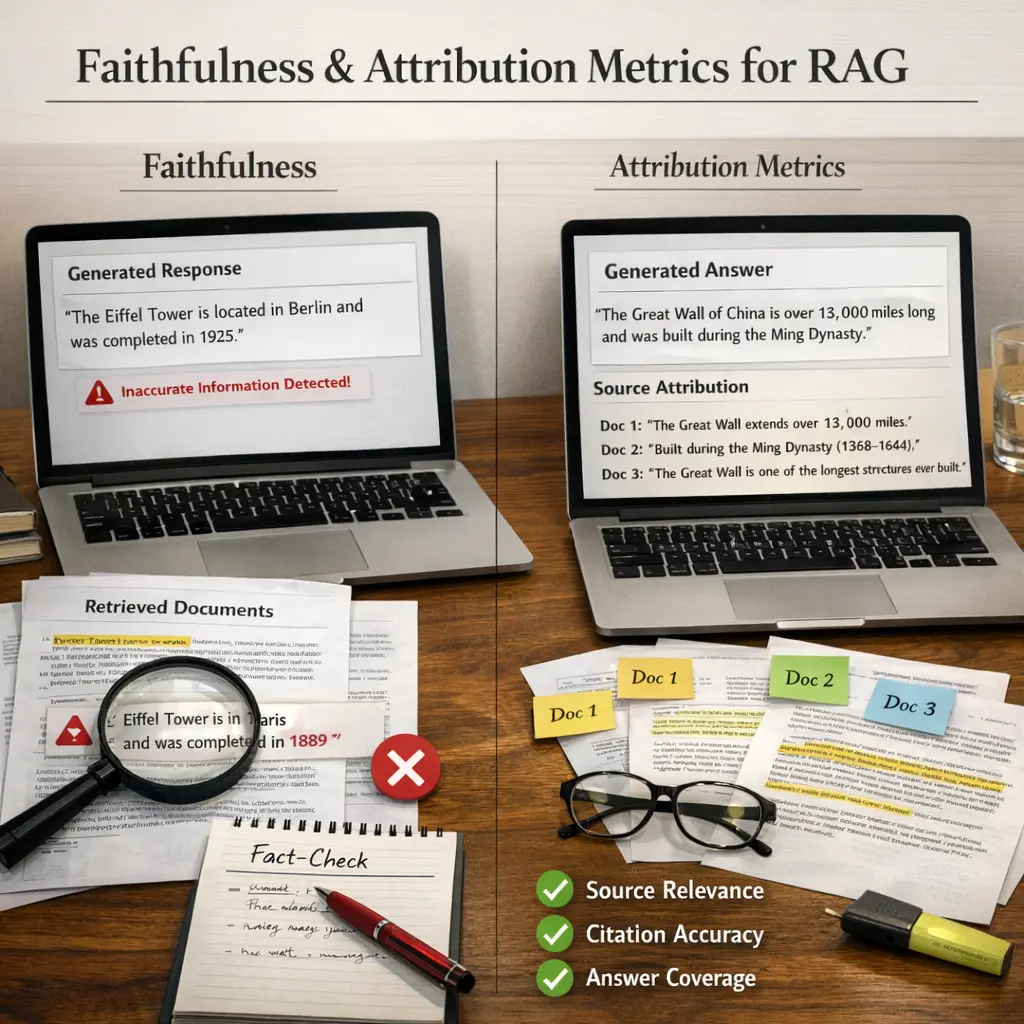
💡 Key Takeaways
- Define faithfulness in Retrieval-Augmented Generation (RAG) and why it matters for trust and accuracy.
- Identify key metrics for measuring alignment between generated content and retrieved sources (e.g., source-claim alignment, citation accuracy).
- Understand attribution: how to quantify and report source usage and provenance in RAG outputs.
- Explore practical strategies to improve faithfulness in RAG (prompt design, retrieval filters, verification checks).
❓ Frequently Asked Questions
What is faithfulness in RAG?
Faithfulness is how accurately the generated content reflects information from the retrieved sources; a faithful answer is supported by the documents and does not introduce unsupported facts.
What is attribution in RAG contexts?
Attribution is the practice of clearly linking statements to their sources, including proper citations or references to the specific documents used.
How are faithfulness and attribution evaluated in practice?
Evaluations combine human judgments of accuracy and source support with automatic checks like entailment or information overlap with sources, citation correctness, and source-span matching.
How can I improve faithfulness and attribution in a RAG system?
Improve retrieval quality, use source-aware decoding, attach citations to claims, perform post-processing validation, and train with data that emphasizes faithful, well-cited content.