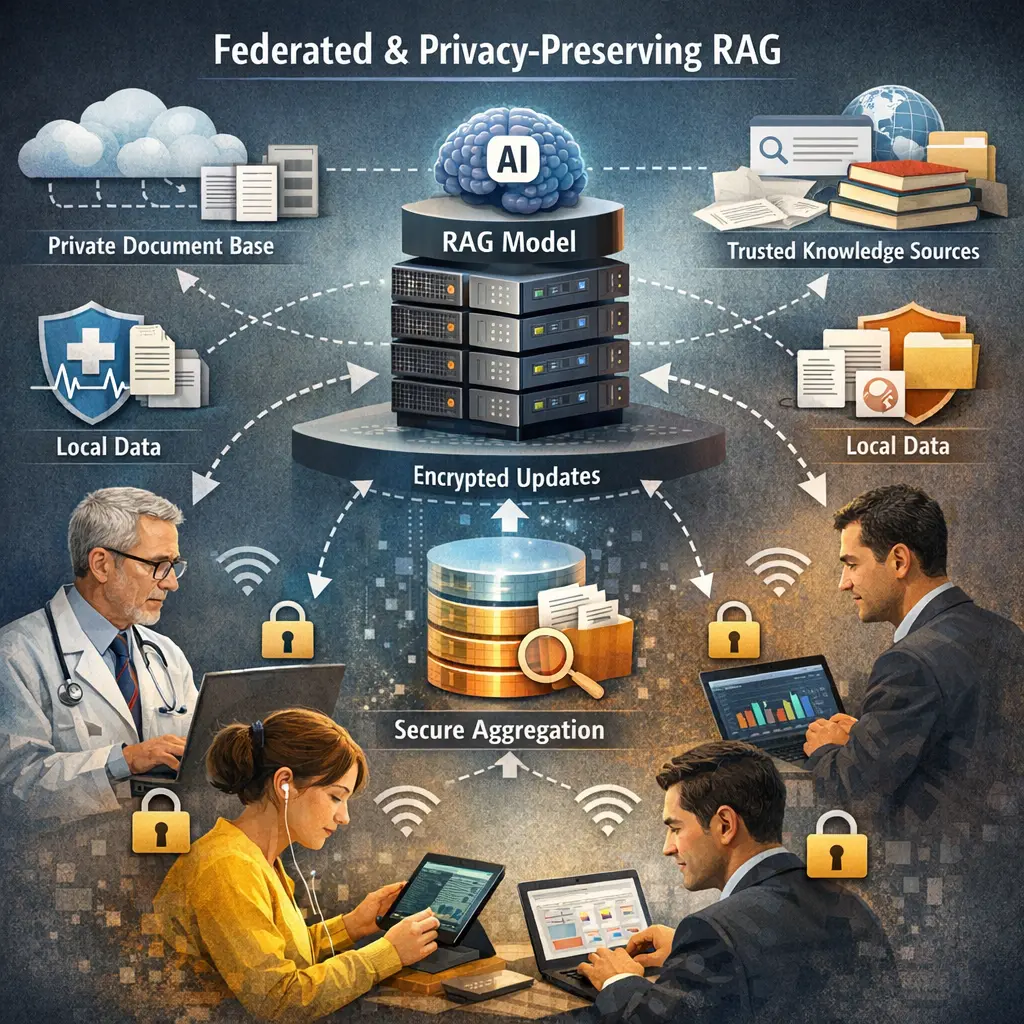
Federated and Privacy-Preserving RAG refers to advanced Retrieval-Augmented Generation (RAG) techniques that enable multiple data sources or clients to collaboratively train or use language models without sharing raw data. By leveraging federated learning and privacy mechanisms such as differential privacy or secure aggregation, these methods ensure sensitive information remains confidential while still allowing the model to retrieve relevant knowledge and generate accurate responses across distributed environments.
Federated and Privacy-Preserving RAG
Federated and Privacy-Preserving RAG refers to advanced Retrieval-Augmented Generation (RAG) techniques that enable multiple data sources or clients to collaboratively train or use language models without sharing raw data. By leveraging federated learning and privacy mechanisms such as differential privacy or secure aggregation, these methods ensure sensitive information remains confidential while still allowing the model to retrieve relevant knowledge and generate accurate responses across distributed environments.
💡 Key Takeaways
- Understand what Retrieval-Augmented Generation (RAG) is and how federated setups differ from centralized RAG
- Learn how federated RAG keeps data local to protect privacy (on-device or edge retrieval)
- Explore privacy-preserving techniques used with RAG, such as secure aggregation, differential privacy, and encryption
- Compare federated RAG with traditional approaches in terms of privacy guarantees, performance, and deployment challenges
- Identify key design considerations and evaluation metrics for federated, privacy-preserving RAG systems
❓ Frequently Asked Questions
What is Retrieval-Augmented Generation (RAG)?
RAG combines a language model with a document retriever, fetching relevant texts to ground the model’s answers in external sources.
What does 'federated' mean in Federated and Privacy-Preserving RAG?
Data stays on users' devices or across multiple organizations; only model updates, embeddings, or aggregated signals are shared with a central server, reducing exposure of raw data.
Which privacy-preserving techniques are commonly used with RAG?
Techniques include secure aggregation, differential privacy, secure multi-party computation, and on-device or encrypted retrieval to protect data during training and retrieval.
What are the main challenges when building federated and privacy-preserving RAG systems?
Trade-offs include maintaining high retrieval quality while preserving privacy, higher communication and computation costs, and the complexity of cryptographic protocols and data heterogeneity across clients.
How can privacy-preserving RAG be evaluated?
Evaluate retrieval relevance, answer accuracy, latency, and privacy metrics (e.g., differential privacy guarantees, leakage risk) under realistic federated settings.