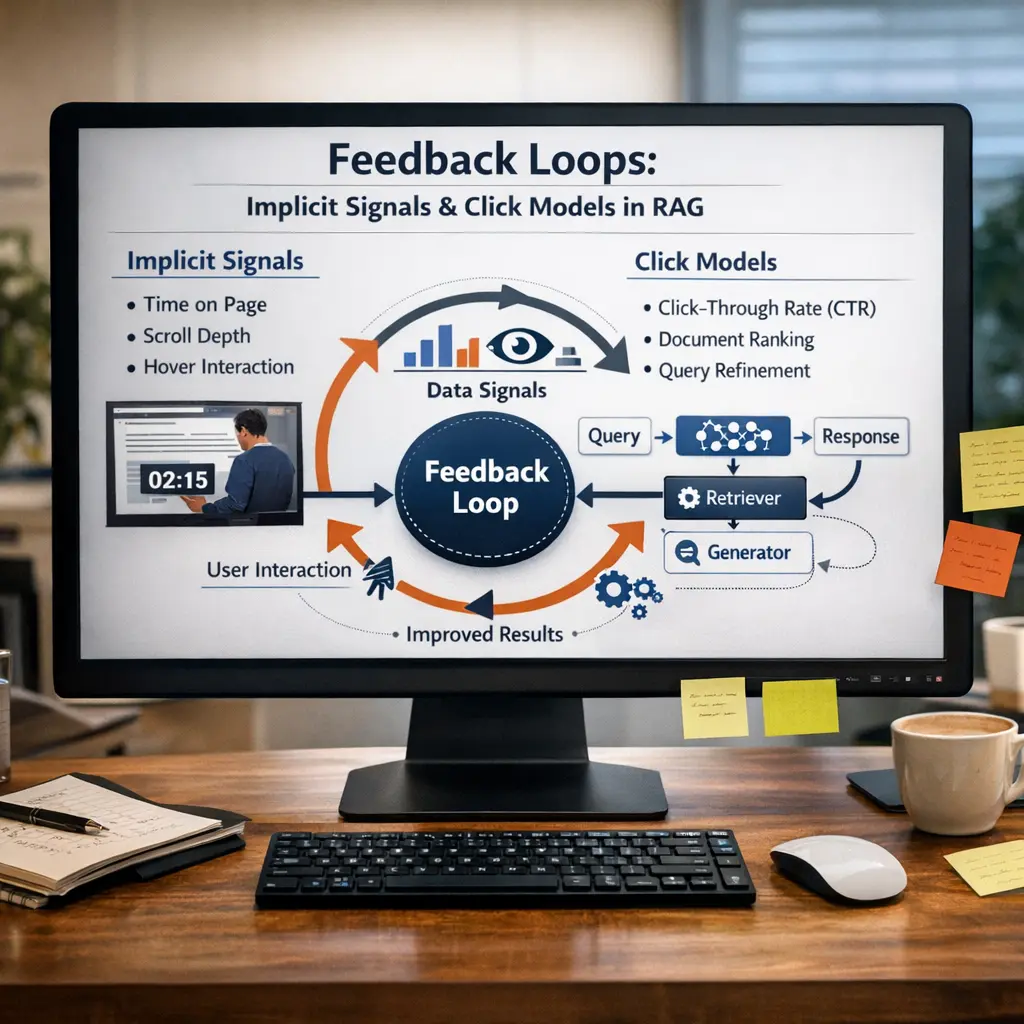
Feedback loops in RAG involve using implicit signals—such as user clicks, dwell time, and interaction patterns—to refine retrieval and generation processes. Click models analyze these signals to infer user preferences and satisfaction, enabling continuous improvement of the system by updating retrieval rankings and generation outputs. This iterative feedback mechanism helps RAG models better align with user intent, enhancing relevance and accuracy over time without relying solely on explicit user feedback.
Feedback Loops: Implicit Signals and Click Models in RAG
Feedback loops in RAG involve using implicit signals—such as user clicks, dwell time, and interaction patterns—to refine retrieval and generation processes. Click models analyze these signals to infer user preferences and satisfaction, enabling continuous improvement of the system by updating retrieval rankings and generation outputs. This iterative feedback mechanism helps RAG models better align with user intent, enhancing relevance and accuracy over time without relying solely on explicit user feedback.
💡 Key Takeaways
- Describe how implicit signals (e.g., clicks, dwell time) influence the retrieval step in RAG and why that matters.
- Explain what a click model is and how it estimates document relevance from user interactions within RAG workflows.
- Explain how feedback loops can emerge in RAG when retrieved content shapes subsequent queries and results, potentially reinforcing biases.
- Identify practical strategies to mitigate feedback loops in RAG, including promoting result diversity, debiasing signals, and monitoring for drift.
❓ Frequently Asked Questions
What does RAG stand for and how is it used here?
RAG stands for Retrieval-Augmented Generation. It combines a document retriever with a generator to produce answers using relevant retrieved content.
What are implicit signals in RAG feedback loops?
Implicit signals are indirect user cues (like clicks, dwell time, and scroll depth) that infer relevance without explicit feedback.
What is a click model and how does it relate to RAG?
A click model estimates the probability of a user clicking a retrieved item given its rank, helping to reweight or reorder results to reflect user interest.
Why are feedback loops with implicit signals important and what should be watched for?
They enable the system to adapt to user behavior, improving relevance over time, but can introduce bias, noise, and privacy concerns if not managed carefully.