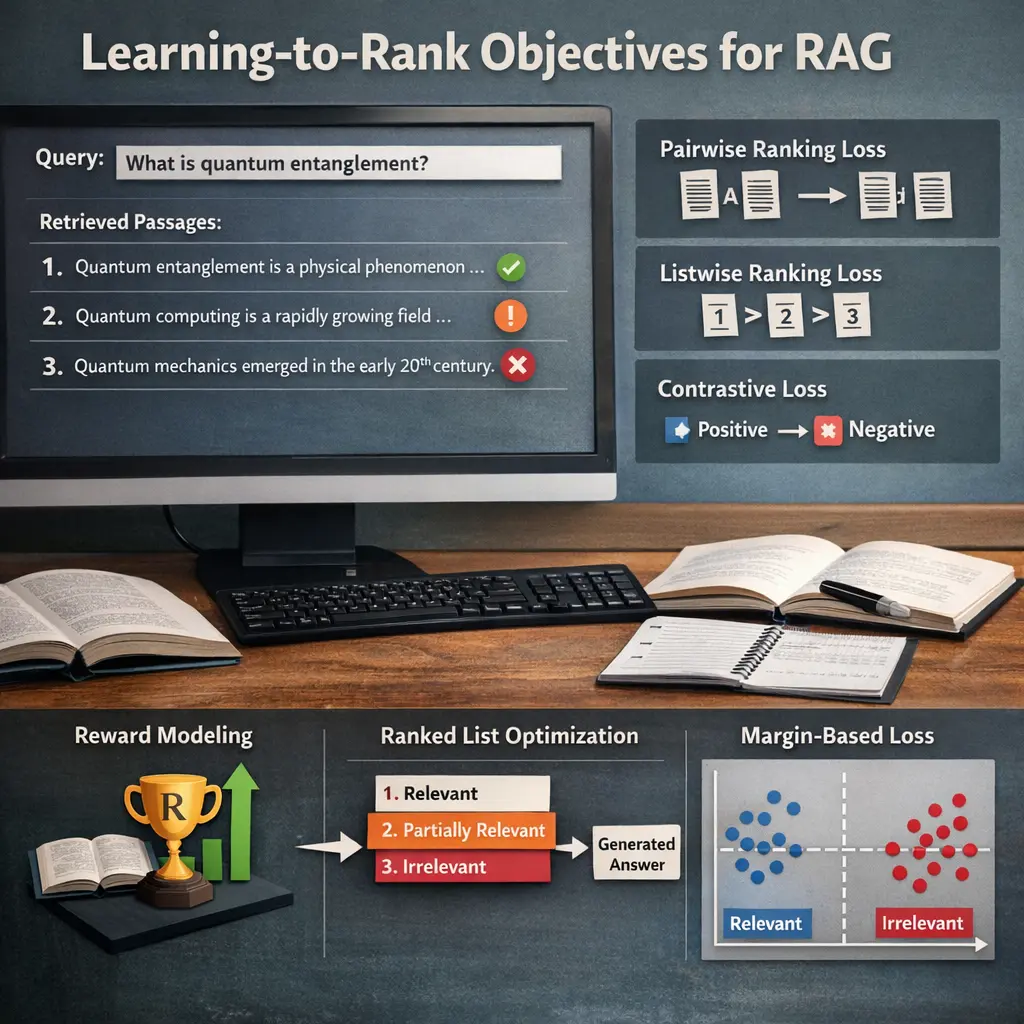
Generative Readout over Retrieved Sets is an advanced Retrieval-Augmented Generation (RAG) technique where a language model synthesizes answers by jointly attending to and integrating information from multiple retrieved documents or passages. Instead of relying on a single best result, the model dynamically reasons over the entire set of retrieved contexts, enabling more accurate, nuanced, and context-aware responses. This approach enhances the model’s ability to generate coherent and factually grounded answers, leveraging diverse evidence sources.
Generative Readout over Retrieved Sets
Generative Readout over Retrieved Sets is an advanced Retrieval-Augmented Generation (RAG) technique where a language model synthesizes answers by jointly attending to and integrating information from multiple retrieved documents or passages. Instead of relying on a single best result, the model dynamically reasons over the entire set of retrieved contexts, enabling more accurate, nuanced, and context-aware responses. This approach enhances the model’s ability to generate coherent and factually grounded answers, leveraging diverse evidence sources.

💡 Key Takeaways
- Understand what generative readout means when it uses retrieved sets to produce outputs
- Learn how retrieved sets are selected, indexed, and fed into a generative model
- Compare this approach to standard generation and retrieval-only methods, noting advantages and limitations
- Practice evaluating outputs for accuracy, relevance, and bias when using retrieved data
- Identify real-world tasks where generative readout over retrieved sets is beneficial (e.g., summaries, Q&A, data synthesis)
❓ Frequently Asked Questions
What is Generative Readout over Retrieved Sets?
A method that uses a generative model to produce answers or summaries from a set of retrieved documents or snippets served as input.
What are retrieved sets?
A collection of items selected by a search or retrieval system in response to a query, used as input for generation.
How does it differ from traditional retrieval or generation alone?
It first retrieves relevant content and then uses a generator to synthesize a coherent answer, combining evidence from multiple sources.
What are common benefits and risks?
Benefits: more informed, context-aware answers. Risks: potential hallucinations or overreliance on retrieved sources; ensure accuracy and proper sourcing.