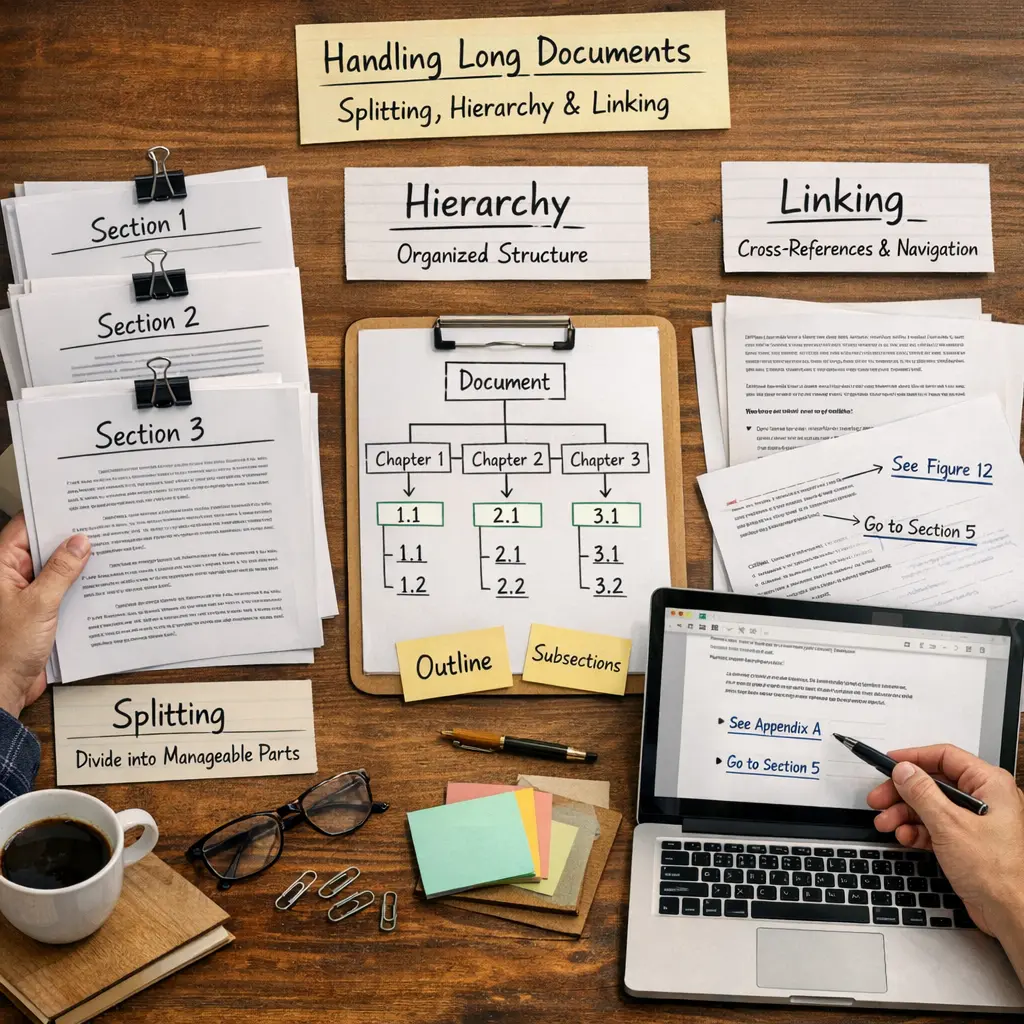
Handling long documents in Retrieval-Augmented Generation (RAG) involves splitting large texts into manageable chunks, organizing them using a hierarchical structure, and linking related sections. This approach improves information retrieval by allowing the system to efficiently search, retrieve, and process relevant segments. Hierarchy maintains context and coherence, while linking ensures seamless navigation between related content, enhancing the overall effectiveness and accuracy of RAG models when dealing with extensive documents.
Handling Long Documents: Splitting, Hierarchy, and Linking
Handling long documents in Retrieval-Augmented Generation (RAG) involves splitting large texts into manageable chunks, organizing them using a hierarchical structure, and linking related sections. This approach improves information retrieval by allowing the system to efficiently search, retrieve, and process relevant segments. Hierarchy maintains context and coherence, while linking ensures seamless navigation between related content, enhancing the overall effectiveness and accuracy of RAG models when dealing with extensive documents.
💡 Key Takeaways
- Split long documents into logical chunks with consistent headings and section breaks.
- Build a clear hierarchy (parts, chapters, sections, subsections) to guide readers and aid skim-reading.
- Use internal linking to connect related sections and external documents, reducing duplication and preserving context.
- Leverage outlines, metadata, and indexing to improve navigation, searchability, and accessibility.
❓ Frequently Asked Questions
What is document splitting and why is it useful for long documents?
Splitting breaks a long document into smaller, logical parts such as chapters or sections. It improves readability, navigation, editing, and performance by loading smaller chunks rather than the entire document at once.
How should you design a hierarchical structure for long documents?
Establish a clear hierarchy using levels (e.g., Part > Chapter > Section) with consistent naming and numbering. Use descriptive headings, ensure each level has a defined role, and keep related content grouped together.
What is linking in long documents and what types exist?
Linking connects related parts to help readers move around. Types include internal links (to sections or figures), Table of Contents links, cross-references, footnotes or endnotes, and external references. Keep links stable and meaningful.
How to maintain context when splitting documents across multiple files?
Provide a global table of contents or index, include section summaries, and use consistent terminology. Include cross-links to related sections and ensure each piece retains enough context or references.