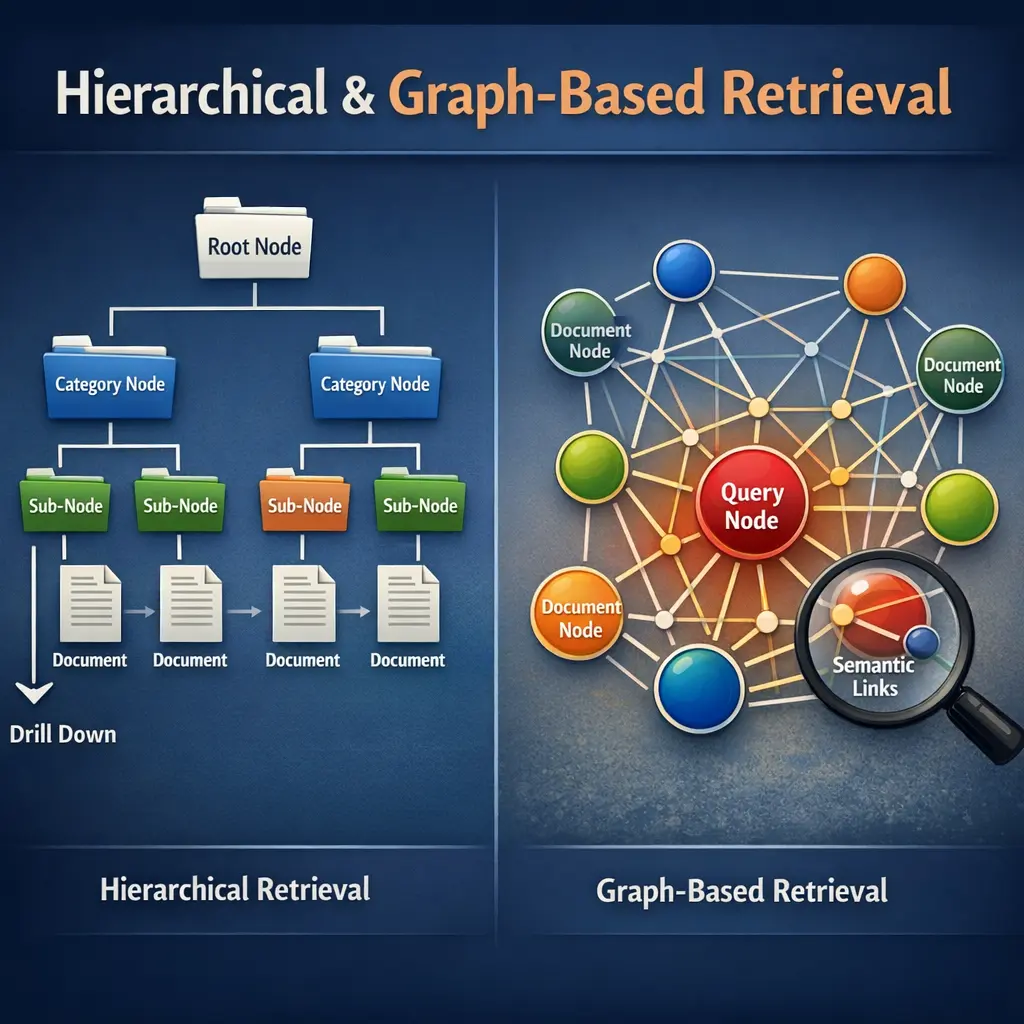
Hierarchical and graph-based retrieval are advanced Retrieval-Augmented Generation (RAG) techniques that enhance information retrieval by organizing data in structured formats. Hierarchical retrieval arranges information in multi-level layers, allowing for efficient narrowing down of relevant content. Graph-based retrieval represents data as interconnected nodes, capturing relationships and context between pieces of information. Together, these methods improve the accuracy and relevance of retrieved data, enabling more precise and context-aware responses in AI-driven applications.
Hierarchical & Graph-Based Retrieval
Hierarchical and graph-based retrieval are advanced Retrieval-Augmented Generation (RAG) techniques that enhance information retrieval by organizing data in structured formats. Hierarchical retrieval arranges information in multi-level layers, allowing for efficient narrowing down of relevant content. Graph-based retrieval represents data as interconnected nodes, capturing relationships and context between pieces of information. Together, these methods improve the accuracy and relevance of retrieved data, enabling more precise and context-aware responses in AI-driven applications.
💡 Key Takeaways
- Explain how hierarchical retrieval organizes data into levels to improve precision and speed.
- Describe how graph-based retrieval models represent items as nodes and their relationships as edges to support ranking.
- Identify common use cases and trade-offs for hierarchical versus graph-based approaches in retrieval systems.
- Outline key techniques and practical steps, including hierarchical indexing, graph traversal, and graph-based ranking methods.
❓ Frequently Asked Questions
What is hierarchical retrieval?
A multi-level approach that first narrows candidates with a fast, coarse index and then re-scores with a finer method to produce final results.
What is graph-based retrieval?
A method that builds a graph where nodes are items (documents, terms) and edges reflect similarity or relationships; retrieval uses graph algorithms to propagate relevance and rank items.
How do hierarchical and graph-based retrieval differ?
Hierarchical retrieval emphasizes fast narrowing using multiple index levels, while graph-based retrieval emphasizes leveraging item connections to capture global structure and relationships.
How can these methods be combined in a workflow?
Use hierarchical retrieval to quickly generate a small candidate set, then apply graph-based reranking or diffusion to refine results by exploiting relationships among items.