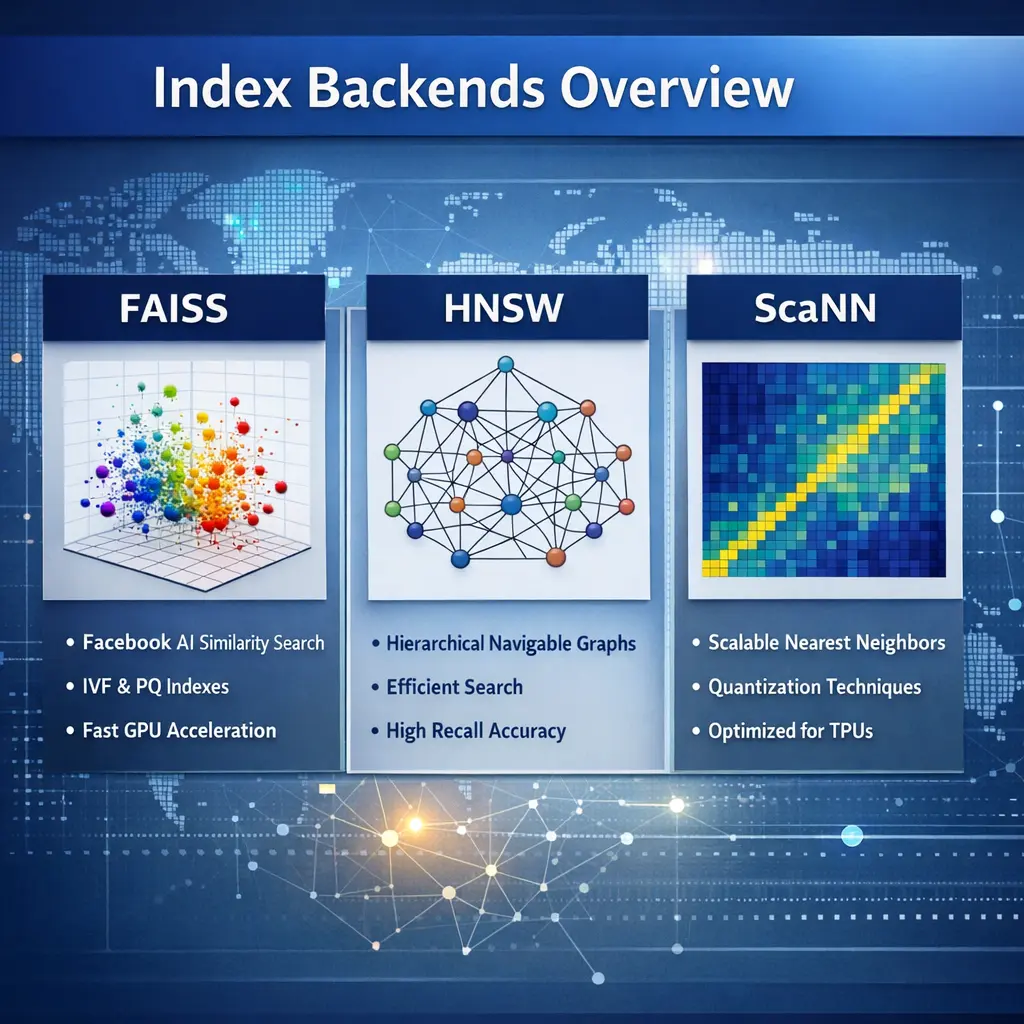
Index backends like FAISS, HNSW, and ScaNN are advanced tools used for efficient similarity search in large-scale retrieval-augmented generation (RAG) systems. FAISS excels at high-speed vector search, HNSW offers scalable and accurate approximate nearest neighbor search using hierarchical graphs, and ScaNN is optimized for fast, memory-efficient searches on dense vectors. These backends enhance RAG workflows by enabling rapid, accurate retrieval of relevant information from vast datasets.
Index Backends Overview: FAISS, HNSW, ScaNN+50
Index backends like FAISS, HNSW, and ScaNN are advanced tools used for efficient similarity search in large-scale retrieval-augmented generation (RAG) systems. FAISS excels at high-speed vector search, HNSW offers scalable and accurate approximate nearest neighbor search using hierarchical graphs, and ScaNN is optimized for fast, memory-efficient searches on dense vectors. These backends enhance RAG workflows by enabling rapid, accurate retrieval of relevant information from vast datasets.
💡 Key Takeaways
- Define what index backends are and why they are used for embedding similarity search.
- Overview FAISS, HNSW, and ScaNN: core algorithms and typical strengths.
- Compare the trade-offs among accuracy, speed, and memory requirements.
- Learn common deployment patterns: CPU vs GPU, static vs dynamic indexes, and batching.
- Choose the right backend based on dataset size, latency targets, and hardware availability.
❓ Frequently Asked Questions
What are FAISS, HNSW, and ScaNN?
They are libraries/algorithms for fast similarity search over high-dimensional vectors (embeddings). FAISS (Facebook AI Similarity Search) offers a variety of index types and GPU support; HNSW (Hierarchical Navigable Small World) is a graph-based ANN method; ScaNN (Scalable Nearest Neighbors) from Google focuses on large-scale, memory-efficient CPU-based ANN with quantization.
How do their indexing strategies differ?
FAISS provides multiple backends (exact Flat; inverted-file IVF with PQ; sometimes HNSW within FAISS); HNSW uses a hierarchical graph to connect items and enables fast navigation for approximate nearest neighbors; ScaNN uses product quantization and learned distance estimation to reduce memory and speed up search.
When should I choose FAISS, HNSW, or ScaNN?
Choose FAISS for flexible, scalable search with GPU acceleration and a range of index types; choose HNSW for fast, high-recall ANN with straightforward setup and dynamic insertions; choose ScaNN for large-scale, memory-efficient CPU-based retrieval with high throughput when frequent index updates are not required.
Do these backends support updates, GPUs, and memory trade-offs?
FAISS supports CPU and GPU and offers both exact and approximate results depending on the index; some FAISS indices allow incremental additions. HNSW supports dynamic insertions. ScaNN is primarily designed for CPU and tends toward static, memory-efficient indexes with high throughput.