Index maintenance in Retrieval-Augmented Generation (RAG) involves processes like upserts, deletions, and versioning workflows to ensure the index remains accurate and efficient. Upserts allow for updating or adding new data, while deletions remove outdated or irrelevant information. Versioning workflows track changes and manage multiple index versions, supporting data consistency and rollback if needed. Together, these practices optimize retrieval performance and data integrity in RAG systems.
Index Maintenance: Upserts, Deletions, and Versioning Workflows
Index maintenance in Retrieval-Augmented Generation (RAG) involves processes like upserts, deletions, and versioning workflows to ensure the index remains accurate and efficient. Upserts allow for updating or adding new data, while deletions remove outdated or irrelevant information. Versioning workflows track changes and manage multiple index versions, supporting data consistency and rollback if needed. Together, these practices optimize retrieval performance and data integrity in RAG systems.
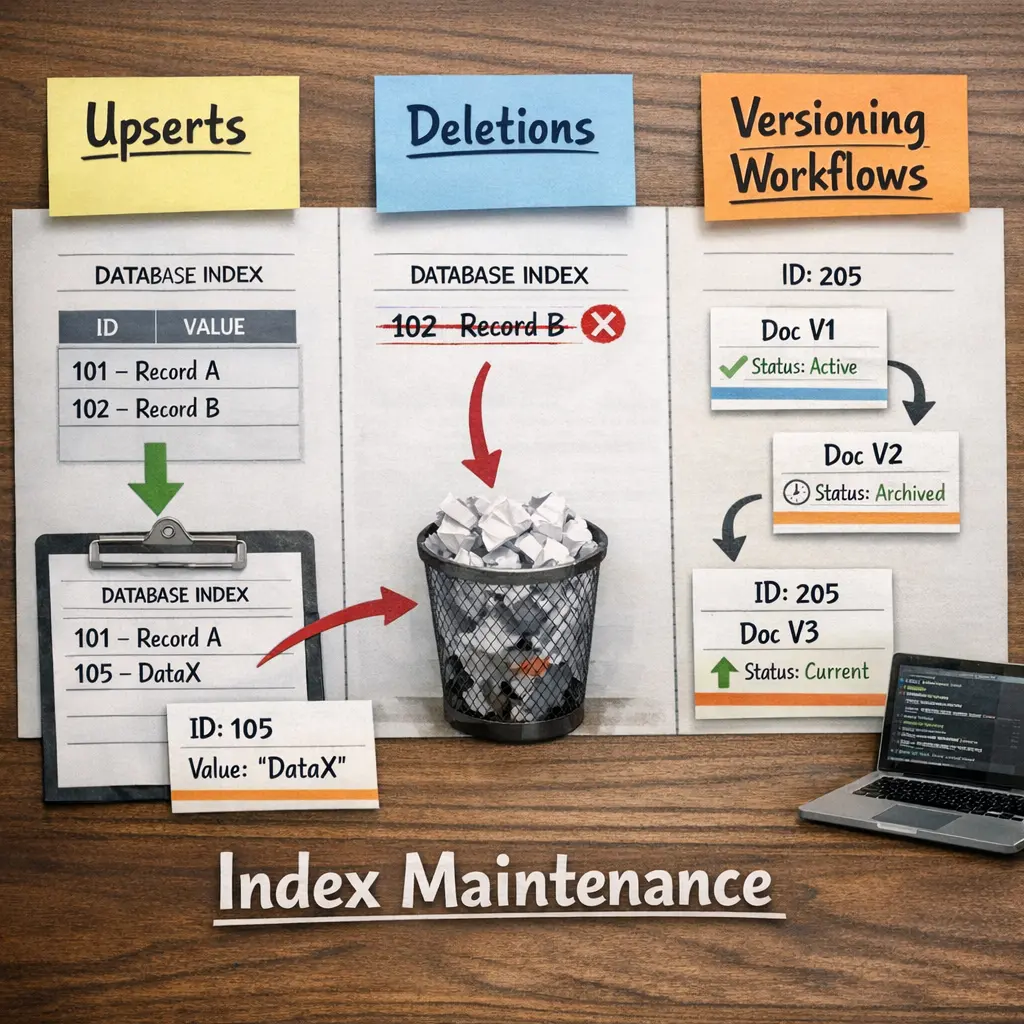
💡 Key Takeaways
- Explain upsert semantics for index records and when to use inserts versus updates
- Describe how deletions are represented (tombstones) and their impact on queries and compaction
- Understand versioning workflows for indexes, including safe upgrades and rollback strategies
- Outline an end-to-end maintenance workflow with triggers, batching, testing, and monitoring
- Ensure idempotency and graceful conflict resolution for concurrent upserts and deletions
❓ Frequently Asked Questions
What is an upsert and why is it used in index maintenance?
An upsert inserts a new record if it doesn't exist or updates the existing one if it does. In index maintenance, upserts keep index entries in sync with the latest row state in a single operation.
How do deletions affect indexes and what is a tombstone?
Deletions remove the corresponding index entries. Systems may store a tombstone (deletion marker) to preserve history until cleanup/compaction removes the entry and consolidates versions.
What is a versioning workflow in index management?
A versioning workflow keeps multiple versions of records over time, enabling historical or time-travel reads. It uses version numbers or timestamps and relies on compaction to prune old versions when appropriate.
What are typical steps in an index maintenance process that handles upserts and deletions?
Detect changes, apply upserts to update/insert index entries, apply deletions or tombstones, perform compaction/merging to remove stale data, and refresh statistics to maintain query performance.