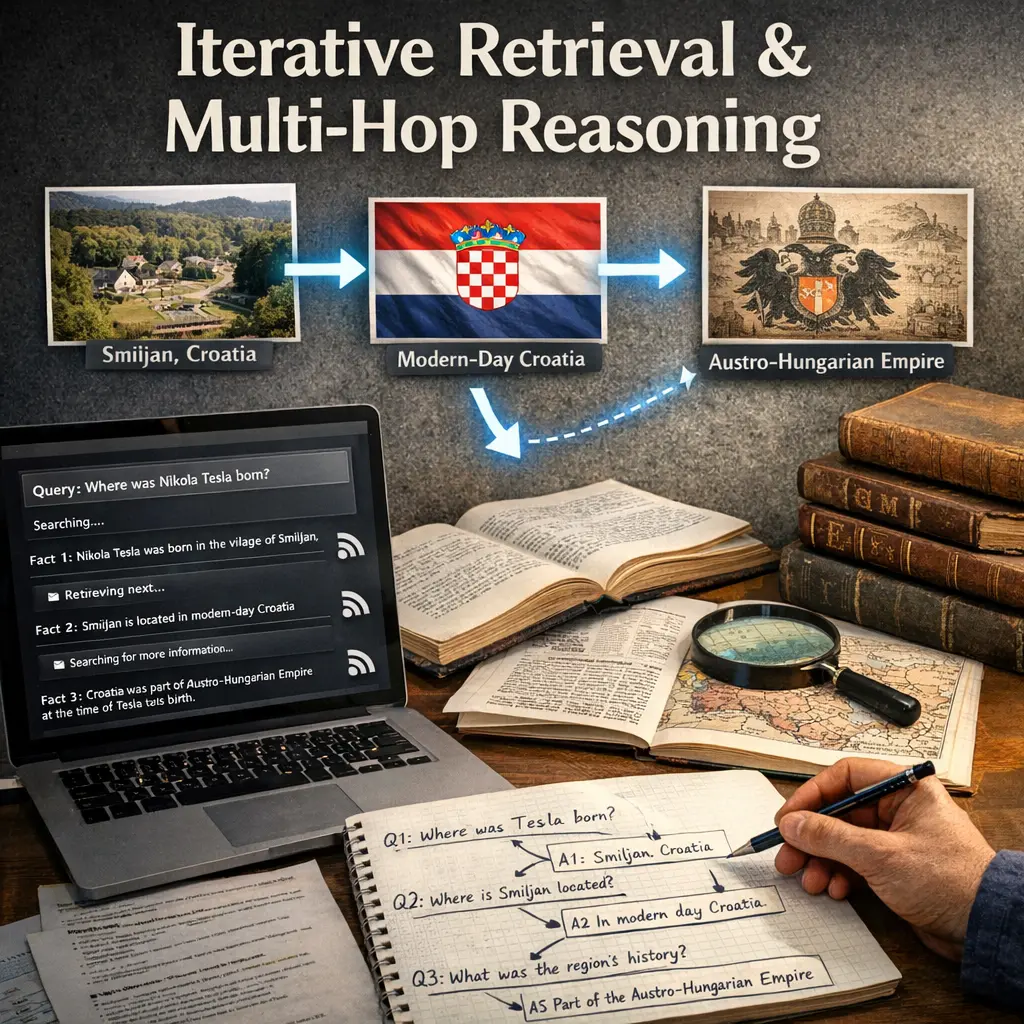
Iterative Retrieval & Multi-Hop Reasoning are advanced Retrieval-Augmented Generation (RAG) techniques that enhance information extraction and synthesis. Iterative retrieval involves repeatedly querying a knowledge base, refining search results at each step. Multi-hop reasoning enables models to connect information across multiple documents or sources, piecing together complex answers that require several inference steps. Together, these techniques allow AI systems to tackle more sophisticated queries that demand deep understanding and integration of dispersed information.
Iterative Retrieval & Multi-Hop Reasoning
Iterative Retrieval & Multi-Hop Reasoning are advanced Retrieval-Augmented Generation (RAG) techniques that enhance information extraction and synthesis. Iterative retrieval involves repeatedly querying a knowledge base, refining search results at each step. Multi-hop reasoning enables models to connect information across multiple documents or sources, piecing together complex answers that require several inference steps. Together, these techniques allow AI systems to tackle more sophisticated queries that demand deep understanding and integration of dispersed information.
💡 Key Takeaways
- Understand how iterative retrieval refines queries based on prior results.
- Learn how multi-hop reasoning connects information from multiple sources to answer complex questions.
- Distinguish single-hop vs multi-hop approaches and the importance of chaining evidence.
- Explore practical techniques for iterative retrieval, including query expansion, evidence gathering, and answer synthesis.
❓ Frequently Asked Questions
What is iterative retrieval?
A retrieval approach that gathers information in steps, using results from earlier steps to guide the next search and refine relevance.
What is multi-hop reasoning?
Reasoning that connects and combines evidence from multiple sources or facts to answer a question that cannot be answered from a single fact alone.
How do iterative retrieval and multi-hop reasoning work together?
The system retrieves initial documents, reasons over them to decide what to search next, fetches more evidence, and then integrates information across hops to derive the final answer.
What are common challenges in these techniques?
Error propagation between steps, query drift, higher computational costs, and ensuring answers are well-grounded in the retrieved evidence.